
New tomb over 3500 years old unearthed in Luxor
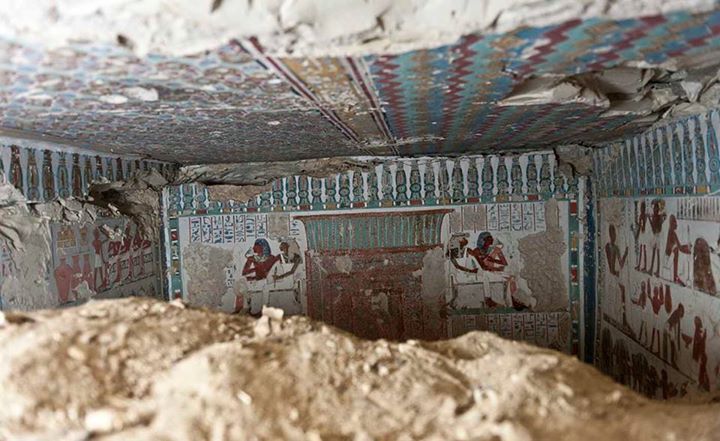
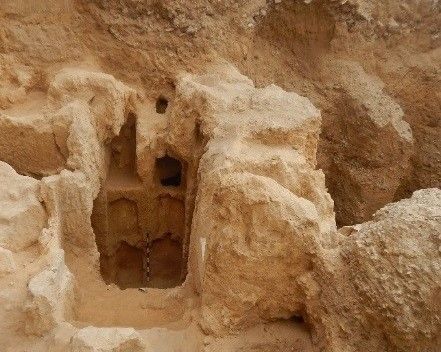
A team of American archeologists and local laborers uncovered a colorful tomb in Luxor that is thought to date back to Ancient Egypt’s New Kingdom, and is perhaps over 3,500 years old.
The tomb was unearthed on Tuesday in the archeological site of Al-Qurna in Luxor City (formerly Thebes), over 720 kilometers south of Cairo. It is presumed to have been built for a nobleman or ancient priest in the Cult of Amoun, perhaps also a member of the then-ruling dynasty.
The owner of the tomb has reportedly been identified as “Amenhotep” — not to be confused with the pharaoh of the same name.
According to a statement issued by the Ministry of State for Antiquities, this tomb was constructed during the New Kingdom’s 18th Dynasty (Circa ~1543–1292).
Colorful engravings and murals on the tomb’s walls depict “Amenhotep” and his wife making offerings to the gods, along with depictions of agricultural work and hunting.

Ministerial sources say the tomb was partially defaced, with some of its hieroglyphs and several of its engravings scratched out. This may have occurred during the religious revolution in the brief reign of the monotheistic Pharaoh Akhenaton (Circa ~ 1351–1334 BC).
The T-shaped tomb is 5.1 meters long and 1.5 meters wide, with smaller chambers to the east and west, which each measure around two meters by two meters. Also found in the tomb is a well-like structure beneath the chambers, which is still being studied and is thought to be another burial chamber.
Authorities also announced the discovery of a previously unknown statue in Sohag, which they claim unlicensed treasure hunters had dug up and were planning to smuggle.
Antiquities police in the Town of Akhmim in Sohag Governorate (over 400 kilometers south of Cairo) claim to have additionally thwarted an attempt to smuggle an ancient limestone artifact.
Measuring 140 centimeters in height and 56 centimeters in width, this artifact appears to be the lower half of a statue shaped liked a seated woman. The base of this statue bears hieroglyphic inscriptions of Pharaoh Ramses II.

The actual age of the statue has not yet been determined, as Ramses II had his cartouche/name-stamp inscribed into many statues and artifacts that had been built prior to his reign (1279 – 1213 BC).
Ministerial authorities claim that this ancient artifact may have been dug out from beneath modern-day residential quarters constructed over ancient ruins. It was reportedly found abandoned on the western edge of Akhmim.

أخبار ذات صلة
Looking back to see the present through the Grand Egyptian Museum
The coincidental nature behind the establishment of the Grand Egyptian Museum
Staging a grand opening for the grand museum
In Cairo, sidewalks have been repainted, screens set-up and security measures tightened. People living nearby say fireworks have been test-run in Giza.…
Where next for world heritage after Egypt finally wins top UNESCO position?
Conservationists express skepticism about Enany given the new UNESCO head's checkered past
Archaeologists discover 2,000-year-old mausoleum in Alexandria
A 2,000-year-old mausoleum containing approximately 300 artifacts was unearthed by a team of Egyptian archaeologists in Alexandria
Your support is the only way to ensure independent, progressive journalism survives.
You have a right to access accurate information, be stimulated by innovative and nuanced reporting, and be moved by compelling storytelling. Subscribe now to become part of the growing community of members who help us maintain our editorial independence.
Join us