
Mubarak’s lawyer concludes defense statement in retrial
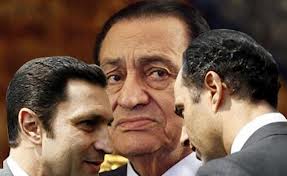
Hosni Mubarak’s lawyer Farid al-Deeb presented his concluding arguments in the last of three sessions dedicated to hearing the defense's statement in the retrial of the former president.
Mubarak, his sons Gamal and Alaa, his Interior Minister Habib al-Adly, and six of Adly’s assistants, have been charged with conspiring to kill protesters during the 2011 uprising. The Mubaraks have also faced charges of financial corruption and causing intentional damage to public funds.
The former president was sentenced to life in prison in June 2012 for conspiring to kill protesters, but the verdict was overturned in January 2013, and a retrial began in April 2013. He was also convicted of embezzling public funds to renovate family property and was sentenced to three years in prison in May, although he is yet to be transferred to prison.
The session started later than scheduled due to scuffles between police forces securing the Police Academy, where the trial took place. The jury was also forbidden from entering the Academy pending security clearances at a checkpoint designated for the press, according to privately owned Al-Masry Al-Youm newspaper.
Sources claimed Interior Minister Mohamed Ibrahim, who was attending the launching ceremony of the new Suez Canal project in Ismailia, phoned the head of the panel, Judge Mahmoud Kamel al-Rashidy, to apologize for the incident, Al-Masry Al-Youm added.
Mubarak, 86, who suffers from a broken femur due to a fall sustained during his hospital stay in July, is currently under house arrest at Cairo’s Maadi Hospital.
According to the Middle East News Agency, the third part of Deeb’s closing statement focused on the financial corruption charges against Mubarak, which included accusations of illegal possession of five villas in Sharm el-Sheikh at an estimated cost of LE39 million, in exchange for using his presidential authority to grant fugitive businessman Hussein Salem two million square meters of land in Sinai.
Deeb pleaded a lack of due process, claiming the charges fall under the jurisdiction of military tribunals. He cited law No. 35 (1979), which stipulates that heads of military divisions during the 1973 war against Israel continue their military service for life, even after they no longer hold civilian positions or professions.
Mubarak served as head of the aviation division during the war in Sinai and he’s commonly referred to as the leader of the first air strike against Israel. Consequently, Mubarak’s abandonment of his position as president of the Republic in February 2011 meant his return to military commander, which was the last position he held before being assigned vice president by former President Mohamed Anwar al-Sadat in 1975.
If this argument holds, the Illicit Gains Authority is not the rightful body to investigate the accusations against Mubarak, Deeb argued.
The defense lawyer also attacked the technical expert assigned by the authority to investigate the case, claiming that the report he filed with the court was fabricated.
Judge Rashidy suffered from high blood pressure mid-session, prompting Mubarak’s medical team to attend to him.
Regarding charges of exporting natural gas to Israel at prices lower than international rates, costing the economy US$714.089 million, Deeb argued that the general prosecution’s investigations into the incident led to the filing of a case against former Minister of Energy Sameh Fahmy, businessman Hussein Salem and five other state figures. He claimed Mubarak was only implicated later, which according to him was for no clear purpose.
Deeb cited testimony that the late head of the Egyptian Intelligence Services Omar Suleiman gave during the first trial. Suleiman claimed Mubarak assigned him to negotiate new contractual terms, raising gas prices to match international rates with then-Prime Minister Ehud Olmert, who agreed to double the price. Suleiman added that the Intelligence Services were the main negotiator in gas export deals with Israel for national security reasons, and did not involve Mubarak in the details.
Deeb’s statement was concluded 20 minutes after Judge Rashidy ordered Mubarak’s transfer back to the Armed Forces’ Hospital in Maadi upon the request of his medical team, after he suffered from a drop in blood pressure. The case was adjourned to Thursday, August 7.

أخبار ذات صلة

Piled-up debts, missing medicines: Sisi cuts back powers of Unified Procurement Authority
UPA’s debt crisis has led to severe drug shortages and higher out-of-pocket costs for patients

Rice export ban for everyone but Argany
In early February, the Egyptian Customs Authority renewed its ban on rice exports, which has been in place for over eight years per the given rationale that it will help…
US court sentences Robert Menendez to 11 years after senator serviced Egyptian govt interests in office
Former United States Senator Bob Menendez was sentenced to 11 years in prison on Wednesday for taking thousands of dollars in cash…
‘Politics for profit:’ US Senator Robert Menendez convicted of bribery, acting as foreign agent for Egypt
The conviction makes him the first US senator in history to be charged for acting as a foreign agent
Your support is the only way to ensure independent, progressive journalism survives.
You have a right to access accurate information, be stimulated by innovative and nuanced reporting, and be moved by compelling storytelling. Subscribe now to become part of the growing community of members who help us maintain our editorial independence.
Join us