
Market sell-off drives Egypt stocks down
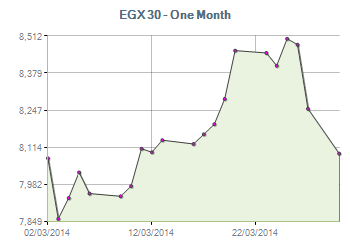
Egyptian stocks are jumping off a cliff — at least that’s what it feels like when looking at the graph tracking the benchmark index’s performance over the past few days.
The main EGX 30 index closed Monday 3.57 percent lower at 7,792 points after trading was halted on 44 stocks that dropped more than the allowed five percent for the obligatory half hour.
The five-percent circuit breaker is a precautionary measure adopted by Egypt’s market after the plunge it witnessed with the outbreak of the 2011 revolution.
Overall, stocks lost LE10 billion on Monday, bringing total market capitalization to LE471.5 billion amid heavy selling from Egyptian and foreign individual and institutional investors. Arab investors seem to be the only ones buying into the market, with individuals comprising net buyers at LE65 million and institutions at LE591 million.
Individual Egyptian investors were net sellers at a total of LE10 million, while institutions were also in the negative at LE77 million. But the biggest net-sellers were foreign institutional investors at negative LE569 million.
Stocks across the board were hit hard, with only seven ending on the positive side and 163 closing Monday’s session in the red. Meanwhile, the EGX 70 lost 3.64 percent while the broader EGX 100 index was down 3.33 percent.
The banking sector, which constitutes 15 percent of the market, was the most negatively affected, with stocks down a gaping 49 percent, followed by financial services at 15 percent and telecoms at 10 percent. The only sector that made some gains was food and beverages—a small four percent of market capitalization—with its stocks up a meager 0.9 percent.
Analysts have called for an investigation in the frenzied selling spree that began during Thursday’s trading session, a day after Field Marshal Abdel Fattah al-Sisi announced his intention to run in the upcoming presidential race.
Early on in Thursday’s trading session, the benchmark index rose 1.3 percent and market capitalization gained LE575 million, but that quickly changed when profit-taking drove a major sell-off of stocks that pushed the EGX 30 down 2.7 percent by the day’s end. According to state-run website EgyNews, the loss totaled LE15 billion.
However, amid speculation surrounding the cause of the sudden downward pressure on the market, Mohamed Omran, chairman of the stock exchange, told Reuters that “Thursday’s trading was normal and there is no reason for suspicion.”
Earlier last week, the EGX 30 climbed to a six-year high of 8,501 points on March 25, continuing the fluctuating but generally upward trend that began earlier this year. Since the start of 2014, Egypt’s capital market has gained around 20 percent.
On February 23, the main index topped the 8,000-point mark, the first time it broke this barrier since the 2008 global financial crisis.
Wael Ziada, head of research at regional investment bank EFG-Hermes, previously told Mada Masr that the positive trend is a reflection of a “market flush with liquidity” as well as little other options for investment. However, capital controls that continue to dominate Egypt’s financial system have largely kept foreign investors at bay.

أخبار ذات صلة
Govt announces plans for partial privatization of 32 state companies, assets amid economic crisis
This program is a repackaging of a 2018 IPO program that stumbled due to hostile market conditions.
More talk, little action: Why are Egyptian authorities unable to sell stakes in state-owned companies?
As of the first week of December, shares of just one government company has been listed on EGX.
EGX back to green after 7-day slide
The Egyptian Stock Exchange (EGX) advanced slightly on Monday, following a dramatic seven-day slide. The benchmark EGX 30 index rose by 3.14 percent on…
Minister’s remarks about depreciation stoke tension with Central Bank
Investment Minister Ashraf Salman’s widely reported comments about the need to devalue the Egyptian pound appear to have kicked off a public…
Your support is the only way to ensure independent, progressive journalism survives.
You have a right to access accurate information, be stimulated by innovative and nuanced reporting, and be moved by compelling storytelling. Subscribe now to become part of the growing community of members who help us maintain our editorial independence.
Join us