
Journalists brace for escalating protests following syndicate raid
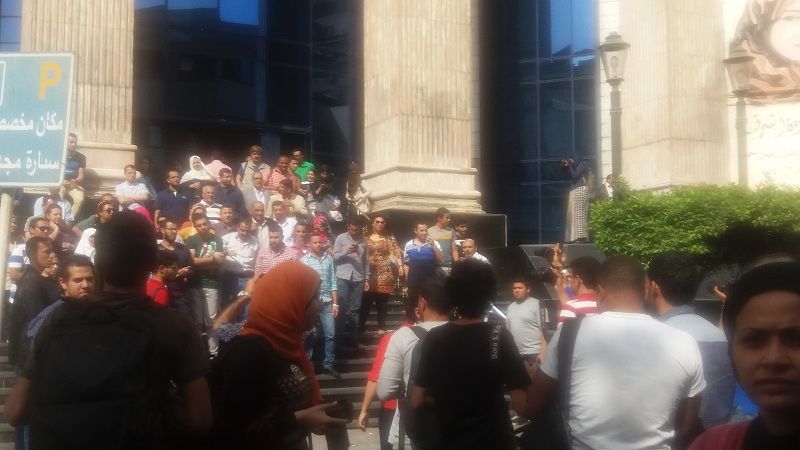
Media workers headed to the Journalists Syndicate again on Monday to protest after security forces blocked the road to the historic downtown Cairo building.
On Sunday, plainclothes police personnel raided the syndicate and arrested journalists Amr Badr and Mahmoud al-Sakka. Both men had previously been summoned for questioning on accusations that they spread false news when they reported on Egypt’s sovereign transfer of the Red Sea islands Tiran and Sanafir to Saudi Arabia.
Sakka and Badr were interrogated by the prosecution on Monday. Lawyer Sameh Samir said they were then remanded into custody for 15 days pending investigations.
The raid and subsequent arrests prompted dozens of journalists to protest inside the syndicate on Sunday night. Many then declared a sit-in until their demands are met.
In a statement, the striking journalists called for the immediate release of Sakka and Badr and all journalists currently in detention. They further demanded the dismissal of Interior Minister Magdy Abdel Ghaffar and an official apology from the presidency.
The raid comes amid a poisonous atmosphere for the press. According to the New York-based Committee to Protect Journalists (CPJ), Egypt was second only to China as the world’s top jailer of journalists in 2015, with 23 journalists held behind bars. CPJ blamed President Abdel Fattah al-Sisi’s administration for using national security and counterterrorism efforts as a “pretext to clamp down on dissent.”
Days before Sunday’s raid, several reporters were arrested, assaulted and harassed while they covered mass protests on April 25 against the island transfer deal. Last week, dozens of journalists protested in front of the syndicate and marched to the prosecutor general’s office, where they presented official complaints against the Interior Ministry.
The syndicate is now expected to escalate its protest actions after the unprecedented police raid. Khaled al-Balshy, head of the syndicate’s freedoms committee, told Mada Masr that a general assembly meeting would be held on Wednesday to discuss possible strategies.
“It is not an official call for an emergency general assembly meeting, however, because that would take at least two weeks of preparation, and we don’t have the luxury to wait,” he explained.
The syndicate previously failed to hold an official general assembly meeting on three different occasions because it did not reach the official quorum. In the past meetings, the syndicate was expected to approve its budget and discuss deteriorating conditions for jailed journalists. But Balshy believes that Wednesday’s meeting will draw greater numbers.
"Journalists are provoked and angry,” he said. “I believe our demands are not difficult to achieve, and the journalists are capable of doing this.”
The chief editors of several newspapers and former syndicate heads are also expected to convene soon to discuss a possible escalation in protest actions and the adoption of a unified stance in response to the police crackdown, Balshy said.
“Among the suggestions is that newspapers print blacked-out front pages. But how the escalation will take shape is linked to the will of those who will attend,” he added.
Shaimaa Abul Kheir, a journalist and press freedom activist, is skeptical of these efforts. She described Sunday’s raid as the natural result of the crackdown on press freedoms since July 2013, a crackdown that she claimed has consistently met with silence from the wider journalism community. Kheir believes the syndicate’s board should play a larger role in exerting pressure to remove Abdel Ghaffar from his post and advocate for the release of imprisoned journalists.
“I believe the syndicate board should have a stronger role in pressuring the state, otherwise it should submit its resignation,” Kheir argued.
“In the long run, the syndicate needs to reconsider its bylaws,” she added. “And more journalists should be allowed to join the syndicate in order to offer a wider umbrella for the protection of journalists.”
In order to join the syndicate, journalists must first hold official employment at an accredited newspaper for at least one year, which means that the thousands of journalists who work as freelancers or write for online websites are not able to join.
In a statement issued Sunday night, the Interior Ministry used this pretext to justify the raid, claiming the two arrested journalists were not syndicate members. However, while Sakka does not belong to the syndicate, Badr is an active member who ran in last year’s syndicate board elections.
The Interior Ministry has increasingly engaged in direct confrontation with independent nongovernmental organizations, syndicates and political parties. The leftist Karama Party was besieged by security forces during the April 25 protests after a number of protesters took shelter at its headquarters to hide from the police. For hours, police guarded the building and refused to allow anyone to enter or exit, demanding that the party leaders hand over the protesters. The party refused, and police forces ultimately left.
Following Sunday’s raid of the Journalists Syndicate, several political parties condemned the attack and vowed to support the syndicate.
Medhat al-Zahed, acting president of the Popular Socialist Alliance Party and a member of the Democratic Alliance — a coalition of liberal post-revolution parties — said the alliance is examining the possibility of staging sit-ins at the headquarters of its respective parties in support of the syndicate.
“The alliance calls on all democratic forces to stand by the Journalists Syndicate against this shameful attack,” Zahed said in an email statement.
The Egyptian Social Democratic Party also released a statement following the raid, calling the move “a dangerous development in attacking social institutions, ending the state of law and establishing an oppressive police state.”
A delegation from the Doctors Syndicate visited the Journalists Syndicate on Monday in a show of solidarity, and met with a number of the syndicate’s board members. Both sides agreed that the delegation would attend the Journalists Syndicate’s emergency meeting on Wednesday.
The Doctors Syndicate was also recently engaged in a stand-off with the Interior Ministry. Earlier this year, thousands of doctors protested after low-ranking policemen assaulted two doctors in a public hospital in Matareya. The protesters called for the policemen to be put on trial, and for the health minister to be referred to internal investigations.
Journalists Syndicate board member Abul Soud Mohamed told Mada Masr that several suggestions would be offered to other professional syndicates who want to show support, such as organizing joint protests and statements, as well as organizing open strikes at syndicates.
Ihab al-Taher, secretary general of the Doctors Syndicate, said the Journalists Syndicate would take the lead in determining the shape of possible forms support through a joint action committee. He added that the unprecedented raid may happen again if professional syndicates did not firmly stand against the Interior Ministry’s practices.
Mohamed vowed that “no middle ground” would be accepted, and that the syndicate would not give up on its demand to remove Abdel Ghaffar.
“Firing the interior minister is not just a demand from the syndicate board, but it is the demand of the journalists,” he said. “The decision is now in the hands of the general assembly.”

Mai Shams El-Din
Mai graduated from the American University in Cairo with a degree in journalism. She worked mostly for local English-language news outlets but has also been writing in Arabic, particularly when…
أخبار ذات صلة

Court extends Activist Ahmed Douma’s remand detention
A Badr misdemeanor court extended on Thursday the detention of prominent Egyptian activist and writer Ahmed Douma for an additional 15 days…
Supreme State Security Prosecution interrogates journalist after home arrests
Security forces went on Sunday morning to the homes of Bastet KE Media owner Monther al-Khilaly and journalist Ahmed Refaat, editor-in-chief of…
Researcher Ismail al-Iskandrani detained again over Facebook posts
The Supreme State Security Prosecution ordered on Wednesday the detention of researcher and journalist Ismail al-Iskandrani for 15 days on false news…

4 Sudanese journalists detained in Aswan face deportation
Four Sudanese journalists who hold refugee status in Egypt are facing an uncertain fate following their arrest by security forces in Cairo…
Your support is the only way to ensure independent, progressive journalism survives.
You have a right to access accurate information, be stimulated by innovative and nuanced reporting, and be moved by compelling storytelling. Subscribe now to become part of the growing community of members who help us maintain our editorial independence.
Join us