
Journalist Rana Mamdouh recounts questioning before state security prosecution during 10-hour detention
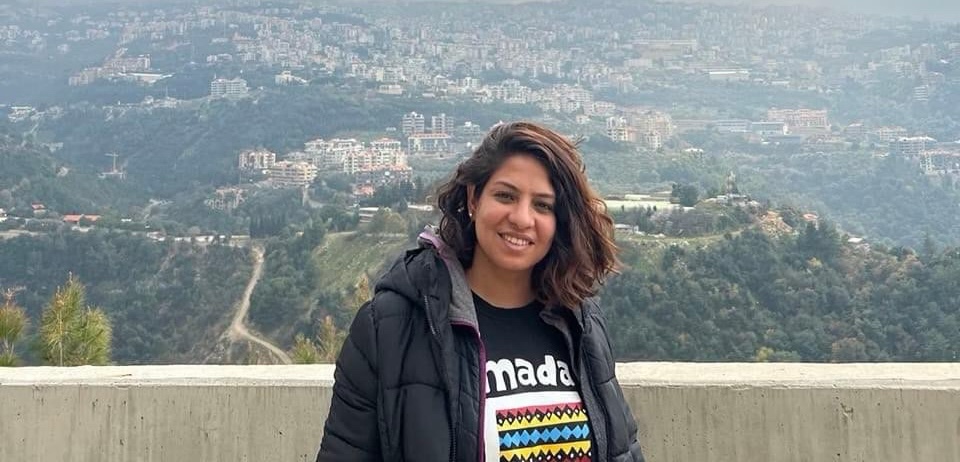
After being arrested on Sunday in Alamein en route to Ras al-Hikma on assignment, journalist Rana Mamdouh was transported to Cairo where she appeared before the Supreme State Security Prosecution. Denied recourse to her own lawyer, Mamdouh was questioned about complaints she had incited citizens of the north coast city to terrorism, the Mada Masr reporter recounted on Monday after being released on LE5,000 bail late last night.
Mamdouh was not allowed recourse to her own lawyers or to call her family throughout the 10 hours she spent in detention.
Speaking to Mada Masr on Monday, she detailed the events that transpired from her arrest until her release late on Sunday.
Mamdouh left Cairo on Sunday morning with a private driver on her way to Ras al-Hikma, the site of a recently announced US$35 billion mega-project financed by the United Arab Emirates and implemented in coordination with the Egyptian government and businessman Hesham Talaat Mostafa. Egypt has already received $15 billion for the project — $10 billion in new investments and $5 billion from a converted deposit at the central bank — helping it unlock new financing to take the first steps out of a deep economic crisis that has plagued the country for two years.
Upon arriving at a temporary checkpoint at the Alamein toll station, security personnel reviewed her ID card, Mamdouh said. As soon as the authorities saw that she was a journalist and was headed for Ras al-Hikma, they held her at the gate and accused her of going to conduct an interview without permission.
She and the driver who had driven her from Cairo were then escorted to the Alamein police station. Upon arrival, a National Security Agency officer asked her for the password to her mobile phone “in order for us to let you go,” Mamdouh recounted. She refused to provide the password.
An hour after they arrived at the station, the driver was taken by a group of police officers to another location. He was later released.
Five hours after her arrest, Mamdouh was escorted out of the station. She was not informed of where she was being taken, nor was she allowed to call her lawyer or any relatives.
After a long drive, she arrived at the Supreme State Security Prosecution in Cairo and was brought before the prosecution.
At the beginning of the investigation, Mamdouh requested that her own lawyer or a lawyer appointed by the Journalists Syndicate be allowed to attend the session, but the prosecution appointed its own lawyer to represent her during the session and told her that “the charge has no relation to your being a journalist.”
When asked about the charge, the prosecutor said that the National Security Agency submitted a report documenting complaints from Ras al-Hikma residents that Mamdouh had incited them to terrorism. The prosecutor told her that if she did not answer the questions, she would be ordered to be held in remand.
The questioning did not touch on the assignment in Ras al-Hikma directly, Mamdouh said. Instead, she was questioned about personal details, such as her social activity, her husband, the nature of her work and when she started reporting with Mada Masr.
At the end of the investigation, the prosecutor said that the orders for her release on bail would be issued “because you wore me out during the investigation session. If you hadn’t worn me out, you would’ve been able to go without bail.”
Lawyer Hassan al-Azhari, who represents Mamdouh as well as Mada Masr, said that the Supreme State Security Prosecution questioned Mamdouh in relation to charges of incitement to commit a terrorist act or crime. Azhari only learned the case details and the charges from the lawyer appointed by the prosecution.
Mamdouh could be summoned again to continue the investigation or could be referred to trial by a relevant court, said Azhari.
Mamdouh was subject to a number of legal violations, said Azahri, including a 10-hour detention without the disclosure of her whereabouts, the fact that she was not allowed recourse to her lawyer or the syndicate’s lawyer, the prosecution’s decision to appoint a lawyer to attend the session with her and the fact that she was not allowed to call her family.
Mamdouh did not commit any legal infractions during her work, said Azhari, describing her arrest and investigation as a clear infringement on her right to carry out her work and all professional norms. He called on the authorities to drop the investigation as there is no evidence that any crime punishable by law was committed.
Weeks ago, Mada Masr Editor-in-Chief Lina Attalah presented herself for investigation at the Cairo Appeals Prosecution on the basis of a report submitted by the Supreme Media Regulatory Council. She was questioned regarding charges of publishing false news and running a website without a license on the basis of a claim that a report published by Mada Masr was lacking sources.
Azhari questioned the legal implications of these investigations. “How can journalists reach sources if they are arrested when they try to reach sources?”
“With so many cases pending against Mada Masr’s staff,” he continued, “there is an impact on their capacity to conduct their work.”
أخبار ذات صلة

Court extends Activist Ahmed Douma’s remand detention
A Badr misdemeanor court extended on Thursday the detention of prominent Egyptian activist and writer Ahmed Douma for an additional 15 days…
Supreme State Security Prosecution interrogates journalist after home arrests
Security forces went on Sunday morning to the homes of Bastet KE Media owner Monther al-Khilaly and journalist Ahmed Refaat, editor-in-chief of…
Researcher Ismail al-Iskandrani detained again over Facebook posts
The Supreme State Security Prosecution ordered on Wednesday the detention of researcher and journalist Ismail al-Iskandrani for 15 days on false news…

4 Sudanese journalists detained in Aswan face deportation
Four Sudanese journalists who hold refugee status in Egypt are facing an uncertain fate following their arrest by security forces in Cairo…
Your support is the only way to ensure independent, progressive journalism survives.
You have a right to access accurate information, be stimulated by innovative and nuanced reporting, and be moved by compelling storytelling. Subscribe now to become part of the growing community of members who help us maintain our editorial independence.
Join us