
Israel’s push for gateway to Litani opens forces to fierce fighting as Hezbollah inflicts losses on multiple fronts
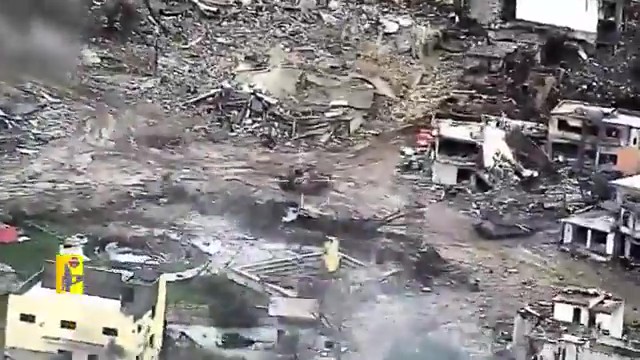
Israeli forces secured passage through a key border town in southern Lebanon this week, however they have faced heavy losses in the face of repeated Hezbollah ambushes as they have tried to move forces toward Qantara, a gateway to the strategic Litani River.
The forces opened passage through Taybeh in the Marjayoun District on Wednesday and have since sent tanks and bulldozers further north toward Qantara.
However, the advance has been beset by setbacks. Hezbollah has ambushed Israeli troops and shelled advancing positions, destroying scores of military equipment and forcing invading troops to pull back.
Fighting peaked late Wednesday, when Hezbollah said it had carried out 87 operations within 24 hours — the highest single-day figure reported in the current escalation — targeting Israeli forces across multiple fronts.
According to the group, the attacks included strikes on armored units, destroying more than 20 Merkava tanks, along with military bulldozers and other vehicles.
While Israel was able to pass through Taybeh, the scale and intensity of Hezbollah’s assault on invading forces indicates that the deeper Israeli troops advance into southern villages, the heavier the fighting becomes.
Passage through Taybeh was secured after weeks of fierce fighting that had prevented the invading troops from reaching the town center.
A source in the Deir Mimas area, which lies on the north bank of the Litani River, facing Taybeh, described nightly fighting marked by airstrikes, missile fire and gun battles during these weeks.
“Israeli forces managed to enter Taybeh and push toward Deir Siryan and Qantara [on Wednesday],” the source told Mada Masr on Thursday morning, saying the fighting was particularly fierce around Deir Siryan. However, there are no signs that they have gained control over these villages, the source added. Heavy clashes continue in Taybeh, with Hezbollah targeting Merkava tanks and Israeli units inside the village.
But with passages secured through the border town, the fighting then moved slightly northward. The heaviest clashes occurred around Qantara, northeast of Taybeh. Hezbollah said it ambushed an Israeli force advancing toward the town on Wednesday night, hitting multiple tanks as they moved forward. In a separate incident near the town’s entrance, Hezbollah fighters targeted Israeli units attempting to push forward, striking a bulldozer and tanks and forcing troops to withdraw on foot, according to the group.
Late Friday night into early Saturday, Hezbollah said it targeted an Israeli unit near the Faqani area on the outskirts of Taybeh as it moved downhill toward the Litani riverbed. In a statement, the group said its fighters lured the unit into a coordinated ambush at around 12:30 am on March 28, using rockets, artillery shells and explosive drones.
Hezbollah described the site of the attack as a “kill zone,” stating that the ambush resulted in significant casualties, with Israeli forces attempting to evacuate the wounded under heavy fire and smoke cover. Helicopters were reportedly deployed to assist with evacuations, while clashes were ongoing at the time of the statement.
Israeli media reported Thursday evening that two of its soldiers had been killed and a number of others injured in clashes with Hezbollah fighters over the course of Wednesday and Thursday. It also said 15 soldiers were evacuated Wednesday night. The soldiers mentioned were from infantry and armored brigades it said were operating in the area.
In the meantime, Hezbollah said it has continued to target Merkava tanks and Israeli troop positions, reporting direct hits across multiple attacks along different axes from west to east.
According to the source in Deir Mimas, Israeli troops remain positioned on the outskirts of Qantara and Deir Siryan, without fully taking either town.
“It would not be surprising if they attempt to expand their ground offensive, particularly as they seek to reach the Litani,” the source said, adding that Qantara holds strategic importance as a gateway to Wadi al-Hujeir and Wadi Slouki, which provide access to the river and surrounding areas.
Ali Abi Raad, a retired general from the Lebanese military, told Mada Masr previously that Hezbollah’s use of guerilla tactics includes luring advancing forces into particular sites to create “kill pockets” and then shifting positions.
For invading forces it’s therefore “not just about reaching the area,” he said. “The real question is whether they can hold it, establish positions or create a defensive base to launch the next phase.”
Israel has repeatedly stated its intent to occupy southern Lebanon extending up to the Litani River to create a “buffer zone” to protect its northern borders. In the last two weeks, it has carried out airstrikes on eight key bridges that link areas north and south of the Litani.
As Israeli forces keep attempting to advance north from Taybeh toward Qantara, they have simultaneously continued a slower push forward past the border area into villages a few kilometers deep into the western sector of south Lebanon, particularly in the villages of Debel, Qawzah and Beit Lif in the Bint Jbeil District. Hezbollah said it has been targeting Israeli troop positions in an effort to slow or prevent movement toward village centers.
While hundreds of thousands of people have been displaced from the south since Israel intensified its operations, not all villages along the southern border are empty. Many, particularly those with Sunni, Druze or Christian majorities, still have residents who have refused to leave. Their fate remains uncertain, as Israeli forces have not yet reached these areas, leaving families in a state of fear and apprehension. Fighting continues to escalate, with Israeli troops pressing forward and Hezbollah determined to prevent any further advance.
Over the past two weeks, Israel has sent tens of thousands of additional troops to its northern border in an effort to deepen its incursion into Lebanese territory. The heavy bombardment and attacks have killed more than 1,140 people and injured over 3,300 and displaced more than a million residents.
أخبار ذات صلة
We will sit together on Srifa hill, Qassem
Two friends try to reclaim a memory other than what the Israeli genocidal machine carved into them.

Delayed for a phone call that didn’t happen: US declares ceasefire in Lebanon
The ceasefire was ready 24 hours before it was announced. Trump wasn't ready yet.
Israeli forces encircle Bint Jbeil but fail to enter town, as Netanyahu looks to Lebanese front to spoil Islamabad talks
Lebanon has become the focal point of two parallel — and competing — ceasefire tracks, one unfolding in Islamabad and another in…

Iran’s insistence on Lebanon ceasefire a test for regional sway
After authorizing the deadliest strikes on Lebanon in years on Wednesday, Israeli Prime Minister Benjamin Netanyahu took to the podium in a national address to assure his audience that Tel…
Your support is the only way to ensure independent, progressive journalism survives.
You have a right to access accurate information, be stimulated by innovative and nuanced reporting, and be moved by compelling storytelling. Subscribe now to become part of the growing community of members who help us maintain our editorial independence.
Join us