
Israeli military clearing new zone, ‘tent city’ in Rafah
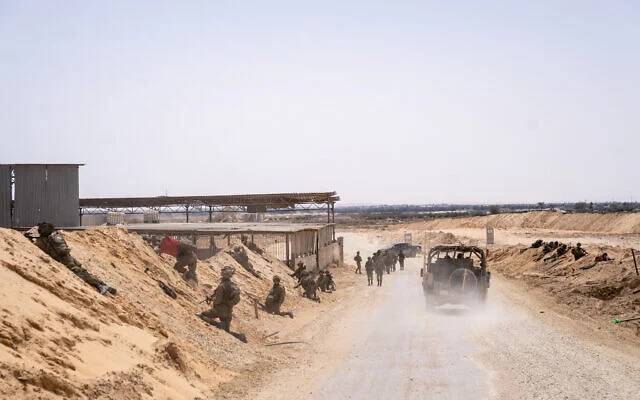
Israel’s military has begun to establish a new isolated zone in an area in the Palestinian city of Rafah, which is currently surrounded by Israeli troops, according to eyewitnesses and a Western diplomat who spoke to Mada Masr on condition of anonymity.
The diplomat said that the controlled zone being constructed includes a tent city to which a number of displaced Palestinians from across Gaza could be moved.
The area will also be used by humanitarian organizations and to store aid supplies, which will be delivered by a security company contracted by Israel, the source said, noting that the potential of hosting displaced Palestinians will not be advertised as the purpose of the zone.
Israeli media has reported, however, that the zone is intended to host Palestinians, with the Israeli Broadcasting Authority describing it as a new “safe zone” like the existing designated humanitarian areas in Mawasi, Khan Younis, where Israel has conducted airstrikes many times, killing people sheltering in tents.
Palestinians from across the strip, including those in Mawasi, would cross into the new currently depopulated zone in Rafah, Israeli media reported.
Israel has displaced over 500,000 Palestinians since March 18, according to recent United Nations figures, after it renewed its war on the strip with an advance into Gaza from the east that has pushed the displaced into western coastal areas and created “kill zones” elsewhere.
Before entering the newly established area, displaced people would be forced to undertake security checks, according to Israeli media, which noted that Israel is framing the move as seeking “to separate Palestinian civilians from armed individuals.”
The Western diplomat said that what will be announced, however, is that the new zone is intended to be used by the UN and other organizations, in coordination with an American company, as a base to manage aid.
The source then clarified that the American company will be run by US-Israeli nationals and specific tribal figures from Gaza designated by the Palestinian Authority.
Israeli media also reported that authorities in Israel prefer a US civilian company handling aid distribution given their disinclination to deal with other security operators in the strip.
The Israeli military has also refused to distribute aid supplies itself, the Israeli Broadcasting Authority reported, and has constructed a comprehensive plan that would “allow the entry of humanitarian aid into the strip without it reaching Hamas.”
Preparations for the new area are already visible in south Gaza, according to eyewitnesses who spoke to Mada Masr. Mahmoud Khalil, who currently lives in the coastal Mawasi area in Khan Younis, told Mada Masr on Sunday that bulldozers and excavators have been moving intensively around the Morag corridor and the city of Rafah over the past few days.
The Morag corridor, occupied by the Israeli military in April, separates Rafah from the rest of the coastal enclave, allowing Israel to control the road linking Rafah to Khan Younis. Israel has also set up a checkpoint near the axis, at which its forces arrested and executed Palestinians as it forced them to flee Gaza’s southernmost city in recent weeks.
Khalil said that Israeli bulldozers in Rafah have reached the perimeter of the southern governorate, extending to the sea coast, and have completely cut off the coastal road by piling dirt and the rubble of demolished houses on the highway to form a barrier.
Another eyewitness, displaced from Rafah last week to the area around the European Hospital in Khan Younis and who preferred to speak on condition of anonymity, told Mada Masr that large areas within Rafah have also been bulldozed clear of houses and rubble.
Since the beginning of March, Israel has halted the entry of all goods and supplies into the strip, imposing a blockade on civilians who have been suffering from the severe shortage of food, water, fuel and medical supplies.
The new plan to facilitate the entry of aid comes as an Egyptian official, speaking on condition of anonymity, said that France and a number of international bodies are placing increased pressure on US President Donald Trump to let humanitarian aid into Gaza.
They added that French President Emmanual Macron discussed aid deliveries to the strip with Trump during the funeral of Pope Francis on Sunday, noting that the Egyptian Foreign Ministry was informed of Macron’s ongoing talks in order for it to play a role in coordinating aid deliveries.
Israel imposed its blockade at the beginning of March as it abandoned the terms of the ceasefire deal and began to starve Palestinians to pressure Hamas into releasing all prisoners outside the deal framework, later relaunching its war on the strip.
Talks to establish a new truce have developed slowly, with a Hamas delegation departing Cairo in recent days after reviewing a proposal put forward by mediators for a five to seven year truce that would see Israel retain control over areas the January ceasefire deal did not grant Tel Aviv.
The group was ready to accept these terms, a Hamas source told Mada Masr at the time, but the proposal also set a condition that it surrender its weapons — still a red line for the group.
While an Egyptian official told CNN that Israel has been invited to talks with the mediators on Monday, an Israeli official said that Israel is yet to receive another offer by the mediators.
Meanwhile, as Israeli forces continue to intensify their attacks across the strip, schemes for forced displacement outside of Gaza continue to take shape after Trump’s multiple advocations of his plans to ‘empty’ Gaza and displace Palestinians into Egypt, Jordan or Saudi Arabia.
While talk has subsided over Trump’s initial version of the plan, hundreds of Palestinians have already been transferred to France and Germany over the past two weeks under what is being dubbed “voluntary family reunification.”
European diplomats and Egyptian sources told Mada Masr in March that regional countries could facilitate the family reunification schemes for Gaza civilians with relatives abroad, contingent on Gulf funding and a guarantee against a full Palestinian exodus.
أخبار ذات صلة

Hundreds of Gaza students demonstrate for right to study abroad
Hundreds of university students trapped in the besieged Gaza Strip gathered on Monday outside the Journalists Syndicate’s headquarters in western Gaza City…

In meeting with Board of Peace director-general, Hamas refuses UN disarmament plans until Israel commits to withdrawal
Hamas has refused to commit to the plans proposed by the United Nations for its disarmament, citing lack of advancement in Israel’s…

Israel agrees to limited reopening of Rafah border crossing — details pending
Israeli Prime Minister Benjamin Netanyahu’s office announced on Monday that it has agreed to a “limited reopening” of the Rafah border crossing…

Sisi touts ‘stabilization’ agenda at first Davos appearance in over 10 years
President Abdel Fattah al-Sisi advertised Egypt’s “stabilization” agenda in Davos on Wednesday, saying the country’s focus on steering away from regional conflicts…
Your support is the only way to ensure independent, progressive journalism survives.
You have a right to access accurate information, be stimulated by innovative and nuanced reporting, and be moved by compelling storytelling. Subscribe now to become part of the growing community of members who help us maintain our editorial independence.
Join us