
In gravest breach of ceasefire yet, Israel kills over 100 Palestinians in airstrikes across Gaza
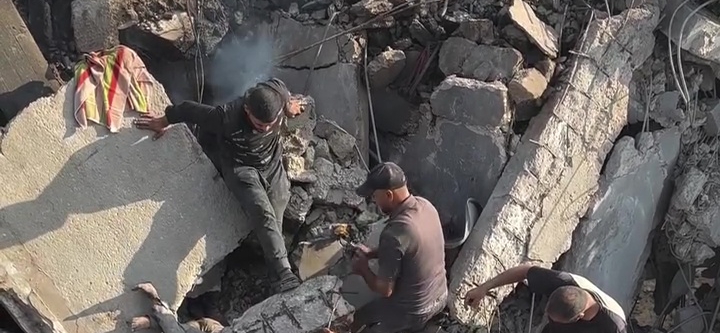
Despite the fragile ceasefire with Hamas, Israel conducted a wave of airstrikes starting Tuesday afternoon in areas across the Gaza Strip, killing over 100 Palestinians.
The attacks followed a series of escalatory statements in which Israeli officials threatened to resume their war on the strip, claiming Hamas had attacked the forces still occupying much of Gaza and that the group was delaying the delivery of the remains of deceased Israeli prisoners.
Hamas has denied targeting Occupation soldiers. Despite the major ceasefire breach, the Israeli military said on Wednesday it would continue to uphold the ceasefire agreement.
At least 104 Palestinians were killed in the attacks since Tuesday night, including 46 children, while 253 were injured, according to the Gaza Health Ministry.
Homes, displacement tents, civilian gatherings, and vehicles were targeted in the Israeli strikes on northern and southern Gaza, with one airstrike hitting the Shifa Medical Complex in western Gaza City.
Gaza Civil Defense spokesperson Mahmoud Basal told Mada Masr that rescue teams are still working on recovering the dead and the injured from under the rubble, amid a severe shortage of resources. Hospitals are overcrowded with critically injured patients and face a dire shortage of medical supplies and fuel, Basal noted.
One of the airstrikes targeted a house belonging to the Abu Dalal family in central Gaza’s Nuseirat refugee camp, killing 19 of its members, mostly women and children, Mahmoud Abu Dalal told Mada Masr. Most of the bodies remain trapped under the rubble, he added.
Another eyewitness, Mansour Abu Sharar, told Mada Masr that northern Gaza’s Beit Lahia also saw an incursion by Israeli military vehicles amid the airstrikes. Many of the people displaced there were forced to flee after Israeli tanks reached their shelters, Abu Shrar noted, confirming that several civilians were injured as a result of the shelling and tank fire.
In statements on Wednesday, Occupation forces claimed the airstrikes hit “30 terrorists holding command positions within the terrorist organizations operating in Gaza,” including three battalion commanders, two deputy battalion commanders, and 16 company commanders, as well as tunnels and weapon caches.
Despite the widescale attack, the Israeli military stated it would “continue to uphold the ceasefire agreement and respond firmly to any violation of it.”
Israeli Prime Minister Benjamin Netanyahu ordered the “powerful strikes” early Tuesday after Israeli forces came under fire in southern Gaza and Hamas handed over the partial remains of a previously recovered hostage a day earlier, according to an Israeli official cited by the Associated Press.
On Wednesday, Occupation forces announced that one Israeli soldier was killed in rocket and sniper attacks. Netanyahu later mourned the soldier in a tweet.
Israeli media quoted an Israeli official on Wednesday morning saying that Israeli forces had “hit dozens of targets and carried out numerous targeted eliminations of Hamas militants,” while stressing that the airstrikes would continue “in light of the ongoing violations.”
Hamas denied having any connection to the Israeli soldier’s death in Rafah and stressed its commitment to the ceasefire, calling the Israeli airstrikes “a flagrant violation of the ceasefire agreement” and “an extension of the series of violations committed in recent days,” including the killing and wounding of Palestinians across the strip and the continued closure of the Rafah crossing. The statement called on mediators to pressure the Occupation to end its violations of the ceasefire deal.
Israel has regularly violated the ceasefire since it came into force on October 10, killing dozens of Palestinians across the strip while claiming to be responding to attacks by Hamas. On October 19, the Occupation launched a similar wave of airstrikes after claiming its forces had come under attack by Hamas fighters in Rafah, which the group denied at the time.
Tensions had also been brewing between Hamas and Israel over a perceived failure to return the remains of Israeli detainees, which prompted Israel to give the Red Cross and Egyptian authorities rare access to aid in the search and expedite the process.
Israel had accused Hamas earlier on Tuesday of violating the ceasefire and threatened to expand control in Gaza, hours after the group announced it had delivered the body of one of the 13 remaining deceased Israeli prisoners.
Later, Israel claimed that Hamas handed over the partial remains of a prisoner whose body was already recovered, after which Netanyahu convened an emergency debate on “Hamas violations,” amid renewed Israeli threats to resume the genocidal war in Gaza.
The Occupation also threatened to expand the scope of the yellow zone, a large swath of land on the eastern side, accounting for over 50 percent of the strip, that has remained under Israeli military control since the ceasefire. The Occupation said it would expand beyond the Yellow Line, citing Hamas’s ceasefire violations and what it called the group’s refusal to hand over the bodies of deceased prisoners, even as Egyptian teams continued searching for them.
Following the start of the Israeli strikes, Hamas announced Tuesday night that it had found the body of another Israeli hostage while searching one of the tunnels in southern Gaza but decided to postpone its delivery amid the Israeli escalation. On Wednesday morning, the group announced it found the bodies of two more hostages, without mentioning their delivery.
Prior to the Israeli strikes, Hamas spokesperson Hazem Qassem told Al-Arabiya that the group was working to quickly hand over all the remaining bodies to remove Israel’s pretexts for maintaining its siege and blocking aid entry. “The Israeli government is searching for pretexts and lies to justify its siege and use of starvation as a tool of political blackmail,” Qassem said.
Hamas leader Khalil al-Hayya also previously confirmed that the movement has faced difficulties locating the bodies because of the scale of the Israeli destruction that altered Gaza’s terrain.
أخبار ذات صلة

Hundreds of Gaza students demonstrate for right to study abroad
Hundreds of university students trapped in the besieged Gaza Strip gathered on Monday outside the Journalists Syndicate’s headquarters in western Gaza City…

In meeting with Board of Peace director-general, Hamas refuses UN disarmament plans until Israel commits to withdrawal
Hamas has refused to commit to the plans proposed by the United Nations for its disarmament, citing lack of advancement in Israel’s…

Israel agrees to limited reopening of Rafah border crossing — details pending
Israeli Prime Minister Benjamin Netanyahu’s office announced on Monday that it has agreed to a “limited reopening” of the Rafah border crossing…

Sisi touts ‘stabilization’ agenda at first Davos appearance in over 10 years
President Abdel Fattah al-Sisi advertised Egypt’s “stabilization” agenda in Davos on Wednesday, saying the country’s focus on steering away from regional conflicts…
Your support is the only way to ensure independent, progressive journalism survives.
You have a right to access accurate information, be stimulated by innovative and nuanced reporting, and be moved by compelling storytelling. Subscribe now to become part of the growing community of members who help us maintain our editorial independence.
Join us