
Government compels public servants to receive COVID-19 vaccination or provide negative PCR test twice per week

By the end of November, all of Egypt’s civil servants are to be barred from entering government workplaces unless they show proof of vaccination, or present negative PCR tests twice a week.
Health experts praised the measure as a way to encourage uptake in the national vaccination program, though other observers noted that the government is yet to clarify who will pay for regular PCR tests for unvaccinated staff, raising concerns about whether some could find themselves unable to go to work as a result.
In a Cabinet circular sent out on Sunday, all of Egypt’s government ministries were instructed to take action within two months to enact the compulsory vaccination rule or oblige staff to take PCR tests every three days.
A legal source, who works in one of the ministries and spoke on condition of anonymity, said that the decision will compel employees to get vaccinated as soon as possible, confirming that in the coming days, every government entity, from ministries to state-owned companies, agencies and institutions, will start asking its employees to bring forward evidence that they have either received or registered to receive the vaccine. Employees who fail to do so will have to provide negative PCR tests twice per week, the source said.
Meanwhile, Ahmed Azab, a healthcare researcher at the Egyptian Initiative for Personal Rights, praised the step to make vaccination compulsory, pointing to the 1985 infectious diseases law that empowers the government to compel public vaccination against any specified infectious diseases, and adding that all vaccinations used in Egypt at present are safe and approved by the World Health Organization.
The Education Ministry, which has been hurrying through an intensive campaign to get all its staff vaccinated before the start of the school year, appears to be the first ministry to implement the Cabinet directive, issuing orders on Tuesday for its subsidiary directorates in the governorates to allow employees who are unable to receive the COVID-19 vaccine for medical reasons to submit a negative PCR twice per week, the privately owned Al-Watan newspaper reported.
Although the majority of workers in the education sector are still not vaccinated, the ministry's statement did not explain whether employees who have registered to receive the vaccine but have yet received it would be allowed to enter their places of work. In a statement, the ministry noted that only 18 percent of its 1.6 million staff nationwide have received two doses of the vaccine, while 34 percent have received only the first dose, though all but three percent of the staff have registered for inoculation.
Both Azab and Dr. Ibrahim al-Zayat, a member of the senior council at the Doctors Syndicate, questioned why the Education Ministry is the first to make vaccination compulsory for its staff. Azab told Mada Masr the decision should be expanded to the broadest possible range of workers, pointing in particular to healthcare workers. While the Cabinet decision will apply to Health Ministry employees, Azab wondered what the rules on vaccination would be in the private medical sector.
Zayat, meanwhile, said that the Health Ministry should be making sure that all medical staff are vaccinated and releasing figures on how many of its staff are inoculated so far, as well as on the proportion of people vaccinated from vulnerable categories.
From the Cabinet circular, it is also unclear how state employees are to deal with the cost of two PCR tests per five-day working week. Government testing sites currently offer PCR tests for COVID-19 at a rate of LE1,260 (US$80), or over half of the public sector minimum wage per month. The legal source said that “tests are very expensive, and if you don’t do them you won’t be able to come in to work, and if that state of affairs lasts for two weeks you’re presumed to have resigned or be suspended.”
Under the civil service law, anyone absent from work without permission for 15 consecutive days or 30 days per year should have their service terminated, unless they provide evidence of an acceptable reason for the absence.
Khaled Abbas, the coordinator of the Center for Trade Union and Worker Services, raised concerns about how the new rules would be implemented, stressing that it would overstep the government’s remit should it transpire in practice that public servants’ tenure in their jobs is tied to whether or not they are vaccinated.
Egypt has announced an ambitious target to finish inoculating 35 million of its citizens against the coronavirus by November. As of September 22, the World Health Organization reports that Egypt has administered over 15 million vaccine doses to its citizens.
With parallel vaccination programs targeting particular denominations of the public, including the state sector, many of those vaccinated in Egypt so far have already received their shots outside of the registration portal that is available to the general public, according to several medical and government sources.
The sources also suggested that while targeted routes to vaccination may relieve pressure on the public system, and were initially intended to ensure that those most in need of the vaccine were able to get it, in practice these systems have allowed privileged access to vaccination for some and not for others.

أخبار ذات صلة

Devaluation drama and hot money’s return: What happened with the pound’s historic plummet?
'As long as there is more demand than supply, the price of the pound will continue to decrease.'
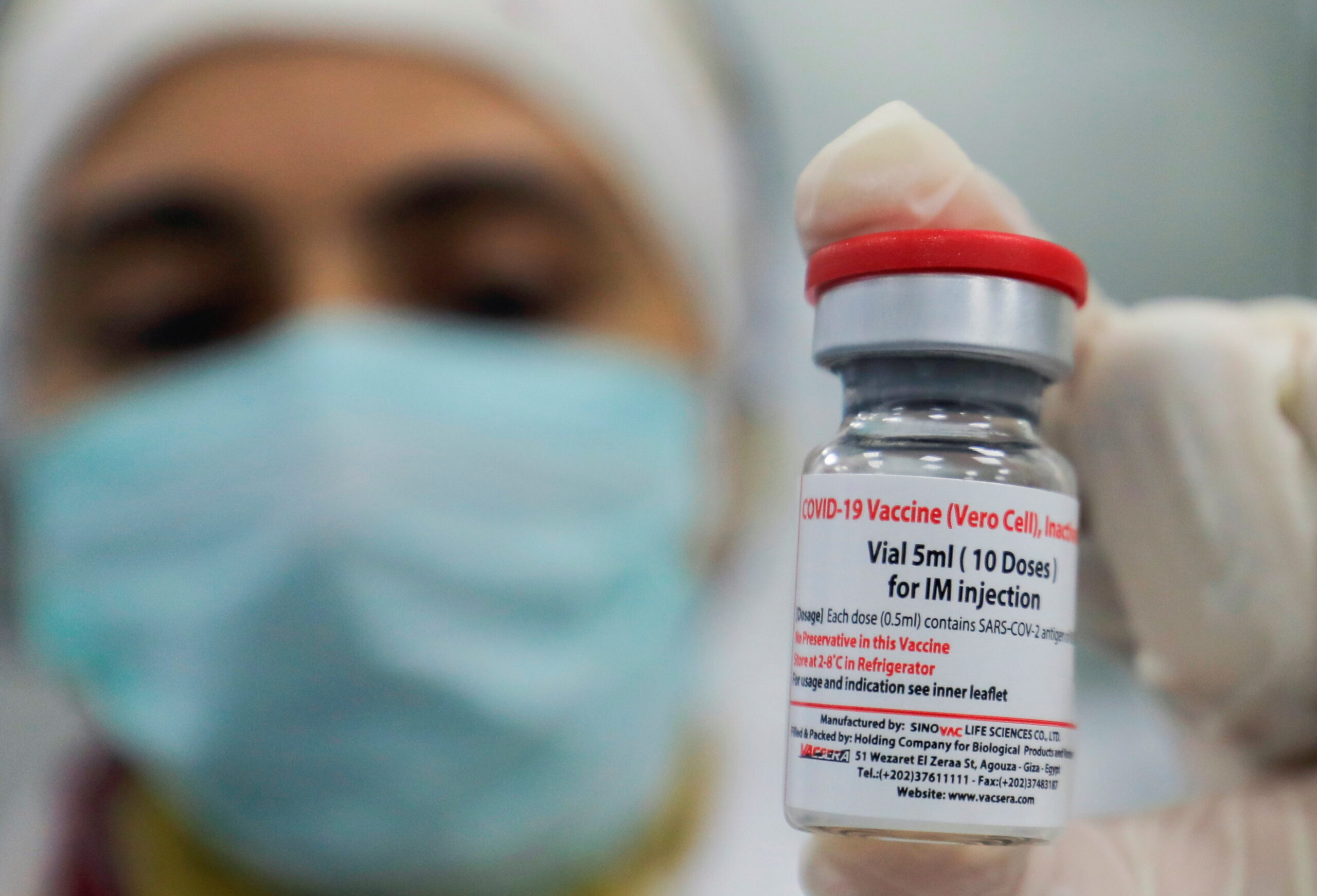
Doctors: Expired Sinovac-Vacsera doses being used in Cairo COVID-19 vaccination campaign
Medical teams are being instructed not to show recipients the ampoules if they ask

Health Ministry fast-tracks COVID-19 booster shots
The government began on Tuesday to administer third booster doses of the coronavirus vaccine.

Egypt announces first 3 Omicron cases
The announcement comes three weeks after the WHO announced the discovery of the strain
Your support is the only way to ensure independent, progressive journalism survives.
You have a right to access accurate information, be stimulated by innovative and nuanced reporting, and be moved by compelling storytelling. Subscribe now to become part of the growing community of members who help us maintain our editorial independence.
Join us