
German archaeologists discover prehistoric rock art in Aswan, 9 statues in Luxor
Two separate teams of German archeologists have made important discoveries in southern Egypt over the past week, unearthing prehistoric rock art panels in Aswan dating back well over 5,100 years, along with the discovery of nine statues in Luxor, estimated to be over 3,350 years old.
On Wednesday, the Ministry of Antiquities issued a statement on its official webpage announcing that a team of archeologists from the University of Bonn had discovered more than 15 prehistoric rock art panels near the site of Qubbet al-Hawa in Western Aswan.
The engraved panels are believed to date to before 3,100 BC — during Egypt’s Neolithic/pre-dynastic period — although their actual age is still being determined. They depict images of wild animals, including cattle, ibex, deer, ostriches, and giraffes, and may have been used in hunting rituals or religious practices.
The director of the University of Bonn team, Amr al-Hawary, is quoted as saying that the panels may also have been used to depict human mastery over nature and wildlife.
The ministry’s statement indicates that prehistoric hunter-gatherers had lived in this area, located in the modern-day Aswan governorate, Egypt’s southernmost province, long before the establishment of Ancient Egypt’s Old Kingdom and Middle Kingdom. These rock art panels have reportedly been discovered by the archaeological site known as Tombs of the Nobles in Qubbet al-Hawa, Western Aswan.
Further research and studies are to be conducted on the panels in the hope of learning more about those who lived in this area prior to the establishment of ancient Egypt’s earliest kingdoms.
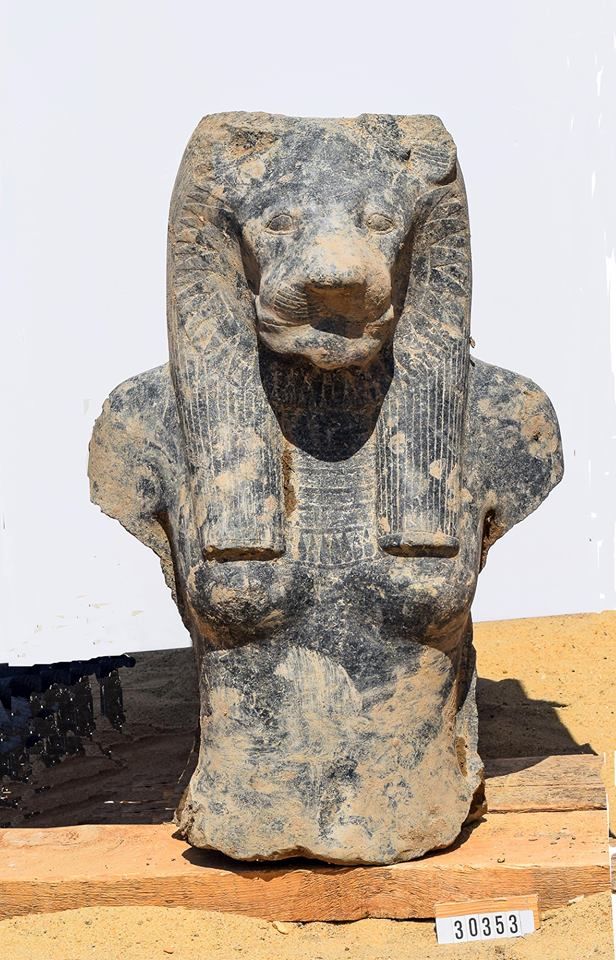
Meanwhile, on Tuesday, a statement issued by the Ministry of Antiquities announced another discovery by German-led Colossi of Memnon and Amenhotep III Temple Conservation Project in Luxor (formerly known as Thebes). Quoting the director of the archaeological team, Hourig Sourouzian, the ministerial statement states that a total of nine statues were discovered within the grounds of the Temple of Pharaoh Amenhotep III.
The temple of Pharaoh Amenhotep III (reigned circa 1388-1351 BC) is located in the area of Kom al-Hitan, on Luxor’s Western river bank.
Originating during the 18th dynasty of ancient Egypt’s New Kingdom, eight of these statues, made of black granite, are those of the lioness-headed Sekhmet a solar deity, the goddess of war and medicine.
Some of these statues of Sekhmet depict the goddess seated, others are sculpted of her standing upright. The goddess is depicted with wigs, with the Ankh/Key of life, and papyrus reeds. The maximum height of these statues of Sekhmet measure 1.9 meters.
Another granite statue was sculpted in the shape of the Pharaoh Amenhotep III. However, it is fragmented and headless. The damaged statue of Amenhotep III is said to measure 77 centimeters in height.
According to the statement, these statues are in the process of being cleaned, restored and fully documented. The statement added that the site where these statues were discovered is currently being fenced off and secured, before being opened to the public.

أخبار ذات صلة
All around the Grand Egyptian Museum
The museum will not be open to visitors until after the three-day celebration
Forever is now, on the art of Art D’Égypte
A new contemporary art scene dominated by public and private stakeholders is emerging
Ancient Egyptian gold workers’ tomb excavated on island in Sudan
An ancient tomb reported to contain the mummified remains of at least 12 Egyptian gold workers has been excavated in Sudan
Archaeologists discover 2,000-year-old mausoleum in Alexandria
A 2,000-year-old mausoleum containing approximately 300 artifacts was unearthed by a team of Egyptian archaeologists in Alexandria
Your support is the only way to ensure independent, progressive journalism survives.
You have a right to access accurate information, be stimulated by innovative and nuanced reporting, and be moved by compelling storytelling. Subscribe now to become part of the growing community of members who help us maintain our editorial independence.
Join us