
Five remain in Wazzani, where Israeli military detonated homes, water facilities over recent days
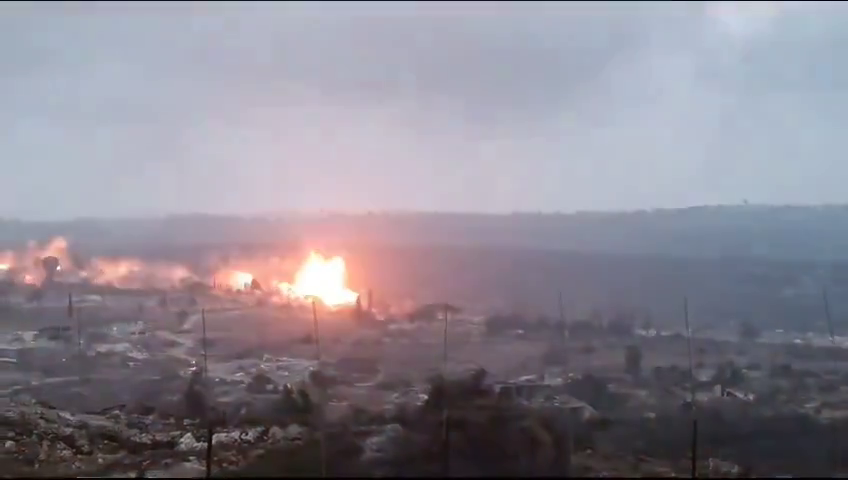
The Wazzani water pumping station was also rigged with explosives and destroyed, the sources added. The facility previously supplied the Marjeyoun and Bint Jbeil districts with water from the Wazzani River.
According to the sources, Israeli forces also blew up water collection tanks near the Lebanese military checkpoint in the Wazzani plain.
Since October, Israeli forces who have been conducting incursions into Lebanon from the southern border for weeks have detonated explosives to destroy homes, sites of worship and other buildings in urban areas of Lebanon along the border. Wazzani is the latest village on the Lebanese border to be subject to the same pattern.
Satellite imagery analyzed by the Washington Post showed that around 6,000 buildings, or a quarter of the buildings in 25 municipalities, had been destroyed by the Israeli military.
Residents of Wazzani, of whom there were around 1,000 mostly making a living via agriculture, had left before Sunday’s explosions took place, according to Ahmed, the mayor of the village. Air-dropped leaflets ordered residents to leave as early as September.
As Israeli soldiers advanced over recent weeks and tanks surrounded the village and destroyed its main road, cutting Wazzani off from access to food and medical supplies, Ahmed explained that the majority of residents were displaced to nearby villages.
Some fled to Khiam, where Israeli bombing on the town and its surroundings in recent weeks killed them, according to Ahmed.

Khiam was subject to intense bombing at the end of October, when Israeli forces were attempting to advance on the town, according to a security source who spoke to Mada Masr at the time. Hezbollah fighters launched rockets in their direction to repel the advance. Israel ultimately withdrew in early November.
Twenty bodies were retrieved from under the rubble in Khiam by the Lebanese military, Red Cross and UNIFIL forces over the course of several days, with the search and rescue operations coming to a near-close last week. Ahmed said all 20 belonged to two families who were originally from Wazzani. “We buried them in Ain Arab, next to Wazzani,” said the mayor.
“Only five people remain in Wazzani,” the mayor continued. Among them is herder Abu Mohamed al-Mohamed. Abu Mohamed told Mada Masr that he, along with his wife and three children, are staying in Wazzani because they own a herd of goats and sheep that he opted to protect. But he said that, after Sunday’s explosions, he fears for his family’s lives and for the house.
Abu Mohamed said he anticipates that he may resort to leaving like the rest of Wazzani’s residents, noting that only five other houses remain standing and that the Israeli military has already threatened to liquidate them. In that case, he said, “There will be no reason to stay. We will head with the flock of sheep and goats to Ain Arab. If we are lucky, we will stay there. If not, we will head to a safer village.”
Three Lebanese security sources also told Mada Masr that explosions were heard on Monday morning in Ayta al-Shaab village, around 500 meters from the border line, coinciding with “the advance of an enemy force that tried to reenter the town after withdrawing more than a week ago following the bombing of the old town.”
In Lebanon’s northeast, in the Baalbek-Hermel Governorate, the Lebanese Civil Defense worked to retrieve eight more bodies on Monday from the sites of the Israeli airstrike on Zeghrine and Qasr villages in Hermel district, where the civil defense pulled 10 bodies yesterday from under the rubble.
Three more people were killed today, and two more injured, in a new Israeli airstrike on Qasr, the Lebanese Health Ministry said.
In Beirut’s southern suburb, the civil defense worked to put out fires in a fuel tank, a warehouse, garages and several houses, as well as a dye shop inside a warehouse in the American neighborhood.
The toll of Israeli aggression on Lebanon since October 2023 has risen to 3,189 killed and around 14,078 injured, the Health Ministry said on Sunday night.
For its part, Hezbollah fired rockets on Monday at two gatherings of Israeli forces on the eastern outskirts of the Maroun al-Ras border village and the Ebad site. The group also targeted a training base for the Israeli paratroopers brigade in the Karmiel settlement in northern Israel with large missiles and sent a barrage of missiles toward the Ma'alot-Tarshiha settlement “as part of the warning Hezbollah directed to the residents of the northern settlements,” the organization said.
Hezbollah had also targeted Safad in Upper Galilee on Sunday among 28 operations it conducted yesterday, including repelling infiltration attempts by Israeli forces in Kfar Kila and Aitaroun.
The Israeli military revealed today that it shot down one drone coming from Lebanon and is still pursuing another airborne target as warning sirens sounded in Upper Galilee.
For his part, Hezbollah media relations officer Mohamed Afif reiterated in a press conference on Monday in Beirut’s southern suburb the Lebanese organization’s commitment to its ties to the Gaza front.
Afif denied that either Hezbollah or Lebanon had received any ceasefire proposal that might have resulted from the political moves of Washington and other capitals, expecting no proposal to come soon.
Hezbollah was reported previously to have agreed to separate negotiations on a ceasefire for Lebanon from negotiations for a ceasefire for Gaza.
US envoy Amos Hochstein visited Tel Aviv last week, with Israeli platforms circulating a draft for a 60-day ceasefire that was said to have been formulated by the US as a pause to hostilities to facilitate work on implementing United Nations Security Council Resolution 1701.
Nabih Berri, head of the Lebanese Amal Movement and speaker of the House of Representatives, has said that Lebanon is awaiting Israel's response to a formula to which Lebanon and the US agreed.
أخبار ذات صلة

Hundreds of Gaza students demonstrate for right to study abroad
Hundreds of university students trapped in the besieged Gaza Strip gathered on Monday outside the Journalists Syndicate’s headquarters in western Gaza City…

In meeting with Board of Peace director-general, Hamas refuses UN disarmament plans until Israel commits to withdrawal
Hamas has refused to commit to the plans proposed by the United Nations for its disarmament, citing lack of advancement in Israel’s…

Israel agrees to limited reopening of Rafah border crossing — details pending
Israeli Prime Minister Benjamin Netanyahu’s office announced on Monday that it has agreed to a “limited reopening” of the Rafah border crossing…

Sisi touts ‘stabilization’ agenda at first Davos appearance in over 10 years
President Abdel Fattah al-Sisi advertised Egypt’s “stabilization” agenda in Davos on Wednesday, saying the country’s focus on steering away from regional conflicts…
Your support is the only way to ensure independent, progressive journalism survives.
You have a right to access accurate information, be stimulated by innovative and nuanced reporting, and be moved by compelling storytelling. Subscribe now to become part of the growing community of members who help us maintain our editorial independence.
Join us