
Update: Authorities use force to disperse Global March to Gaza participants
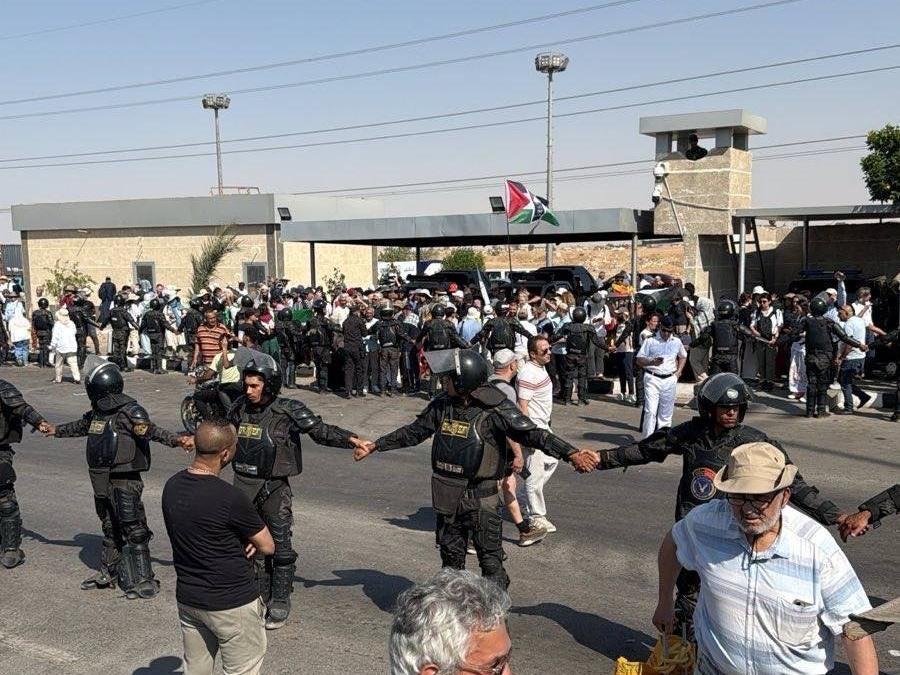
Security forces and civilians attacked participants from the Global March to Gaza at a checkpoint on the way to the city of Ismailia outside of Cairo on June 13.
The march’s organisers posted an urgent call in the evening for all participants to return to Cairo given the “escalating violence.”
One of the participants explained to Mada Masr the escalation that took place throughout the day: “People started getting stopped at the second checkpoint on the road to Ismailia at around 12:30 pm. More people started arriving and getting held up. There were delegations from everywhere, North Africa, France, Netherlands, Switzerland. They took our passports, and we waited for over four hours until we got the passports back. Some people left right there and then. Other people decided to stay. Those who stayed gathered in a square near the mosque. Everyone sat down and we started chanting. At this point, authorities started doing intimidation tactics. Saying either we leave willingly, or we stay and will get beaten up. Everyone was given the option and the Canadian delegation decided to stay. We were chanting and slowly they started spraying the air with something and closing in on us with some soldiers. They sent in infiltrators wearing white abayas and covering their face. They started beating people up and throwing water bottles at people. They had whips and batons and were extremely violent and aggressive. Some people were dragged on the floor. The purpose was to get people to leave.”
Earlier on Friday, Egyptian authorities continued to deport several international activists taking part in the march, including foreign individuals who had entered the country via Cairo International Airport the previous day.
Deportations took place as activists attempted to travel toward Ismailia from various locations across central Cairo.
Organizers from the different countries’ delegations had circulated instructions in the morning designating a hotel in Ismailia as the meeting point. Participants were advised to travel individually or in small groups and were explicitly urged not to protest upon arrival. Organizers also confirmed that they remained engaged with Egypt’s Foreign Ministry to coordinate forthcoming steps.
However, police stopped several activists as they left Cairo. According to testimonies from two Belgian nationals, officers confiscated their passports and initiated deportation proceedings against them. Other participants with US citizenship reported being stopped at the first checkpoint outside Cairo, where they were detained and ordered to leave the country. After being blocked from continuing their journey, they began chanting “Free Palestine” at the checkpoint.
In an update on their Whatsapp channel, the march’s organizers reported that police forces have stopped all cars coming from Cairo at a checkpoint 30 km outside the city, forcing anyone carrying a non-Egyptian passport to get off. The update mentioned that activists started a sit-in at the checkpoint.
Activists at the checkpoint reported being violently treated by police to forcibly get into a bus. One activist said their passport was taken and they have been waiting for hours under the sun, while some were dragged violently into a bus.
Meanwhile, an Irish activist as well as a number of Swiss activists who were bound to take part in the march reported that their colleagues, who had already reached the designated hotel in Ismailia, were detained by security forces and placed, along other protesters, on a bus guarded by armed officers. The bus remains near the hotel in Ismailia as of the time of publication.
The Global March to Gaza had aimed to bring around 4,000 activists from over 80 countries, and their original plan was to take buses from Cairo to the city of Arish in North Sinai, then walk the remaining distance to the border town of Rafah, the closest point to Gaza. Organizers said the march’s aim is to call for an end to the war and push the aid piled up on the Egyptian side of the border into Gaza, which has been under siege.
On Wednesday, Egypt’s Foreign Ministry released a statement saying that while “foreign delegations” are welcome, visiting North Sinai requires permits. Meanwhile, a government source who spoke to Mada Masr on condition of anonymity said that none of the activists will be allowed into Rafah for sovereignty and security reasons. Several activists arriving from different European countries to take part in the march were deported upon arrival at Cairo International Airport, according to the organizers and eyewitness accounts.
On another front, security and military forces affiliated with the eastern Libyan authorities halted in the early hours of Friday the advance of the Sumud Convoy, a separate but parallel initiative in which around 1,000 people are travelling by land across North Africa toward Egypt.
According to a statement shared via the caravan's WhatsApp channel, security officials claimed the delay was necessary pending formal approval from Benghazi.
Efforts to coordinate with Libyan authorities to resume the convoy's advance toward the Egyptian border have been ongoing as of the time of the organizers’ most recent statement. According to the organizers, convoy participants are camping at the site where they were stopped — an area lacking basic necessities and with recurring telecom outages. They called on authorities in Benghazi to “honor their declared welcome of our brave initiative, as stated in yesterday’s Foreign Ministry statement, and to receive our convoy.”
The organizers also expressed gratitude for the outpouring of support from Libyan communities in surrounding areas, who have provided water, food and tents to sustain the group as they wait for passage.
In its statement, the Libyan Foreign Ministry expressed its full support for the convoy and its moral and human position which "embodies the depth of the Maghreb and Arab world’s commitment to the Palestinian cause."
However, the statement also referenced Egyptian authorities, stressing the importance of following existing laws that regulate access to the Rafah border area in Egypt.
*This story was updated to reflect the escalating violence on June 13.

أخبار ذات صلة

Israel finally approves Egypt’s gas deal after nail-biting battle
In an unexpected move, Israeli Prime Minister Benjamin Netanyahu announced on Wednesday Israel’s final approval of a controversial gas export deal with Egypt, months after Israeli hesitation following the initial…

Egypt doubles down on Israeli natural gas imports in US$35 bn deal with 14% price increase
A US$35 billion gas deal announced on Thursday will see Egypt redouble its energy dependence on Israeli fields as an expansion of…
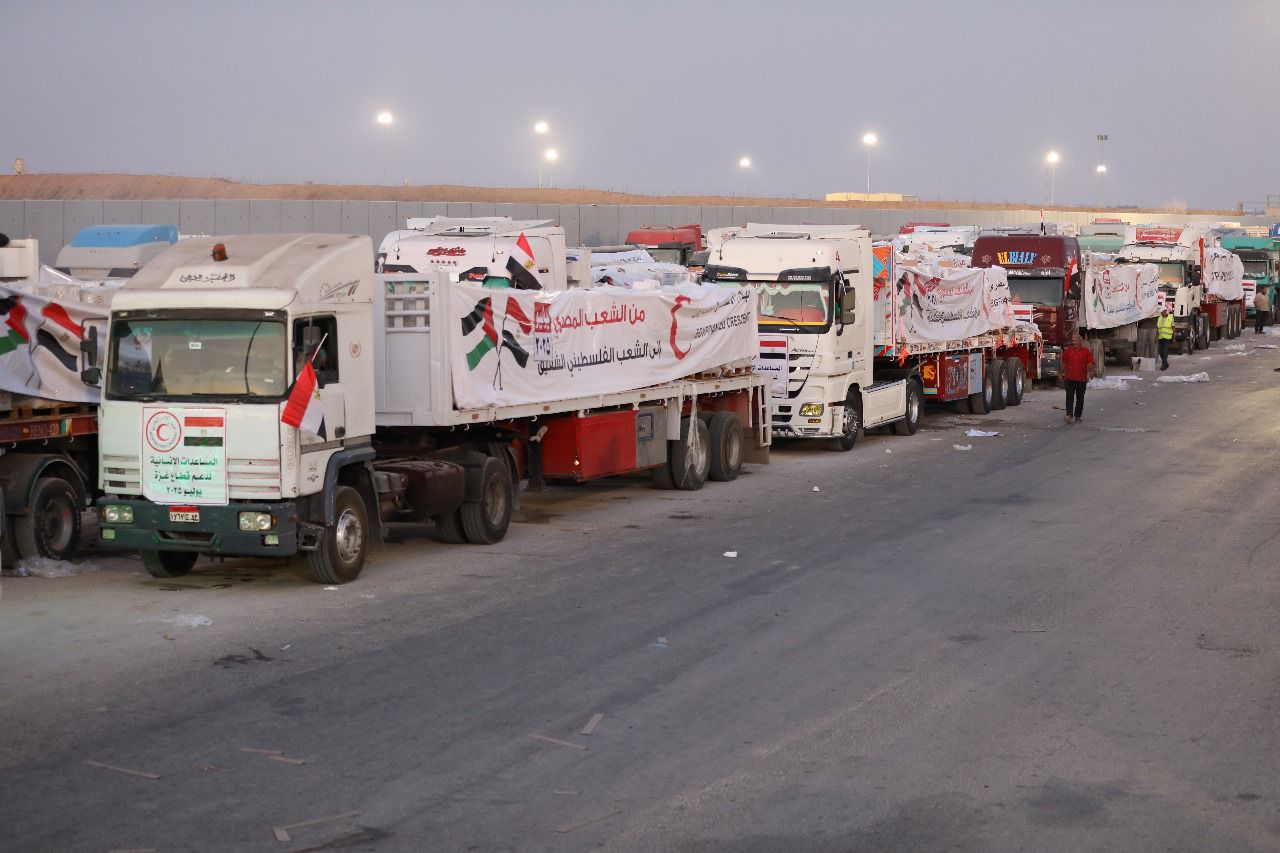
Just 150 aid trucks depart to Gaza from Egypt as Israel announces ‘tactical suspension of military activities’
The window for the small aid delivery from Egypt opened after Israel announced a limited pause to fi
Source: Al-Azhar grand imam withdrew call to save Gaza at foreign minister’s request
According to Al-Azhar, the decision to withdraw, which it called brave and responsible, came so the
Your support is the only way to ensure independent, progressive journalism survives.
You have a right to access accurate information, be stimulated by innovative and nuanced reporting, and be moved by compelling storytelling. Subscribe now to become part of the growing community of members who help us maintain our editorial independence.
Join us