
Death is the main headline for stories on Egyptian schools this week
Egyptians woke up to a series of headlines detailing violent deaths across the nation's schools this week, with one university student and two schoolchildren dead by Thursday.
On Monday, 19-year-old Yara Negm, a first-year engineering student at the German University in Cairo (GUC), died in the campus parking lot when a school bus backed up and pinned her against another bus. She bled to death before an ambulance arrived at the scene.
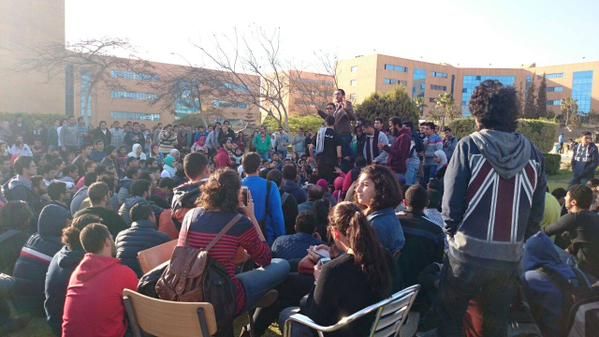
Since Tuesday, hundreds of GUC students have been sitting-in to protest what they call the GUC administration's negligence and impunity in the case. Student Michael Sherif told Mada Masr that the university ambulance arrived 15 minutes late, even though it was only meters away from the parking lot at the time of the incident. Students have accused the ambulance services of delaying treatment because they demanded proof that Negm was a GUC student before taking action. Sherif also claimed the medical team was unprepared for the severity of Negm's injuries, and the driver had no idea which hospital to take her to.
“We knew this was going to happen,” Sherif said. “Every day we pull one of our friends out of the way of a bus at the last minute." He explained that there isn't enough room in the parking lot for students to stand and wait for their rides, as “there are too many buses in the parking area.”
On Tuesday, protesting students blocked the buses from leaving campus. The administration ultimately responded by declaring a three-day mourning period in which all classes were suspended, and halted student activities for two weeks.
But students accuse the administration of making empty gestures to quell their anger without taking responsibility for Negm’s death.
A list of 10 demands was presented at the sit-in, including holding those responsible for student security accountable for Negm’s death, overhauling the campus parking lot, installing sensors in the buses and stationing ambulances around campus, the GUC student newspaper reported. The students also called for a number of new safety procedures, such as regular evacuation drills and establishing an emergency hotline.
Student unions and movements from several other universities have said they stand behind the GUC students, and some sent delegations to the demonstration in a show of support. The student union for private universities issued a statement condemning GUC for Negm’s death.
“Negligence has become a lifestyle for those responsible for managing the institutions of this country, and it has exceeded all limits. It is now reaching every one of us in the roads, work, home, and now on university campuses,” the statement said.
Members of the liberal Dostour Party’s student movement also issued a statement that declared, “We were taught that universities are places for learning to prepare us to become active citizens. But now, they are graves.”
This was not the first incident of its kind in recent history. In April 2013, Mansoura University professor Laila al-Zalabany fatally struck freshman early education student Gehad Moussa when she suddenly reversed her car. Furious students accused the university of negligence, and of attempting to hide evidence implicating the professor in Moussa's death. The victim's brother told local media that the administration pressured his family to drop charges in the case. A criminal court ultimately sentenced Zalabany to a year in prison and an LE5,000 fine.
At Misr International University (MIU), in late 2012 freshman pharmacy student Antoine Sameh was fatally hit by a speeding truck as he waited for a microbus on the busy Cairo-Ismailia road in front of the campus. MIU students launched furious protests after his death, saying that for the past two years they had asked the university to build a pedestrian bridge in the area to prevent recurring road accidents. The administration had said they were legally unable to do so, but finally constructed the bridge in 2014. It was named in Sameh's memory.
Negligence and violence have also run rampant in the country’s grade schools. Last week, a teacher beat a primary school student to death, while another was fatally electrocuted by a power box that had erroneously been left open in front of the school.
Islam Sherif, 11, died at his school in Cairo’s Sayeda Zeinab district after his teacher beat him on the head with a stick, leading to severe internal bleeding. The teacher was suspended by the Education Ministry and referred to the prosecution.
Ahmed Ismail, 9, was electrocuted when he went to play in front of an open electricity cabin as he waited for his school bus. Investigations showed that students were allowed to leave school one hour earlier than usual that day.
Hany Hilal, head of the Egyptian Coalition of Children’s Rights (ECCR), told Mada Masr that Egypt's rising rates of violence hit society’s most vulnerable groups the hardest, namely women and children.
Looking at cases of violations committed against schoolchildren over the last year, the ECCR found that 19 children died due to negligence or violence, 26 students were sexually harassed by teachers or other school staff, 36 students were injured by violent teachers, and 26 other children were injured due to unsafe transportation.
Hilal said that the ECCR has asked the government to implement provisions in the Child Law that enforce the protection of children. Article 4 of the law’s executive regulations grants all children the right to “have access to various preventive measures, as well as [protection] from all forms of violence; physical, moral, or sexual insults; negligence, or any other form of abuse or exploitation.”
“The media is always sending messages of hate and incitement. There is terrorism and bombing everywhere,” Hilal pointed out. “Vulnerable social groups like children are typically the first victims of escalating violence, and the state is not taking steps to end this. This is where the negligence begins.”

أخبار ذات صلة

Media businessman Mohamed al-Amin arrested for assault of minors at orphanage he funded
Amin was personally approached by the government to fund the care home in 2020

Lawyer: At least 2 dozen minors among those sentenced in military case last week
Approximately 26 of the 156 defendants sentenced to prison by a military court last week were minors

Innocence behind bars: The fate of Egypt’s minors at the mercy of criminal and military courts
Mada Masr looked into 35 cases of minors who have appeared before criminal and military courts

Sexual assault of 3-year-old exposes school, legal failures
The mother of a three-year-old boy raped by a 36-year-old security guard at a private school in Nasr City last month screamed for justice outside a police station after receiving…
Your support is the only way to ensure independent, progressive journalism survives.
You have a right to access accurate information, be stimulated by innovative and nuanced reporting, and be moved by compelling storytelling. Subscribe now to become part of the growing community of members who help us maintain our editorial independence.
Join us