
Al-Ahram apologizes in English for skewing NYT article, but takes it back in Arabic
The uneasy exchange between the state-owned daily newspaper Al-Ahram and the US-based paper the New York Times (NYT) continued into Friday, when Al-Ahram published one letter in its English edition apologizing for misquoting NYT correspondent David Kirkpatrick, but also published a counter statement in its Arabic edition attacking both Kirkpatrick and the publication.
The confusion began when Al-Ahram reported on a Kirkpatrick article published in the NYT on October 7.
Al-Ahram’s summary of the piece portrayed the American columnist as lavishly praising Egyptian President Abdel Fattah al-Sisi following his visit to New York to speak before the United Nations General Assembly (UNGA).
In reality, however, the article was actually questioning local media’s coverage of Sisi’s visit, which hailed “as a transformational moment, for the Egyptian president and even for the general assembly.”
Kirkpatrick went on to assert that Sisi had cemented his power and secured wide popularity without facing much dissent by capitalizing “on fears of the chaos that has engulfed surrounding countries.”
But Al-Ahram’s summary drew on specific passages from the Kirkpatrick piece, quoting them out of context to make it appear that Kirkpatrick himself was issuing the praise for Sisi, lauding the president for proving his worth and earning international respect for his UNGA speech.
There was immediate backlash on social media as readers realized that the Al-Ahram article misattributed several quotations from other media personalities to Kirkpatrick, and generally misrepresented the tone of his article. Responding to the outcry, on Friday Al-Ahram issued an apology on its English-language site, Ahram Online, claiming that its piece was drawn from Egypt’s flagship Middle East News Agency (MENA), which had originally distorted the NYT article, and other local papers ran the same story.
In the apology letter, Al-Ahram said it regretted the error, which occurred “at a time when the current editorial management of the newspaper and the organization as a whole is bent on restoring its credibility and asserting the traditions of proper and ethical journalism based on the highest standards of the profession.”
These efforts come amid “low ethical and professional standards” in Egyptian journalism, the editorial continued, “which makes reform an uphill battle.”
However, also on Friday, Al-Ahram published a separate statement in Arabic titled, “The hidden truth behind what Ahram and NYT published,” in which the newspaper defended its credibility and claimed it was targeted by the NYT and Kirkpatrick, who “rejects the political discourse since June 30 and vehemently defends the terrorist organization,” referring to the outlawed Muslim Brotherhood group.
The Arabic-language editorial accused Kirkpatrick of falsely propagating the idea that the Egyptian state was suppressing freedoms and violating human rights in order to cast doubt on the popular will to oust the former Brotherhood government.
While it briefly acknowledged that the review was taken from MENA and that it misquoted the NYT piece, Al-Ahram’s Arabic statement largely focused on defending its credibility and raising questions around the agendas at play in Kirkpatrick's writing and the NYT's coverage of the region in general.
“Regardless of the content of the foreign correspondent’s report, Al-Ahram reiterates the credibility of what it publishes or takes from other newspapers,” the statement read. “We assure the NYT correspondent that we don't need to forge what he writes, and that the political regime in Egypt trusts the people’s awareness and that it will not follow the NYT’s reports, which serve specific policies and positions that are not above suspicion.”
The Arabic statement also pointed out that while other Egyptian newspapers published a similar article — which the editorial claimed proves that it did not intentionally distort the NYT report — Kirkpatrick only focused on the state-owned newspaper, in an attempt to indicate it was acting on higher orders.
Kirkpatrick declined Mada Masr's request for a comment on the incident.
This is not the first time the state-owned newspaper has been accused of skewing a foreign article or photograph in an attempt to glorify or appease an Egyptian president.
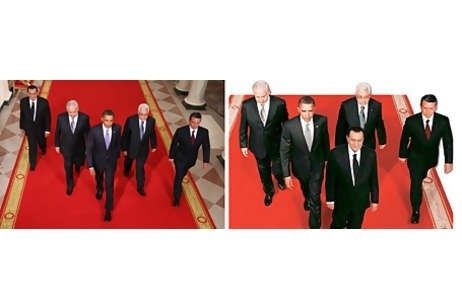
In 2010, Al-Ahram published a doctored photograph to put then-President Hosni Mubarak at the forefront of a delegation including US President Barak Obama, Israeli Prime Minister Benjamin Netanyahu, Palestinian President Mahmoud Abbas and Jordan's King Abdullah II at the Middle East peace talks in Washington.
Following backlash on social media, Al-Ahram said the altered “expressionist photo” was meant to show Mubarak's prominent role in the Palestinian issue and Egypt’s leading position in the peace process.

أخبار ذات صلة
Remembering Hani Shukrallah, the activist-journalist
Memories from four different generations touching on the life and work of Hani Shukrallah
State Information Service, Journalists Syndicate heads jockey for syndicate top job
Diaa Rashwan and Abdel Mohsen Salama compete for the post of Journalist Syndicate chair
Critics blast amendments to Journalists Syndicate law drafted behind closed doors
Proposed amendments to the law governing Egypt’s Journalists Syndicate have come under fire

Journalists Syndicate trial, Ahram Gate libel suit postponed
A Cairo misdemeanor court adjourned the trial of three leading members of the Journalist Syndicate who are accused of disseminating false information and…
Your support is the only way to ensure independent, progressive journalism survives.
You have a right to access accurate information, be stimulated by innovative and nuanced reporting, and be moved by compelling storytelling. Subscribe now to become part of the growing community of members who help us maintain our editorial independence.
Join us