
After arrest of Abdel Rahman al-Qaradawi in Lebanon, prosecutor awaits Cairo’s word on extradition
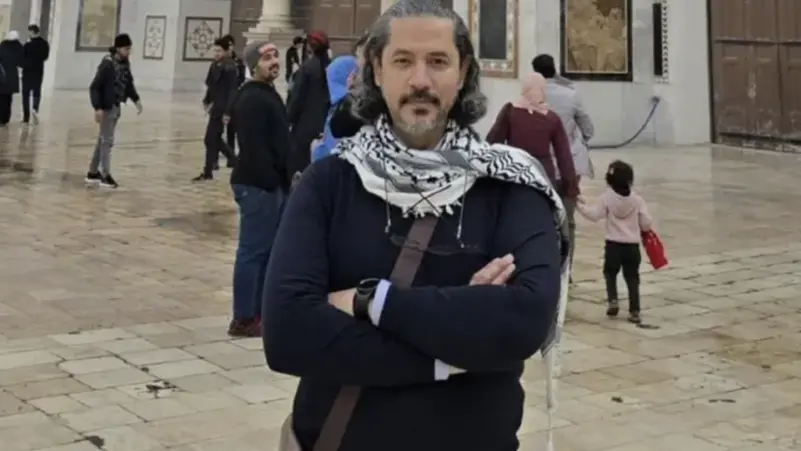
The Lebanese public prosecutor postponed on Tuesday a hearing that was due to look into the legal grounds for the Saturday arrest of poet Abdul Rahman Yusuf in Lebanon, his lawyer, Mohamed Sablouh, told Mada Masr.
Yusuf was stopped by Lebanese authorities on the basis of an Egyptian court ruling against him that dates back to 2016.
The poet, who is the son of the late Yusuf al-Qaradawi, former head of the International Union of Muslim Scholars, entered Lebanon on Saturday from Syria, where he had joined celebrations of the fall of the Assad regime and made remarks critical of the regimes in Egypt, the United Arab Emirates, and Saudi Arabia.
The arrest was made based on an Interpol notice issued by the Arab Interior Ministers Council based on the 2016 court ruling to imprison Yusuf for three years on charges of spreading false news, said Sablouh.
Lebanese Public Prosecutor Jamal al-Hajjar told the media in recent days that he would ask Egypt to send an extradition request for Yusuf, which he would review before making his decision. He also said he had received a telegram from the UAE government demanding Yusuf’s extradition to stand trial on charges of “inciting destabilization of security in the UAE.”
Yusuf posted a video on social media, later deleted, during his quick visit to Syria to participate in the celebrations of the fall of Bashar al-Assad’s regime. In the video, which showed him walking around inside the Umayyad Mosque square, Yusuf criticized the ruling regimes in Egypt, Saudi Arabia, and the UAE.
According to the lawyer, Yusuf was brought before the public prosecutor in Lebanon on Monday to give an initial statement.
He was asked about the ruling issued against him in Egypt and the accusation of publishing statements that would harm the reputation of the Egyptian state. He was also questioned about the UAE’s request to extradite him, which followed the video he posted from the Umayyad Mosque in Damascus.
Yusuf was due to appear before the prosecution again on Tuesday for a final decision, but the session was postponed, according to Sablouh, as an extradition request from Cairo is yet to be delivered.
According to Sablouh, the public prosecutor will submit his final decision as a recommendation to the Lebanese Cabinet, as the decision to extradite or not will ultimately be up to the Lebanese prime minister.
Yusuf's defense, meanwhile, will submit a legal memorandum arguing that he should not be extradited to Egypt for three reasons, the lawyer explained. First, Lebanon has signed the international conventions related to the principles of freedom of opinion and expression, and therefore “no crime has been committed that would be a reason for extradition,” Sablouh said. Second, Lebanon has also signed the UN Convention against Torture, which prohibits the extradition of anyone who may be subjected to torture, he noted.
“What is happening with Abdul Rahman is that he is from a family that opposes the Egyptian regime and has thus suffered harm from the Egyptian regime, whether his sister Ola, his brother-in-law, or his father, may God have mercy on him, who received a death sentence. Consequently, handing him over will make Lebanon liable because we risk exposing him to torture or death,” Sablouh said.
Third, Sablouh believes that the ruling issued in Egypt, related to a misdemeanor, should be dropped after a certain period of time, adding the defense team is also working on the necessary international procedures to consider the ruling as time-barred.
Misdemeanor rulings expire after five years, according to Egyptian law. But Yusuf had also received another three-year prison sentence from a Criminal Court on charges of “insulting the judiciary,” which was upheld by the Court of Cassation in 2018. Criminal Court rulings expire after 20 years. However, Yusuf was not confronted with the ruling during the investigations at all, according to Sablouh.
Sablouh, who visited Yusuf on Tuesday, said that a delegation from the Turkish embassy in Lebanon visited Yusuf in prison in the morning and that Turkish authorities are currently seeking to facilitate his travel to Turkey, as he holds citizenship there.
أخبار ذات صلة

Douma in new remand detention cycle as court rejects appeal
Prominent Egyptian activist and writer Ahmed Douma has entered a new cycle of remand detention, with a court rejecting an appeal against…

Court extends Activist Ahmed Douma’s remand detention
A Badr misdemeanor court extended on Thursday the detention of prominent Egyptian activist and writer Ahmed Douma for an additional 15 days…

Ahmed Douma arrested from home overnight
Police arrested activist and writer Ahmed Douma from his home in the early hours of this morning, lawyer Nabih al-Genady told Mada…

Activist Ahmed Douma banned from travel
Poet and political activist Ahmed Douma told Mada Masr that Cairo International Airport authorities prevented him early Sunday from traveling to Beirut…
Your support is the only way to ensure independent, progressive journalism survives.
You have a right to access accurate information, be stimulated by innovative and nuanced reporting, and be moved by compelling storytelling. Subscribe now to become part of the growing community of members who help us maintain our editorial independence.
Join us