
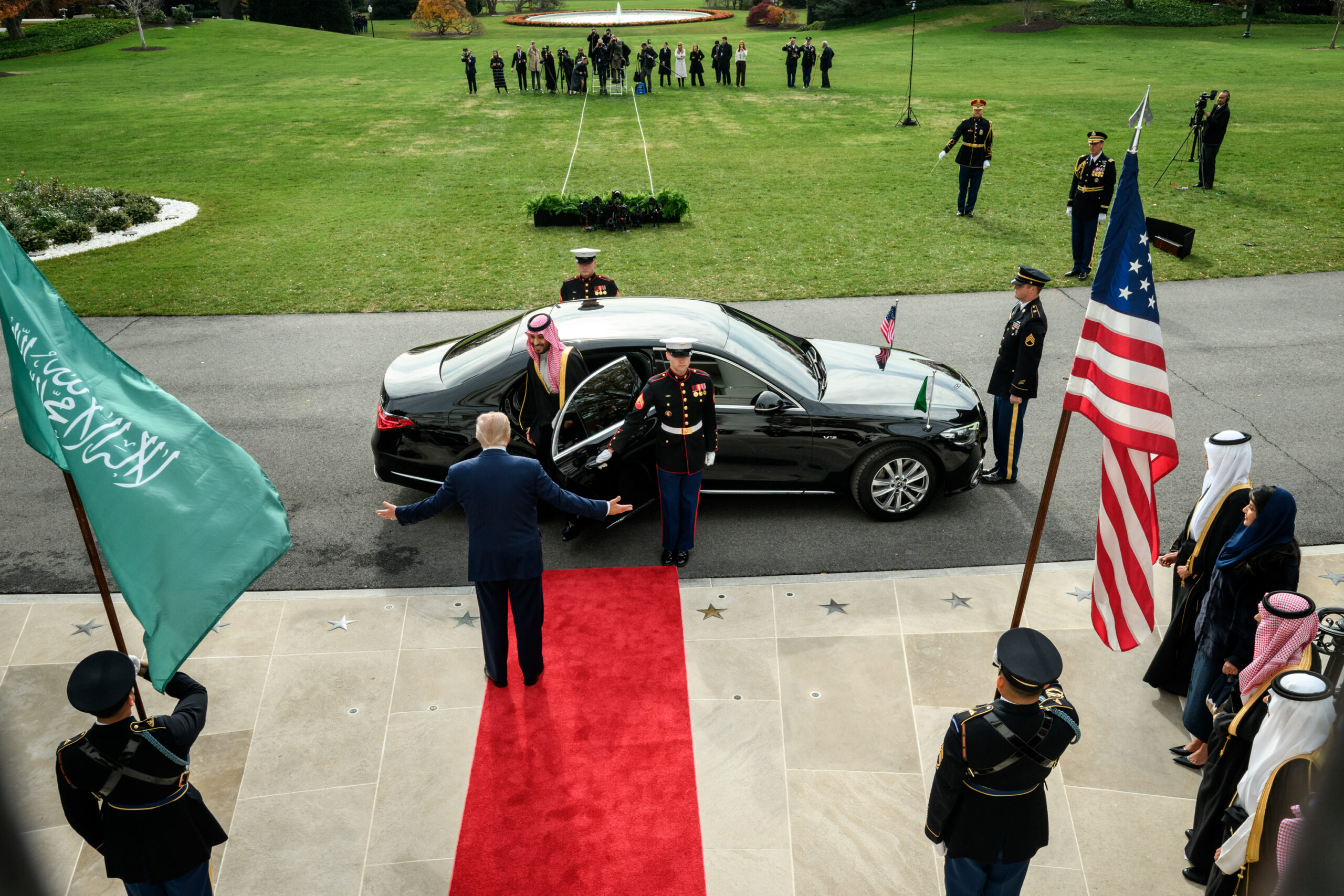
With region in turmoil, Trump meets MBS to hammer out transactional economic deals
When Saudi Crown Prince Mohamed bin Salman touched down in Washington DC today, war was still ongoing in Sudan. Palestinians in Gaza were still braving the winter weather in tent cities pitched amid the rubble of a two-year-long war. Israel was still occupying southern Lebanon and Syria.
Riyadh plays a significant diplomatic role in each of these contexts. But as bin Salman sits down with United States President Donald Trump for bilateral consultations before a black-tie White House dinner, the conversation will be mostly about economic dealings between the US and Saudi Arabia.
Today’s visit to the US is the first for the de facto Saudi ruler since US intelligence implicated him in the 2018 state-led murder of Jamal Khashoggi. In their sit down before the press, Trump quickly insisted the crown prince knew nothing about Khashoggi’s murder and moved on to the main reason for the meeting: how the two sides will make good on a Saudi commitment to invest in the US, which stood at US$6 billion coming into the meeting but in typical grandiose fashion ballooned up to nearly $1 trillion a few minutes into their talks.
Trump gave an indication of the transactional dynamic in a Monday evening press pool at the White House.
When asked if the US would be selling F-35 fighter jets to Saudi Arabia, Trump replied: “I am planning on doing that. They want to buy. They’ve been a great ally. They’ve got to like us very much. Look at the Iran situation, what we did in terms of obliterating — we obliterated their nuclear capability. Yeah, I will say that we will be doing that. We’ll be selling F-35s.”
“The kingdom is seeking to acquire approximately 48 F-35 fighter jets in a multi-billion dollar deal,” a Saudi diplomat tells Mada Masr. “Saudi Arabia has long expressed interest in the Lockheed Martin-produced fighter jet as part of its efforts to modernize its air force and counter regional threats."
The F-35 deal may be one of several defense agreements, the diplomat says, pointing to discussions held by Saudi Defense Minister Khalid bin Salman last week in Washington with American officials.
“bin Salman also seeks Trump's support for a peaceful Saudi nuclear program,” the Saudi source adds.
A regional diplomat who holds direct talks with Saudi officials agrees. “[This visit] is about MBS wanting to get Trump fully on board with the mega defense agreement and nuclear cooperation agreement. This is the core of the visit,” the diplomat says.
That isn’t to say that regional issues won’t show up on the agenda, the regional diplomat notes. However, at the level of big picture politics, Saudi Arabia and the US are mostly aligned, the source adds.
The regional component of the agenda is limited and it is mostly what Trump will ask, according to the regional diplomat. “Trump will ask him to finance the International Stabilization Force and the reconstruction in Gaza — and MBS will agree. He will ask him to put pressure on [Interim Syrian President Ahmed al-Sharaa], who is hesitant about the security deal with Israel. And he will agree. On Lebanon, they are on the same page of supporting a higher Sunni influence at the expense of Hezbollah. On Sudan, they are now on the same page on the need for a full and sustainable humanitarian ceasefire,” they add.
Securing United Nations approval for the International Stabilization Force — the international military coalition to be deployed in Gaza under the mandate of the Gaza International Transitional Authority headed by Trump himself — ahead of bin Salman’s visit was of paramount importance for Washington, according to the regional diplomat.
“The first thing that Trump will tell bin Salman when he sees his face is: the resolution is there, put the cash on the table,” the regional diplomat says. “Bin Salman already got what he wanted from Trump on Gaza, which is the ceasefire.”
This economic transactionalism is part of a new page in Saudi diplomatic policy, according to the Saudi diplomat, who says the days of traditional rhetoric governing Saudi foreign policy are gone. Saudi Arabia will not invest in any country because of “love of Arabism” or "because it's a Muslim country,” the source says.
The goal is regional stability, and if the region is stable, this will positively impact the interests of Saudi Arabia and the Gulf states, and extend to the world at large, the diplomat adds. “Saudi Arabia’s political stability makes it a key player in regional agreements, particularly in Syria. It will also play a major role in Lebanon through significant economic agreements and support for the Lebanese army. The Saudi role in Lebanon will be distinctive in the future, just as it is in Syria. When some ask why we are giving this support, it is because Saudi Arabia, like any other country, has economic interests in these countries and invests there as a form of business.”
Since the election of Trump to office, the US administration has taken advantage of the increasingly “liquid” state of the region created by former US President Joe Biden to advance a project for a “New Middle East,” one that downplays long held diplomatic tenets of “stability” in exchange for a web of economic relations built around Israel and US companies.
The US has seen Gulf states, particularly Saudi Arabia, as key partners in this mission.
Where Egypt was once the main interlocutor for advancing American interests in the region, that role has increasingly been eclipsed by Gulf countries, marking a pronounced change in regional balance of power.
A high-level Egyptian official previously told Mada Masr that alongside the normalization talks with Saudi Arabia that have proceeded behind closed doors in the last year, US and Israeli officials have made it clear that the Gulf will be receiving political, security and economic privileges “that may reduce those that Egypt enjoyed under [the Camp David Accords].”
And as the US has embarked on a new push for normalization deals with Israel, following the 2021 Abraham Accords, Riyadh has worked to ensure that it is in the driver’s seat, not Egypt or the UAE.
Saudi Arabia has become “Washington’s reconciliation Godfather,” a Syrian political source close to Hayat Tahrir al-Sham previously told Mada Masr. Keen to cement a lucrative defense agreement with the kingdom, long thought to be the carrot that would induce Saudi-Israeli normalization, the US was willing to accommodate what the regional diplomat says was Saudi’s desire to be seen “as the card holder of the Syrian situation in the region.”
Saudi Arabia has accordingly played an increasingly large role in Syria over recent months, which the Saudi diplomat explains in economic terms.
“Saudi Arabia's role in Syria began with former President Bashar al-Assad. It wasn't as extensive then as it is now, but after a long period of estrangement due to the regime’s crimes, an agreement was reached with Assad to turn a new page. There were plans to establish projects, and with his fall, Saudi Arabia has continued its plan with the new regime,” the Saudi diplomat says.
Noting that Saudi Arabia is supportive of Sharaa and his approach, the diplomat adds that, “Saudi Arabia is keen to invest in a large and geographically important country like Syria, and it has the right to defend its interests there.”
Nonetheless, Riyadh isn’t going to completely subordinate its own political demands to the joint US-Israeli vision for the region.
“The Saudi-Israeli normalization process will also be discussed, including the conditions the Saudi and American sides will request,” the Saudi diplomat says. “But there will be no Saudi-Israeli normalization unless there is a clear agreement respecting the kingdom’s historic commitment to securing an independent Palestinian state with East Jerusalem as its capital. The peace between Syria and Israel will not be achieved without Saudi approval.”
However, Israel continues to dig in its heels on both fronts.
When Sharaa visited New York for the UNGA summit earlier this year, the US, Israel and Syria held talks on a possible security agreement.
A Syrian diplomat and the regional diplomat told Mada Masr that a deal was beyond reach at the time given the hard line that Israel was driving, with both sources noting that Israel was demanding to have a “humanitarian corridor” to Suwayda.
“Israeli conditions have become so exaggerated, to the point that they are insulting and a threat to Sharaa himself,” the regional diplomat said at the time. “Their insistence to have a humanitarian corridor to create a geographic link between Israel through the Golan Heights to Suwayda is not something Sharaa could agree to at all. The Israeli insistence to have a say and restriction on the armament of the Syrian army is not something Sharaa could go with. If he were to agree, he would be eliminated by the radical elements of his constituency. And he said this outright to the Americans.”
Reuters reported earlier this month that Sharaa told the Americans there have been attempts on his life.
And on Sunday, just a day before the UN vote on the US resolution that legitimizes international governance of Gaza, Israeli Prime Minister Benjamin Netanyahu vowed to oppose any attempt to establish a Palestinian state.
Nonetheless, Israel’s lack of willingness to give into the Saudi insistence on a pro forma declaration on a Palestinian state isn’t stopping them from engaging with the US-Israeli plan for the strip.
“The Gaza Riviera project is underway,” the regional diplomat says, adding that the Saudis are considering investments in the project as much as the Emiratis and the Qataris are.
When asked about Riyadh’s role in Sudan, the Saudi diplomat pointed to a host of investments, aid and debt relief steps the Saudi Kingdom has taken since 2019.
Riyadh has become increasingly involved in Sudan’s politics as a member of the four-country Quad alongside Egypt, the UAE and the US.
At the beginning of November, Egypt and the US made a push for a three-month ceasefire to go into effect.
“Egypt is trying to work with the Saudis on a new push on a ceasefire. The initiative is about a humanitarian ceasefire. The cooperation with the Saudis is very helpful. We expect to see something after the bin Salman visit to DC,” an Egyptian official says.
And whether it is Sudan or the rest of the region, Saudi diplomats feel they have all the cards in their hands.
“As the strongest and largest Arab state currently, it is natural for Saudi Arabia to play this role and intervene,” the Saudi diplomat says. “If Saudi Arabia doesn't intervene, then who will?”
تقارير ذات صلة

The long and costly wait for a new personal status law
Bassant Soliman’s suicide triggered renewed public backlash against personal status laws in Egypt
We will sit together on Srifa hill, Qassem
Two friends try to reclaim a memory other than what the Israeli genocidal machine carved into them.

How Israel recognized Somaliland
Somaliland officials have pursued formal diplomatic recognition for over 30 years.
Your support is the only way to ensure independent, progressive journalism survives.
You have a right to access accurate information, be stimulated by innovative and nuanced reporting, and be moved by compelling storytelling. Subscribe now to become part of the growing community of members who help us maintain our editorial independence.
Join us