
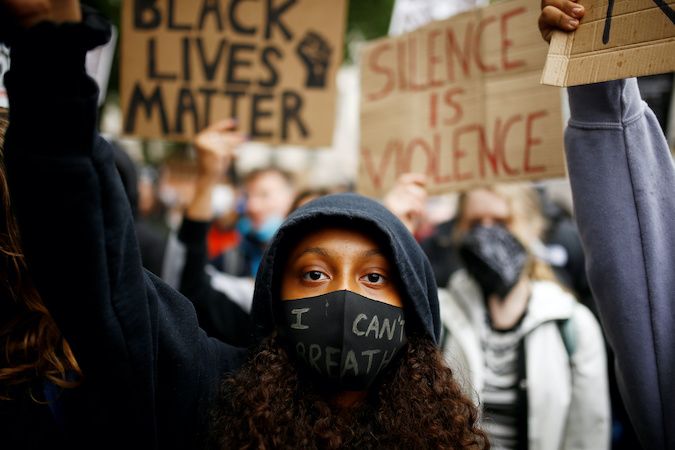
Why now: Jelani Cobb on the uprising in America
The massive anti-police brutality and anti-racism protests that erupted across America in the last two weeks have captivated the world’s attention and inspired solidarity protests in Paris, Berlin, Tunis and international attention. In Cairo, nearly a decade after the 2011 revolution, we are in the strange position of watching a superpower in revolt, with demands to defund and abolish the police — which seemed unimaginable just weeks ago — making concrete gains.
We spoke about these unprecedented and still-unfolding events with Jelani Cobb, who writes about race, politics and culture at The New Yorker magazine and teaches journalism at Columbia University. He is also a historian specializing in post-Civil War African American history and the Cold War. The interview has been lightly edited for clarity.
Mada Masr: Footage of George Floyd’s murder became part of what you described as a “burgeoning genre of videos capturing the deaths of black Americans.” The size and scope of the protests in response to his death far exceed anything we have seen over the past few decades in the United States. Why this? Why now?
Jelani Cobb: I don’t think the reaction to George Floyd’s death can be separated from the fact that there is also a pandemic and a recession, both of which have been incompetently handled by the Trump administration. People were already angry, already frustrated and then we saw a gruesome video of a handcuffed man who posed no threat being killed by police. You also can’t separate George Floyd’s death from the fact that Trump has repeatedly pushed for more aggressive, more violent forms of policing in this country. Finally, I think the manner of Mr. Floyd’s death was particularly shocking. In this country we’ve seen lots of videos of black people being killed by police, almost always by gunshot. The public, particularly the white public, could always say that those deaths were not acts of malice or perhaps they were some terrible mistake. But it took nearly nine minutes for Mr. Floyd to die. At any point, the police could’ve made a different choice, yet they didn’t. It took a particular degree of callousness and commitment to end his life and there are a lot of people in this country who had not ever countenanced that kind of brutality.
MM: Many police chiefs around the country, as well as the National Fraternal Order of Police, were quick to condemn Floyd’s killing and the police officers’ actions in a way that was unthinkable only a few years ago. What was different this time? And how does that contradict the violent police response to the protests?
JC: The opposition to the police who killed George Floyd from other police departments and even the major police union is highly atypical. When something like this happens their typical stance is to say “Let’s wait until all the facts come out,” or to outright defend those actions. I think it was impossible to come up with any credible reason why an officer should kneel on a handcuffed man’s neck for nine minutes. But the truer indicator of what these organizations think can be seen in their defense of outright brutality and violence against nonviolent protesters. In New York City, police drove two cars into a barricade where there were protesters; in Buffalo, New York they violently shoved a 75-year-old man to the ground, seriously injuring him. In both those cases the officers were supported by police organizations and police leadership. So their reaction to the Floyd video was an aberration. Their general stance is still to defend lots of other indefensible police actions.
MM: From the beginning of the protests, there have been stories of solidarity both in organized form — like the Minneapolis transport union’s refusal to transport detainees — and individual. Has the revitalized organization among progressives around various social justice causes primed it for this? Is there anything new or different in how the protests are being organized, or in how the media is covering them? What can you say about how this movement might spread, if at all, to other issues in addition to police brutality?
JC: I think there are progressives who have been primed for this moment by things like the grassroots organizing by groups like Black Lives Matter and Color of Change and Moms Rising in previous incidents like this one. There are lots of white people who were very engaged with the Bernie Sanders political campaign who I suspect are part of these protests in significant numbers as well. Trump and the reactionary wave he rode to power have shown progressives what exactly was at stake and it’s possible to see these protests as a kind of counterpoint to the right-wing demonstrations we saw in Charlottesville.
One of the starkest differences however is in how media are covering the story. With the exception of the more reactionary networks there has not been a both-sides approach to what happened. Part of that is because of the dynamic I mentioned earlier, the length of the video and how Mr. Floyd died. Another part is that a month before George Floyd died, a 25 year old named Ahmaud Arbery was shot while jogging in Georgia by two white men who thought he was a burglar. The video of his death is equally horrific. That same month, Breonna Taylor, a 26-year-old medical technician, was shot in her home during a police raid at the wrong address. It put networks in a position of not being able to deny that there was some thread connecting the people who are being killed in this way.
MM: A raft of police reform measures were put in place after the killings of Michael Brown and Eric Garner in 2014, with federal and local governments investing heavily in police training, including on racial bias, and in technology like body cameras. Did they make any difference? What are people calling for now?
JC: Police reform has a very checkered history in this country. There are a few successes, if you measure success by a decrease in complaints from community members about the kinds of behavior that is now at the center of the protests. But in other instances it doesn’t really achieve much. We don’t really know how effective the Obama-era reforms would’ve been because they came late in his presidential term and were promptly gutted as soon as Donald Trump took over. Trump and his attorney general Jeff Sessions pushed policing in the opposite direction. Body cameras have been a more complicated story because statistically they tend to lead to a decrease in police use of force but they also become another mechanism of government surveillance. One of the other issues with body cameras is that police unions have been successful in having state legislatures pass laws that would prevent the public from actually seeing the footage. Obviously, any effect body cameras would have on reducing police violence disappears if those police know that no one will ever see what they did.
MM: Your latest piece in The New Yorker is about how government failed to learn “even from the most recent past” in its response (or lack thereof) to George Floyd’s murder. What could they have done differently? And what can government do now? What are the ways out or forward from this confrontation and immediate anger?
JC: Police reform is not a magic pill to cure this problem but the Trump administration moved away from even the most basic things it could do. By law the federal Department of Justice has the power to conduct oversight over any police department that is found to be chronically troubled. The program relied upon “consent decrees” or legal agreements that spelled out exactly what reforms the department had to complete in order to get out of federal oversight. Minneapolis was a prime example of a department that should’ve been under federal oversight. They killed unarmed citizens in high-profile incidents in 2015 and 2018. A third incident, the killing of Philando Castile in 2017, happened about ten minutes outside Minneapolis. Mr. Castile was legally authorized to carry a firearm but was shot by a cop anyway. Absent any kind of outside push for reform, a situation like the one we saw with Mr. Floyd was all but inevitable.
MM Millions of people around the world are watching the state use violence against American citizens en masse, on their TVs, laptops and phones. These images carry echoes of the revolutionary protests of the last decade; we are used to associating them with the end of a government’s legitimacy. What revolutionary potential do you see here? What are the non-electoral victories that might be possible?
JC: I’ve been thinking a lot about this. Consider how the United States media would cover this story were it happening in Africa or Latin America. They would give lots of context about government corruption and the long path of brutality that had led to this moment. Depending upon its geopolitical interests the State Department would lend covert support to the protesters and the president would make some boilerplate statement about encouraging all governments to adhere to the standards of the Universal Declaration of Human Rights. But all of those things can be said of the United States itself. The fact is that the grievances we’ve seen in other places are not entirely different from those that many, especially black and brown people, have in the United States. That’s one of the important aspects of the Civil Rights Movement in the 1950s and 60s. It was a moment where people in the U.S. were able to find solidarity with things like anti-colonial movements abroad because they recognized the common themes. That’s something we’ve gotten away from in subsequent years.
I think there is a great deal of potential to sweep away systems that we’ve never had the momentum to impact before. There is an actual movement to abolish policing, that is to say radically change the way in which law is enforced in the United States. Most of us never thought we’d see that in our lifetimes.
MM: You’ve written about white supremacy as a transnational movement, within which the election of Trump held huge significance. Black liberation movements have a long history of internationalism, allying with causes like the freedom movements in Palestine and Algeria. What are your thoughts on what people outside the U.S. can do for the anti-police brutality cause in America today?
JC: One of the key things about the United States is that, as a world power that thinks of itself as exceptional, it is also highly susceptible to public embarrassment. International protests pointing to the failings of this country were invaluable assets during the civil rights and Black Power movements. People who are in the streets protesting U.S. policies against its own citizens are every bit as influential as the people who are in the streets in the United States.
Mada Masr’s suggested listening on this story: the June 8 DemocracyNow! show on police abolition, and this episode of NPR’s Code Switch, titled A Decade of Watching Black People Die.

تقارير ذات صلة

The khot of Upper Egypt
Mohamed Mahsoub clashed with police, decrying injustice in Upper Egypt before being killed.
Journalist Solafa Magdy accuses police officers, personnel of assault, harassment, Interior Ministry denies
Magdy was arrested alongside her husband on November 26, 2019
Police assault on lawyers sparks 4-day general assembly at Marsa Matrouh syndicate branch
According to Attiya, the Matrouh Police Station chief has a history of infractions against lawyers.
Your support is the only way to ensure independent, progressive journalism survives.
You have a right to access accurate information, be stimulated by innovative and nuanced reporting, and be moved by compelling storytelling. Subscribe now to become part of the growing community of members who help us maintain our editorial independence.
Join us