
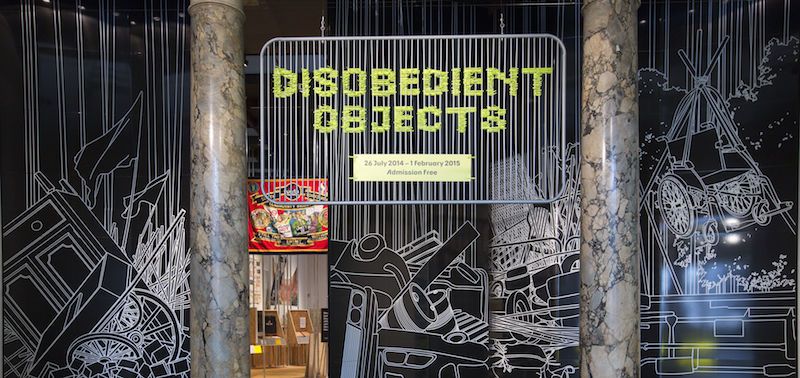
Too smooth: A show about objects of resistance
There is one exhibit in London which gives me near-religious feelings.
In the Museum of London, a display shows large photos of suffragettes in the process of being arrested, and mugshots taken afterwards. The women look disheveled, angry, stubborn, difficult. In their faces — and the self-righteous demeanor of the policemen arresting them — we see what a powerful work of taboo-breaking they had to undertake, and how much their disorder, aggression and sometimes violence shattered all manner of social contracts.
I am, by and large, someone who avoids apparent lunatics in the street, and sides with the quietly disapproving mass. But I know it is thanks to these mad-seeming women that I have the vote, and am now treated by the state as a human being and not something between a servant and a piece of property to be traded. So I come close to worshipping these women, and their courage to rip apart the social fabric on simultaneous aesthetic and political levels. These are no elegant Edwardian ladies, and that's the point.
This aesthetic taboo-breaking is at the core of a new exhibition at London’s Victoria & Albert Museum, Disobedient Objects, which brings together a series of things, from home-made placards to giant inflatable paving stones, made and used in protest: objects used to concentrate messages and remake public spaces to the will of angry people seeking change.
Improvised gas masks from Turkey's Gezi Park are here, made from remastered water bottles; so are misshapen saucepan lids banged to create deafening noise against government policies and corruption in Argentina. In a corner we have stencils used by Syrians who crept out in the dark of night to make quickfire graffiti against the government, at risk of their own lives.
Just across from those we find suffragette teacups, with green logos of winged women, used to normalize women's liberation by bringing it back into the home. The re-making of the domestic is a characteristic of women's protest: A heartbreaking, beautifully stitched handkerchief, made by his mother, expresses love for Roy Rivera Hidalgo, “disappeared” in 2011 aged 18 in a police raid during Mexico's drug wars. Hidalgo is one of 26,000 to have gone missing; his mother paid a ransom to a drug cartel, but he has still not returned. By sewing designs of broken hearts and messages of love on handkerchiefs displayed in public, their mothers refuse to let the “disappeared” vanish. Elsewhere, Chilean women's patchworks, or “arpilleras,” reproduce the horrors of that country's dictatorship; explosions and people dropped from planes are eerily reproduced in fabric.
 Chilean Arpilleras wall hanging: Dónde están nuestros hijos, Chile Roberta Bacic's collection. Photo © Martin Melaugh
Taken together, these objects start to form a sort of iconography of protest; as protest movements have their martyrs and heroes, they also have their relics and their holy images. It is hard not to feel a kind of devotion when looking at many of these, and by putting the once-despised under a spotlight in a grand hall, the V&A creates something with echoes of a temple.
But there are also more overtly aesthetic projects: banners of the Guerrilla Girls, US-based women artists fighting sexism and racism in art, show naked women in roaring gorilla masks lounging in the pose of the oil-painting nude against a bright yellow background as they hold mock penises. Perhaps the most startling object in the show is the “Tiki love truck” created by British artist Carrie Reichhardt in memory of a US man executed for murder, John Joe “Ash” Amador. The bright orange pickup truck, or “mobile mosaic mausoleum,” has a death mask of Amador as its centerpiece; it is decorated with tiles, mottos and ceramic lobsters with babies' heads. This is far from the messy realities of street protest, but it is as memorable a demonstration against the death penalty as you are likely to see.

For a one-room show, Disobedient Objects is disproportionately absorbing; 90 minutes in, I was still discovering new things: a triangle logo used by gay men in the 1980s to protest for treatments for AIDS; a Myanmar banknote into which the designer covertly replaced the image of General Aung San with a modified portrait of the general’s anti-government daughter, Aung San Suu Kyi, at massive personal risk. The exhibition takes us back to the specificity of protest, bringing out the particular and the detailed in a way that news reports saying “Tens of thousands of people took to the streets of the capital city today...” can often miss. While protest is a global phenomenon, particular protests are unique to themselves; this is important, particularly when some protesters are in immediate fear for their lives and others are kicking giant, silver inflatable paving stones around the streets of Barcelona.
Yet this show also skirts around many of the differences and the rough edges of the modern phenomenon of protest. The selections and captions create a strangely simplified world in which the protester is always right, usually demonstrating against some form of “neoliberal” authority, and always peaceful.
So the issue of violence in protest is slid over in preference to opening up the question of whether and when it might be justified. Many of the protests whose artefacts are exhibited here — including the British ones, like the 1980s strikes by miners and printers — had violent elements. But the one explicit nod to violent protest in the room is a slingshot made from a child’s shoe by a Palestinian protester to throw stones at Israeli soldiers. “Peaceful disobedience only works when protesters have cultural visibility and the government acknowledges their right to protest,” a caption informs us, adding that where this is not the case protesters “sometimes resort to other means”. It is unlikely that the audience will not know this; better perhaps to invite us to think about whether and why we support it. Another caption refers to Mexico’s Zapastistas as “nonviolent” — certainly not the case throughout their history, though again, there is plenty more to say about their change in tactics.
There is similar muddle around the question of capitalism — big question though it is. On a video screen, a journalist speaks of the “joy of resistance” in which “capitalist relationships are suspended”: undoubtedly true of some of these protesters, even if “neoliberal” is too broad a catch-all to encompass the many causes they are fighting for and against. But 1980s Polish and Chinese protesters, also celebrated here, were taking to the streets against communism, not capitalism; their ideals were deeply at odds with those of the Occupy movement, for example.

The show also elides the question of protests which we, the assumed audience, might disagree. What about Westboro Baptist Church or anti-abortionists picketing clinics? And there's no mention here of demonstrations by Islamists, despite their size and their importance to the politics of countries from Europe to Asia. Egyptian protests sympathetic to the Muslim Brotherhood and its ousted President Mohamed Morsi created protest camps and an iconography to rival any shown here, but their four-fingered Rabea symbol doesn't feature. Human Rights Watch this month labeled the Rabea massacre, in which more than 800 people were killed by government forces, “Egypt's Tiananmen.” But we, the exhibition-goers of the V&A, will never allow it to have the same iconic force in our world as the Chinese massacre, because while the Rabea crowds were protesting the ousting of an elected president, they were also supporting a party which favored conservative elements of religious law. They had many of the same features as “our” martyrs, but get none of their acclaim.
You can't fit all of these questions surrounding protest into one room, and this show fits a great deal in, for all that. But it also leaves the impression of an exhibition that smooths over some of the most interesting questions it raises, and could benefit from breaking a few of its own taboos.
Disobedient Objects is on show at the V&A until February 1, 2015
تقارير ذات صلة
A visitor’s guide to Cairo Design Week after John Berger
For its third and largest edition, the self-proclaimed fastest-growing design week in the region set out to transform Cairo into an “open-air design playground.” Its ambition took physical form: oversized…
One man’s currency design challenge raises questions about a sensitive topic
“Banknotes are the direct communication means between citizens in everyday life.”
The 2016 Dubai Design Week: High hopes for sustainable design in the region
Designers utilize old skills and local materials to make new products at Dubai Design Week.
Your support is the only way to ensure independent, progressive journalism survives.
You have a right to access accurate information, be stimulated by innovative and nuanced reporting, and be moved by compelling storytelling. Subscribe now to become part of the growing community of members who help us maintain our editorial independence.
Join us