
The politics of rebellion
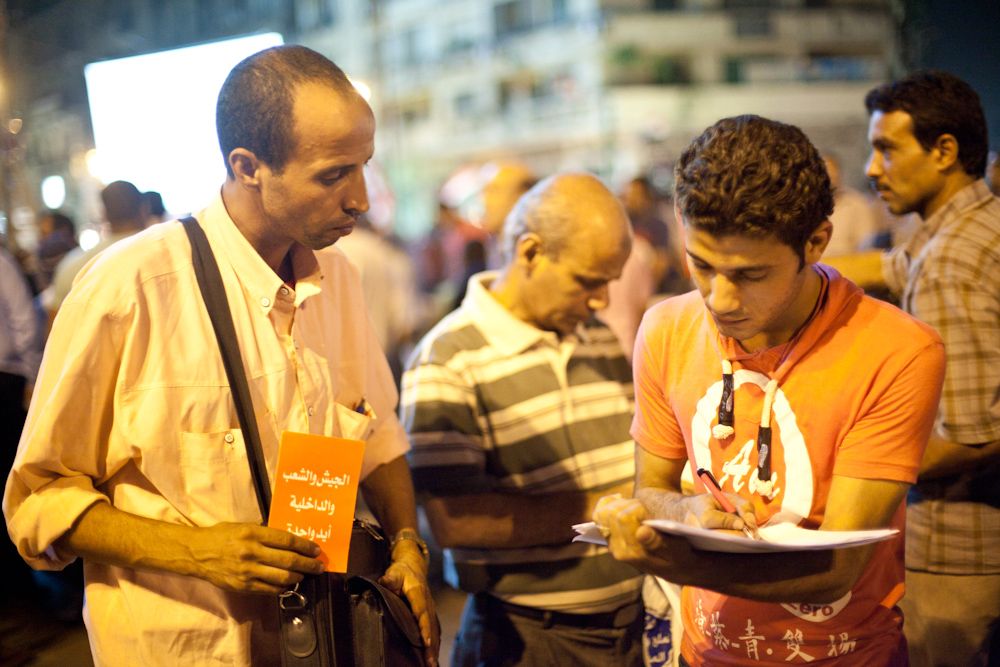
A 40-year-old woman walks into Al-Shohadaa metro station in the heart of Cairo, lugging a heavy pack of documents bearing the Tamarod (Rebel) campaign logo.
As she enters the crowded metro station, Hoda Abdel-Al asks the passengers to sign the petitions to withdraw confidence from Brotherhood-affiliated President Mohamed Morsi. Last week, the campaign declared that it had already collected 15 million signatures against the first democratically-elected president.
While collecting signatures, sometimes she enthusiastically engages in conversations with those who sign the petitions; at other times, she argues harshly with Morsi’s supporters. But as she moves from one metro station to another, Abdel-Al seems tireless as she wipes the drops of sweat soaking her veil.
"I'm just an Egyptian citizen who wants a better life for her country," Abdel-Al says, adding that she does not belong to any political party or organization.
Abdel-Al complains that she was subject to the biggest deception of her life when she elected Muslim Brotherhood candidates in the parliamentary elections, and Morsi in the presidential polls.
"I have elected the Brotherhood in all elections. I was always sympathetic to them due to the discrimination against them during [former President Hosni] Mubarak's regime. Once they were in power, I discovered that they are not different from Mubarak," she explains.
Abdel-Al, a mother of four and a housewife, says that the first thing that she liked about the Tamarod campaign was its independence from other political parties and groups.
"They are all the same, all that they seek is power. They are not different from the Brotherhood," she says, running to catch the metro to go to a new station.
One of the things that Abdel-Al says she personally experienced through her interaction with those signing these petitions is that they trusted the campaign because it was not associated with any political party.
She volunteered to join the campaign weeks ago out of mere enthusiasm, and used to print the petitions with her own money. Sometimes her relatives and family members would donate money to fund her photocopies.
Throughout her work, she discovered that many non-politicized campaign members joined forces in a completely decentralized way, without any direct connection to the original campaign organizers.
Many see the success of the Tamarod campaign as a reflection of the failure of party politics to engage with the masses after two years of revolution, and an effort to find novel ways of challenging the Muslim Brotherhood’s authority.
For those in party politics, this goes back to the control of the former Mubarak regime over political life, which characterized the opposition as so-called “cartoon” parties, laughable for their inability to challenge the authorities. But the weakness of party politics also goes back to the 1952 military coup, which instituted a one-party state.
"The politics of dictatorships controlling party life have left political parties with a bad legacy," says General Coordinator of the Egyptian Social Democratic Party Ahmed Fawzy.
He believes that these problems should not be seen as a failure of party politics, but rather as a problem that will be solved as soon as a functioning democracy is established.
But activist Ahmed Imam disagrees with Fawzy. He thinks Tamarod's success is a direct result of the failure of party politics — a paradox, given his membership in the political bureau of the Strong Egypt Party.
"I also believe that the hijacking of the Tamarod campaign by political parties may make people lose trust in it," says Imam, whose party declared that it doesn’t officially endorse the campaign in order to help maintain its grassroots identity.
Imam believes that political parties failed completely to absorb the mass movements in the streets and translate them into viable political programs and solutions.
"Political parties were too involved in screaming and protesting in the streets without trying to organize and build real connections with the non-politicized masses," he says.
Some think that disenchantment with Brotherhood rule and the opposition’s inability to formulate adequate solutions has encouraged the people to walk away from party politics.
But for Fawzy, parties should be able to capitalize on and support the work of Tamarod by connecting to it.
"Our party managed to collect half a million signatures for Tamarod, and other parties collected similar numbers. Connecting with popular movements in the street is important and beneficial. But we are totally against hijacking the campaign by political parties," he assures.
Fawzy also explains that the experience of party politics in Egypt will take time to become more mature as the democratic transition progresses.
"If we compared the numbers of those registered in political parties today to those registered two years ago, we can see a huge difference. Change will take time. You cannot ask a patient who is just out of intensive care to run in a marathon," he says.

Mai Shams El-Din
Mai graduated from the American University in Cairo with a degree in journalism. She worked mostly for local English-language news outlets but has also been writing in Arabic, particularly when…
تقارير ذات صلة
Iranian protester: Young generation does not have our fears, tomorrow will be shaped by their courage
"We must be unpredictable and conquer public spaces"

How Egyptian diplomacy navigated the summer of 2013
How Egypt’s foreign policy sailed through the difficult events of the summer of 2013
Stuck between two revolutions
In early June, when I was writing an article about Tamarod (or “Rebel,” a grassroots initiative that campaigned for former President Mohamed Morsi’s ouster), I found that it wasn’t the…
Your support is the only way to ensure independent, progressive journalism survives.
You have a right to access accurate information, be stimulated by innovative and nuanced reporting, and be moved by compelling storytelling. Subscribe now to become part of the growing community of members who help us maintain our editorial independence.
Join us