
The legal responsibilities of occupation: Unpacking the World Court opinion on Israel’s aid obstruction
In an advisory opinion issued Wednesday, the International Court of Justice found that Israel’s hindrance of the work of United Nations agencies and other international organizations in the Occupied Palestinian Territory was a breach of its legal obligations to Palestinians.
It also found that Israel’s denial of humanitarian access to UN agencies and relief organizations contributed to the use of starvation as a weapon of war and to forced displacement.
The advisory opinion was mobilized by a request in December from the UN General Assembly, which asked the ICJ to clarify Israel’s responsibilities toward the UN and its agencies in relation to the Occupied Palestinian Territory after Israel passed a law banning cooperation with the UN Relief and Works Agency for Palestine Refugees in the Near East (UNRWA).
It also said that Israel should ensure that Palestinians in the occupied territories have access to essential supplies for daily life, facilitate relief schemes and respect and protect relief and medical personnel and facilities.
The court also found Israel's justification and evidence for refusing to cooperate with UNRWA invalid, finding no evidence of the agency’s alleged ties to Palestinian militancy — as per Israeli officials’ claims.
We sat down with Abdel Ghany Sayed, scholar and lecturer of international law and former member of the International Criminal Court’s Office of the Prosecutor, to unpack the advisory opinion, examining its implications, limitations, and potential effectiveness in addressing Israel’s abuses in Palestine — especially as both Israel and the United States have already publicly rejected it.
The interview has been lightly edited for clarity.
Mada Masr: Can you give us an overview of the court’s advisory opinion?
Abdel Ghany Sayed: A positive aspect is that the court not only highlighted Israel’s obligations in abstract — that would’ve been disappointing — but it also outlined concrete steps that Israel is obliged to take.
These include stopping starvation, forced displacement and deportation, ending the obstruction of the work of UN agencies, restoring UNRWA access, allowing the International Committee of the Red Cross to visit detained Palestinians and respecting UN immunities.
However, the court did not outline Israel’s secondary obligations to make reparations for its unlawful conduct.
MM: The court laid out Israel’s obligations toward UN agencies and relief organizations, and the implications of hindering their work in the context of the crimes of starvation and displacement, the much feared ultimate goals of this war. Can you talk us through how it reached its opinions?
AS: The court treated the obstruction of UN relief as constitutive of the crimes of starvation and displacement, and it unanimously observed that the latter crimes have been committed and must be stopped. We can hence comfortably say that the ICJ finds Israel to be using starvation as a method of war.
The court also observed that Israel should not restrict the presence and activities of UN agencies and other international organisations to a degree “that creates, or contributes to, conditions of life that would force the population to leave.”
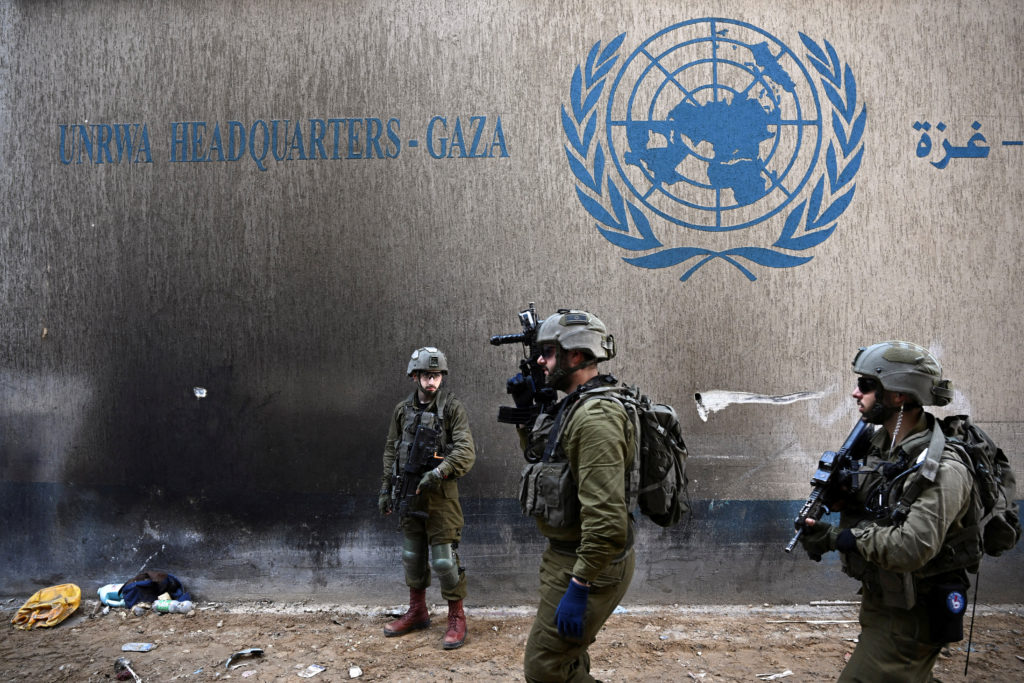
Israel passed a law in October 2024 prohibiting UNRWA from operating within its own territories and Israeli organizations from cooperating with UNRWA, alleging the agency had ties to “terrorist” groups.
In its ruling, the court considered Israel’s allegations of partiality against UNRWA invalid and the steps it took to disable its work unjustified.
The court stated that UNRWA is both neutral and indispensable, stating that there is no evidence that it “breached the principle of impartiality” as Israel has not substantiated its claims that a significant number of UNRWA staff are members of Hamas, and that it remained “the principal means and the backbone of all humanitarian response in the Gaza Strip, serving Palestinian refugees and civilians in urgent need of life-saving humanitarian assistance.”
The court hence noted that UNRWA is integrated into Palestinian society, plays a central role and cannot be replaced on short notice.
The court also clarified that the characterization of a UN agency as impartial cannot be a unilateral act; it must follow an objective process initiated by the UN.
Aside from hindering the work of UNRWA, the court also noted that Israel blocked the delivery of humanitarian aid starting March 2025, and facilitated the work of the Gaza Humanitarian Foundation, which was described by the court as “a purported replacement for UNRWA, [that] has been widely criticized by the United Nations and other international actors, and its operations have been alleged to be inconsistent with core humanitarian principles.” Citing UN agencies, the opinion stated that over 2,100 Palestinians have been killed at or near GHF distribution sites since that system began operating on May 27, 2025.
The court made it clear that security concerns are not a legal justification to block humanitarian aid, stating that while some provisions of the Fourth Geneva Convention and other rules of international law allow an occupying power to consider issues of security or military necessity, the protection of security interests does not constitute an exemption to Israel’s obligations as an occupying power to ensure Palestinians have access to the basic necessities of life.
MM: An important starting point is that the court assesses Israel’s obligations both as an occupying power and a UN member. Can we break this down?
AS: The court looks at Israel’s responsibilities under international rules that apply when one state occupies and effectively controls another territory. Even though Israel withdrew its troops and settlers from Gaza in 2005, the court noted that Israel still controlled Gaza’s borders, airspace, and sea access, as well as key services and movement. Because of that, Israel remained bound by the laws of occupation. Thus, Israel remained an “occupying power,” and Gaza remained an “occupied territory,” under international law.
Moreover, the court found that since October 2023, Israel’s control over the Gaza Strip has increased significantly, as evidenced by Israel’s increased military control over large portions of the territory and its obstruction of all humanitarian aid entering the strip.
The court therefore found that Israel’s obligations under the law of occupation also increased significantly, commensurate with the increase in its effective control over the territory.
The law of occupation, part of international humanitarian law, requires the occupying power to care for the population’s basic needs — food, medicine and humanitarian aid — and to allow relief supplies to reach people without obstruction. Israel must not block or delay aid, except briefly and for genuine security reasons.
The court found that Gaza’s population has not been adequately supplied, meaning Israel has not met these obligations.
As a member of the United Nations, Israel must cooperate with the UN and other countries to promote peace and human rights. It is also required to respect the UN’s independence and the safety of its staff and facilities. In occupied areas, Israel cannot claim sovereignty to restrict the UN’s work. This means it must allow UN agencies — like UNRWA — to operate freely and must not target or interfere with their schools, hospitals, or shelters. Only the UN itself can decide if one of its facilities loses that protected status. By limiting UN access and refusing to cooperate on some issues, the court found that Israel has not lived up to its responsibilities as a UN member.
MM: The court’s demand that Israel uphold its obligation to cooperate and respect UN agencies and other relief organizations’ work is based on Israel’s obligations as an occupying power with no sovereignty over the Occupied Palestinian Territories. Can you explain this point?
AS: Israel’s occupation does not confer it sovereignty over the areas it occupies, and hence it cannot deny UN access to them. The court’s ruling read: "In the occupied territory, over which Israel, as an occupying power, enjoys no sovereignty, it is not entitled to decide unilaterally, with respect to the presence and activities of the United Nations in and in relation to the Occupied Palestinian Territory, in the same way as in its own territory."
Hence, as an occupying power, Israel cannot extend its laws to impede Palestinian self-determination and it must fulfil the following obligations:
- Ensuring the population is supplied with the essentials of daily life
- Agree to and facilitate relief schemes so long as the population is inadequately supplied
- Facilitate medical personnel access
- Stop forced displacement and deportation
- Stop the use of starvation as a method of warfare
Israel is therefore under a positive obligation to ensure the population is supplied with the essentials of daily life as best as possible.
There is also the negative obligation to not impede relief.
Israel’s obligations to allow relief, including through UNRWA, also extend to the West Bank and Jerusalem. The court also noted that Israel's annexation of Jerusalem continues to be in violation of its obligations toward the UN as well as to the Palestinian people. The opinion read, "Israel continues to exercise sovereign power in East Jerusalem. Moreover, these laws have directly resulted in obstructions to the operations of UNRWA in and in relation to the Occupied Palestinian Territory." The court also recalled that “Israel’s territorial claim over East Jerusalem has long been declared ‘null and void.’”
MM: How can the court’s advisory opinion be put to use?
AS: The most dramatic consequence is that this advisory opinion could be used to strengthen existing diplomatic efforts and a campaign by Palestinian civil society and collectives of international lawyers to suspend Israel’s UN membership.
Also in her most recent report, “Gaza genocide: A collective crime,” UN Special Rapporteur on the Occupied Palestinian Territories Francesca Albanese recommended that states “suspend Israel from the United Nations under Article 6 of the UN Charter.”
Otherwise, the opinion creates binding international law.
It is true that Israel’s and the US’s propaganda machines (as well as apartheid South Africa’s for that matter) have for decades sought to dismiss ICJ advisory opinions as “non-binding.”
However, advisory opinions like the ICJ’s declare what international law is. They’re authoritative and binding in substance. When lawyers call them “non-binding,” we mean they create new obligations for states which are due to the court itself. Unlike judgments in contentious cases, they clarify existing law without attaching an enforcement order, such as reparations.
The legal determinations the court made are important and binding. In this regard, the court’s findings in relation to Israel’s obstruction of UN agencies, use of starvation as a method of war, and forced displacement and deportation of Palestinians will be used before the International Criminal Court — such as in the pending cases against Israeli Prime Minister Benjamin Netanyahu and former Defense Minister Yoav Gallant — as well as any future cases before national courts.
Another potential consequence is that the UNGA may find sufficient momentum and legitimacy as a result of the advisory opinion to act under the exceptional Uniting for Peace framework to impose collective measures (e.g., economic sanctions) against Israel for its violation of the privileges and immunities of the UN and its personnel.
When the Security Council is blocked by a veto member — as it frequently has been over the past two years in repeated votes on ceasefire resolutions — a resolution under the Uniting for Peace framework allows the UNGA to enforce, through its members, collective measures.

تقارير ذات صلة

Gaza’s phase two arrives. Kind of …
Consensus over key questions lags behind the United States' announcement of progress.

Gaza’s child amputees

Israel finally approves Egypt’s gas deal after nail-biting battle
In an unexpected move, Israeli Prime Minister Benjamin Netanyahu announced on Wednesday Israel’s final approval of a controversial gas export deal with Egypt, months after Israeli hesitation following the initial…
Your support is the only way to ensure independent, progressive journalism survives.
You have a right to access accurate information, be stimulated by innovative and nuanced reporting, and be moved by compelling storytelling. Subscribe now to become part of the growing community of members who help us maintain our editorial independence.
Join us