
The First Congress of Arab Music and Alois Hába’s microtonal school
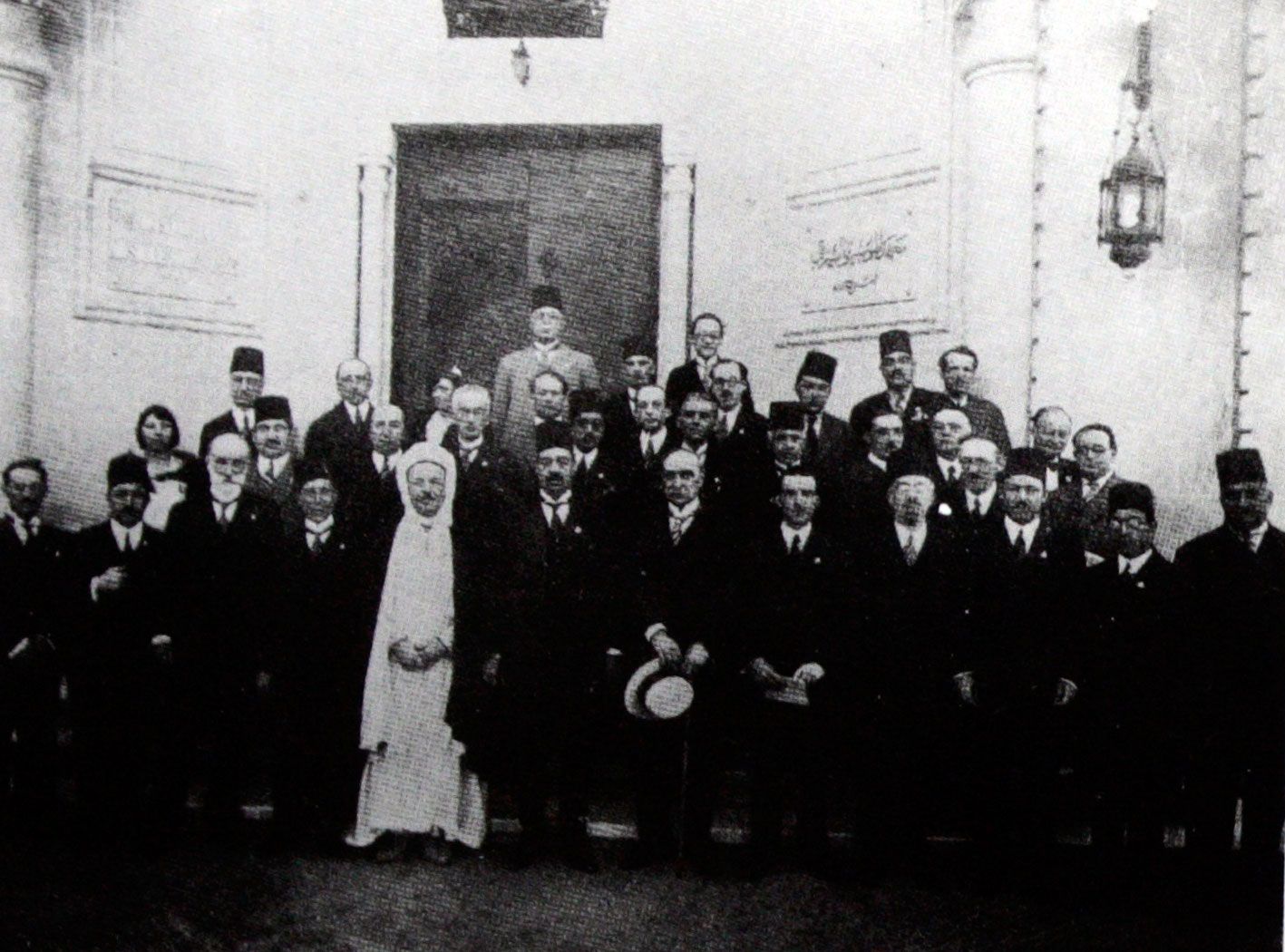
The Congress of Arab Music, held in Cairo in 1932, was the first international scientific forum on non-European music to bring together distinguished composers, scholars, performers and educators from European and Arab countries.
“The congress was a prime concern to the government of Egypt, including King Fouad himself, and was linked to reforms intended to bring Egypt up to par with the modern ‘civilized’ world,” Lebanese performer, composer and ethnomusicologist Ali Jihad Racy has written in his lengthy essay on the subject, Historical Worldviews of Early Ethnomusicologists: An East-West Encounter in Cairo, 1932.
The scholarly discourse and impact of the event’s symposium and festival centered on the consolidation, renewal and enhanced international dissemination of Arab musical traditions. In French ethnomusicologist Jean Lambert’s opinion, the congress invented the concept of Arab music, contributing to an identity construction used to “purify” what was now considered as Arabic from the influence of Turkish, Iranian or religious minorities’ music.
In the context of this shift from the conception of “oriental” music to that of “Arab” music, the past, present and future of Arab music culture was discussed systematically at the symposium through seven committees: general issues of musical development and the role of Arab musical history in world music culture, the musical scale, rhythmic modes and composition, musical instruments, recordings and film, music education, the history of Arab music and manuscript heritage and notation.
In his review of the Cairo Congress for the Melos music journal at the time, musicologist Curt Sachs wrote: “Three weeks we have been meeting in the beautiful rooms of the Academy of Oriental Music and discussing in seven committees the theoretical and historical issues, composing practice, instruments, and education. It must be noted that for the representatives of two such different cultures as West and East it was not always easy to come to a unified opinion. Curiously, almost throughout, the Oriental [colleagues] have proven to be radical progressives, and the Europeans as admonishing and braking conservatives. And it was not always easy to communicate our long historical experience-based attitude that in the arts the most important thing is organic growth rather than foreign imitation.”
Sachs’ assessment reflected only one of many diverse and often conflicting views, proposals and approaches set out by European delegates when considering how to develop and update Arab music. The congress raised the issues that were at the time inherent in discussing other countries’ music cultures: historical change and cultural identity, politically motivated definitions of national music that re-interpret heritage, the use of modern Western methods (such as notation techniques) for preserving traditional oral repertoires and the adaptation of Western instruments due to certain technological advantages.
In the interwar context of strengthening the international dimension of musical production and reproduction, these issues were equally important for both Eastern cultures and the so-called peripheries of western European, especially because processes of modernization and the development of national music were often intertwined.
Information about the Cairo Congress of Arab Music quickly spread all over the world, reaching countries that had little contact with oriental music traditions. It therefore had an impact on the self-awareness of European musical cultures. One such example is the repercussions of the congress in Lithuania, where during the interwar period composers also sought to modernize national tradition. In Lithuania, interest in cultural exchange between eastern and western musicians was stimulated by Czech composer Alois Hába (1893–1973), an active participant in the Cairo Congress and a major composer of microtonal music.
Immediately after the event, Hába sent a short report on the results of the symposium for publication in the Lithuanian musical press. In his words, “after long and sometimes sharp debates (mainly differences of opinion were expressed between the Czech and German composers), it was decided to develop a culture of Arab music in the spirit of the national character, using quartertone and sixth-tone systems cultivated by A. Hába.” The Czech composer’s forecast and expectations regarding his passion were too optimistic, but he did actually manage to engage Eastern musicians in his microtonal experiments. Together with his assistant, the composer and pianist Karel Reiner, Hába accepted an invitation by organizers to give lectures on and demonstrations of quartertone music in Cairo. The congress was introduced to the latest model of quartertone piano (created according to Hába’s design and produced by the August Förster company in 1931) for the performance of avant-garde quartertone music.
(Ali Jihad Racy mentions that the quartertone piano invented by Hába was examined together with half a dozen pianos featuring various “oriental” tunings, but the Committee for Instruments “reached a generally unfavorable conclusion, largely because of the impracticality of playing them.”)
Hába’s conviction that his system met the needs of renewal of Arabic music perfectly was based not on egotistic aspirations to promote his own musical doctrine, but was deeply related to the influence of eastern musical traditions on his theoretical system and compositions. In the 1920s, the Berlin Music Academy deputy director Georg Schünemann had introduced Hába to the city’s traditional music archives, which inspired his orientalist studies, especially in Arab and Lebanese music. Knowledge of the up-to-date research of ethnomusicologists such as Alexander Ellis, Erich Hornbostel, Otto Abraham and Robert Lach also had an impact on Hába’s concept of music perception and performance, which often relied on the oral tradition. As a result, Arabic music was one source of his ambitious microtonality theory, which promoted the idea of abandoning the western tonal system to move toward a microtonal compositional practice.
During the Cairo Congress, Hába’s theoretical insights and microtonal compositions supported the proposal for a standardized modal system recognized by all Arab music practitioners. It was based on quartertone harmony — that is, the adoption of a musical scale consisting of 24 equally spaced octave notes by subdividing each semitone into two quartertones. Particularly passionate supporters of this proposal were so-called modernists, especially the Egyptian representatives Mansour Awad, Mahmoud al-Hefni and Emile Aryan, who sought to modernize and partially Europeanize Egyptian music. By contrast, the proposal was rejected by Turkish musicians “on account of its arbitrary nature and inappropriateness for accurate measurements of Near Eastern pitch.”
Hába’s part in western-eastern musical encounters in Cairo and his ideas about the integration of oriental heritage into the revitalization of modern music were reflected in the writings of his pupils in Czechoslovakia and Lithuania. Lithuanian composer Jeronimas Kačinskas (1907–2005), one of Hába’s pupils and an outstanding follower of his microtonal school, strongly advocated radical modernization of national tradition in his creation and cultural activities. In 1932 in Kaunas, Lithuania’s second-largest city, the Society of Progressive Musicians and the music journal Muzikos barai (Fields of Music) were launched by Kačinskas with a group of young musicians who strongly opposed the mainstream of Lithuanian national modernism, especially its narrow conception of what musical nationalism could be. Kačinskas proposed an original way for renewing national music: modernization based on creative individuality that did not repeat earlier stages of human creation.
In an echo of some of the ideas discussed at the Cairo Congress, Kačinskas accepted the re-interpretation of Lithuania’s unique national tradition (including the option of a critical re-structuring of the ancient models of its traditional music) and rejected the superficial adaptation and imitation of western influences. Promoting the ideology of the musical avant-garde, he wrote in 1931: “Quartertone and sixthtone systems of composition implemented in Prague are nothing other than an upgrade of Eastern music […] According to some famous Prague musicians, Lithuanian people are closer to the Orient than to the western European spirit: they have noticed the character of Lithuanian musical rhythms and melodies. If we look at our past music, then we will find there a number of intervals smaller than halftones. It is seen that in ancient times Lithuanians did not know Greek and German dur [major] and moll [minor] tonalities.”
Hába’s involvement in the Cairo Congress and Kačinskas’ insights into correspondences between oriental heritage and modernist music reflect the self-awareness and positioning of the Prague microtonal school in the 1930s. In Europe’s modern music scenes, a discussion about the search for new paths began.
An active and influential member of the International Society for Contemporary Music, Hába was not satisfied with its pluralist music and the weak position of the musical avant-garde at the society’s festivals. By the mid-1930s, with the start of a mass emigration of composers from Germany and Austria, the position of the Prague school of microtonal music as a milieu for the musical avant-garde in the environment of the ISCM had become stronger. Kačinskas would write that “the creative forces belonged to Europe’s Eastern and South-Eastern states: Czechoslovakia, Yugoslavia, Hungary, Poland, and Lithuania.” For the Prague microtonal school, Hába’s appearance at the Cairo Congress of Arab Music and the inclusion of his experiments with microtonality in the debate about the development of oriental music traditions was a strong argument when discussing the imagined future of European modern music.
This in an edited version of a text commissioned by the European-Egyptian Contemporary Music Society on the occasion of its ongoing Heritage and Modernity festival. For more information and readings, see here.
تقارير ذات صلة
The ambivalent hybridity of pre-independence Arab societies
On wrestling ambivalently with the collaborations between Egyptian and European modernists that have shaped our contemporary realities.
Reading turath in Ahmed Sadiq Saad’s texts
Tanmiya and turath: a dehistoricized tradition is the effect and pivot of a dehistoricized present
Creating a history mixtape: A conversation with Andrew Simon
Cassettes decentralized state-controlled Egyptian media long before the invention of the internet
Your support is the only way to ensure independent, progressive journalism survives.
You have a right to access accurate information, be stimulated by innovative and nuanced reporting, and be moved by compelling storytelling. Subscribe now to become part of the growing community of members who help us maintain our editorial independence.
Join us