
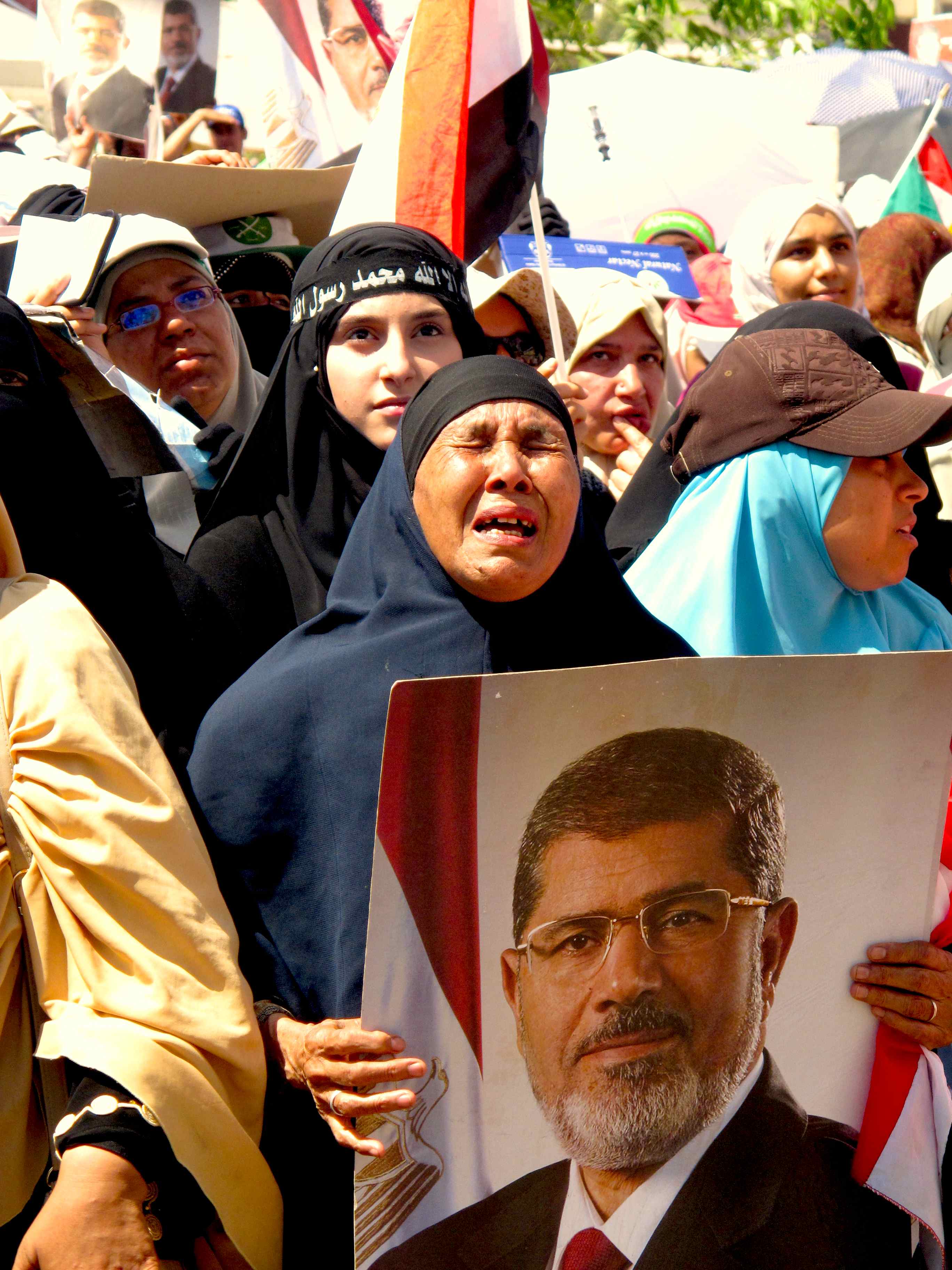
The difficult survival
Perhaps it won’t be long before deposed President Mohamed Morsi is likened to former President Mohamed Naguib, both remembered as short-lived, first post-revolution presidents.
Naguib was the first president after the 1952 revolution and he resigned under pressure from the Revolutionary Command Council. Back then, the young Muslim Brotherhood launched an uprising to force the council to reinstate him. Fifty-nine years later, the Brotherhood are in uprising mode again after Morsi’s forced ouster by the military.
While there are numerous similarities, speculation about the future of the Brotherhood cannot draw much reference from the 1950s. The 1954 crisis meant the isolation of the Brotherhood from the political scene, but not their demise. The 2013 crisis is yet to reveal its implications for one of Egypt’s older organized surviving political groups and the scope of both its political and religious projects.
Writing on his political blog, Salamamoussa, Magdy Atteya says that what is happening now is different from 1954 because both Egypt and the Brotherhood are not what they were then.
“In 1954 the Brotherhood had leaders such as Sayyed Qutb and Maamoun al-Hodaiby, who differed in their opinions. This is completely different to today’s cohesiveness and unity,” Atteya tells Mada Masr. Qutb is generally known to be the hardline pole of the organization.
Moreover, Atteya argues that the group stands in a stronger position because of their growing economic power.
Some believe the organizational power of the Brotherhood will have to wane following the current crisis.
“In 1954, the Brotherhood used to say to their supporters, ‘if we do x, y and z, we will realize our goals.’ Today, they have done everything to reach the seat of power and yet have failed to achieve anything. They have nothing new to offer so that their supporters continue to back them,” Atteya says.
But Mostafa al-Imam, a young Brotherhood member, is of a different opinion.
“Despite the frustration that many Brotherhood youth felt, we regrouped afterwards and reminded ourselves that we have to stand our ground," he says. "We received messages from leaders telling us to do the same thing so that we would be victorious.”
He adds that this Ramadan brought with it an intense spiritual state that filled the Brotherhood youth with determination.
“Belief is what makes the difference. We believe this period is a test – ‘so that God can separate the bad from the good.’ We all have faith that God will make us victorious soon,” Imam says.
“This religious discourse is extremely successful in linking Brotherhood members with the group. It is the secret of its cohesiveness in the face of crisis,” says Amr Magdi, a political science researcher.
Magdi, a Brotherhood member until six years ago when he left the group, says he expects this cohesiveness to continue and sees no signs of splits in the near future, although all eventualities cannot be predicted.
For Brotherhood spokesperson Gehad al-Haddad, the group's strength lies in its very organizational nature. “The Muslim Brotherhood was built around various oppressive regimes. It was built as a decentralized group and even its finances are grassroots financing; each member pays their dues. So if you cut through the organization horizontally or vertically it doesn’t affect us at all,” he says.
The group’s popularity has been dented, however, and a large section of their support base has been lost, Magdi says, asking whether the Brotherhood will be able to put up Ramadan decorations in the street and engage in dawah (preaching) activities like they used to and expect the same reception.
But for some Brotherhood leaders, the situation is completely different: the current moment is one of strength for the group, with more external support.
“Street activism against the military coup is steadily increasing now that Morsi’s opponents have started to join anti-coup protests,” says Haddad.
Ahmed Aref, another Brotherhood spokesperson, says millions have joined the “pro-democracy” camp and that the steadily increasing support for it has reached the army, which he says has affirmed that it is against the “military coup” that happened on July 3 through a statement deposing Morsi. Aref does not rule out the possibility of a coup against Abdel Fattah al-Sisi, the minister of defense, because “the army does not accept a coup against legitimacy.”
Haddad says that the measures being taken by the interim president and transitional government are meaningless because both are pursued by the specter of illegitimacy.
“If we agreed to what has happened and entered new elections and won, what guarantees would we have that the army wouldn’t simply stage a coup against elected institutions again?” Haddad asks.
“We have to teach the army a lesson so that it never again interferes in politics,” he adds. “What we are currently doing is not for us, but for the coming generations.”
Haddad’s comments represent a large proportion of Islamist youth who have completely lost faith in the democratic process, having begun to feel that democracy does not include them.
“How can we trust elections when the message being sent to us is clear: Islamists will not rule even if they are elected?” Imam wonders.
Meanwhile, violence has spread in Egypt’s streets between Morsi supporters and security forces, the residents of the areas where they are staging protests, their opponents, and unidentified groups.
Haddad denies any link between the Brotherhood and those committing acts of violence in the street. All the Brotherhood needs to do now is maintain pressure, he says, adding that it has no plan other than mobilizing in the street for peaceful protests until Morsi is reinstated and legitimacy is restored – after that everything is negotiable.
“Violence is not part of the Brotherhood ideology and we haven’t committed an act of violence in 92 years, only when we were resisting British occupation. We know what the unavoidable result of violence is and we have seen with our eyes what happened in Algeria and Syria,” he says.
That said, Haddad affirms that violence was inevitable and that the Brotherhood warned the army of its likelihood if legitimacy was stripped from them. He reiterates that Morsi supporters are not only Brotherhood members and that it is therefore natural that some individuals among them express anger through violence.
Magdi, meanwhile, views the violence as a calculated attempt to upset the political scene in order to pressure the army into unannounced and non-transparent negotiations. But he deems it a “merely a political escalation without a vision.”
“Some individuals might want to provoke violence and the Brotherhood currently provide moral support for acts of violence. In addition, their silence on the current violence indicates they are convinced by it but do not want to say so openly. Fundamentally, however, the Brotherhood do not use violence and fear its consequences,” Magdi explains.
His problem is not the Brotherhood’s adoption of violence, but their isolation. History has proven that dealing with the Brotherhood through security measures such as arresting their leaders doesn’t work, he says. Rather than weakening the group such measures give allow it to withdraw into itself and delay discussing controversial issues, Magdi suggests, adding that it also gains a stronger excuse for internal unity and, as violence against it increases, it will win greater sympathy.
“This isn’t a solution when dealing with the Brotherhood,” Magdi says. “The solution is political openness and making the Muslim Brotherhood legal.”
“If the 30 June uprising and the transitional government succeed in regulating the Brotherhood’s situation this will contribute to establishing a clear division between it and the Freedom and Justice Party. This in turn will help establish a division between its dawah and political activity and might breathe new life into the group’s membership,” he adds.
But this political opening could go two different ways, Magdi argues. It could help the Brotherhood evolve or turn it into an extremist right-wing group like European extremist parties who can win roughly 20 percent of parliamentary seats while the majority of the public reject them and they have no powerful presence.
Political prospects for the Brotherhood right now are weak, in the opinion of others. For Atteya, the Brotherhood can continue their dawah work but politics may be hard because they created the Freedom and Justice Party and did not allow it to operate independently.
He adds that while the Brotherhood previously performed politics under the Hosni Mubarak regime through their organization, they felt compelled to follow the standards of Western democracy after the revolution by forming a party to fulfill their dream of attaining power.
“The more important question for Brotherhood leaders now is whether they have given up the dream of holding power, because the current generation of leaders will never be in power. If the Brotherhood do rule Egypt again, other figures will make this happen,” Atteya concludes.

Mohamad Salama Adam
Adam describes himself as a failed physicist and day laborer journalist. He spent his formative years between Wardan, a town in rural Giza whose only claim to fame is a…
تقارير ذات صلة
Being Brotherhood
Within days of President Mohamed Morsi’s ouster, members of the group from which he hails started reliving the kind of political alienation and oppression that marred the reign of his predecessor.…
The view from the palace’s window
From the presidential palace’s window, the view ahead of the planned June 30 protests is different. The protests, set to challenge the one-year rule of President Mohamed Morsi, alongside the…
Abdel Moneim Abouel Fotouh: A man apart
His political journey has been a winding one.
Your support is the only way to ensure independent, progressive journalism survives.
You have a right to access accurate information, be stimulated by innovative and nuanced reporting, and be moved by compelling storytelling. Subscribe now to become part of the growing community of members who help us maintain our editorial independence.
Join us