
South Africa brings Israel to the World Court: Can a ceasefire be expected?
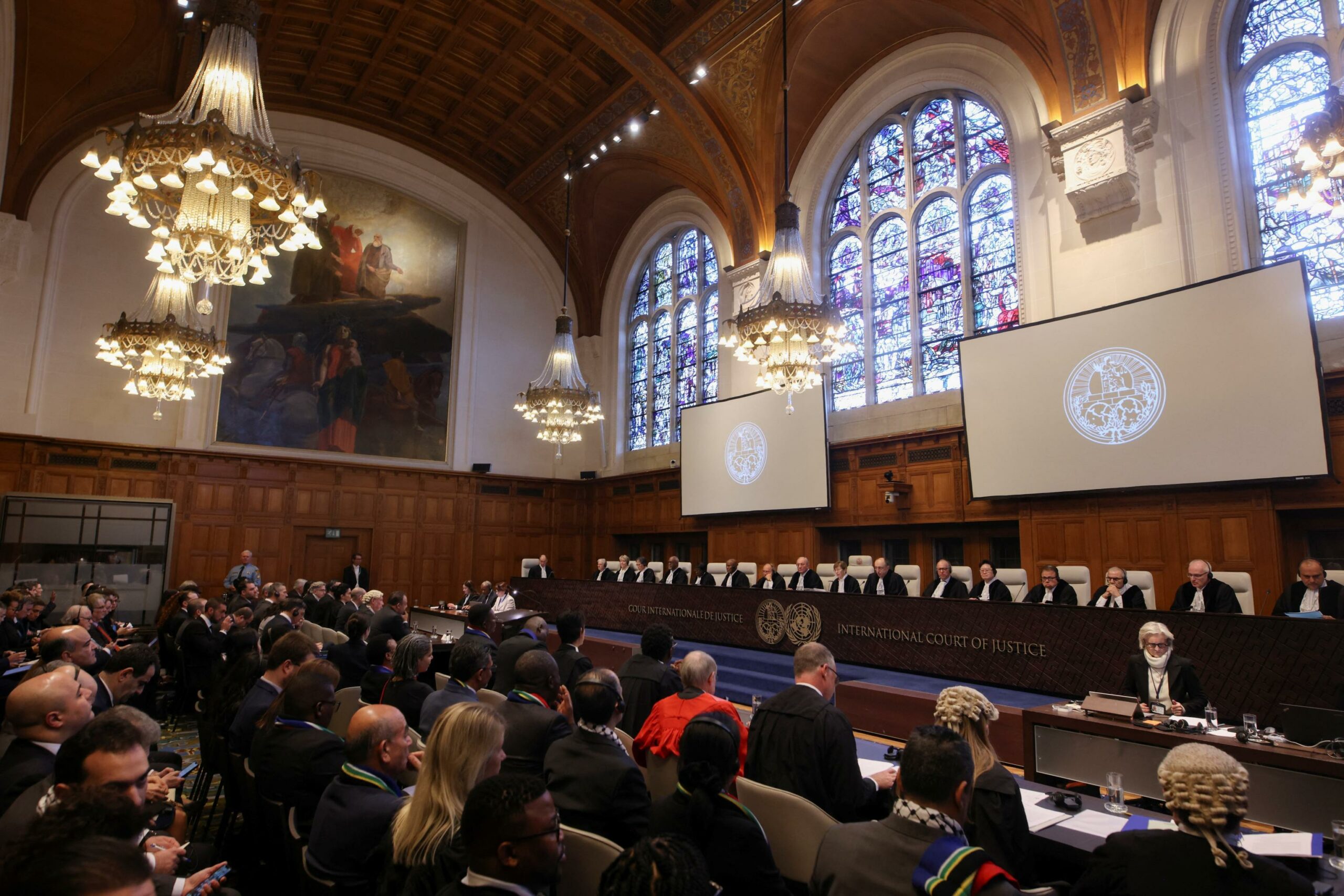
Thursday and Friday witness the first hearing of South Africa before the International Court of Justice, which accuses Israel of committing genocide against Palestinians in the Gaza Strip.
In the filing presented to the ICJ on December 29, South Africa accuses Israel of breaching its obligations under the 1948 genocide convention, drafted following the Holocaust, in its war on Gaza, which has been ongoing for almost 100 days, killed over 23,000 Palestinians and displaced about 1.9 million.
The lawsuit asks the court to impose emergency provisional or short-term measures that would order Israel to halt its military assault on Gaza, saying it is necessary “to protect against further, severe and irreparable harm to the rights of the Palestinian people.”
While the case is expected to last for years in court, the provisional measures, if approved by the court, which would happen in a matter of days, could have a decisive effect on the war, as they would practically mean a court decision to issue a ceasefire. International criminal law scholar Abdelghany Sayed explains that these measures “have value.” Even if Israel ignores these measures, namely a ceasefire, any country that is a member of the UN, and hence of the ICJ, can impose sanctions on Israel, Sayed says.
The court’s provisional measures have been quite common in recent years, and they seek to “freeze” the legal situation at hand, until the prosecution proceeds.
“A ceasefire decision from the court is possible,” a Palestinian diplomat who attended the first hearing today in The Hague tells Mada Masr, adding that Palestine gives all its support to the South African application, which is comprehensive and is carried by a strong legal team.
The court
The ICJ, also known as the World Court, is the UN legal body that deals with inter-state disputes. It was established in 1945 by the UN Charter, after the Second World War. All state members of the UN are de facto members of the court.
The court is composed of 15 judges, elected by absolute majority by the UN General Assembly and Security Council, for a nine-year term. They are generally and practically elected from different geographic regions with permanent members of the Security Council often having a judge serving, even though the court’s statute says that the judges should be elected with no regard to their nationality. These elements often contribute to the general assessment that the court is not fully independent. The current court composition includes judges from Germany, France, Russia, China, India, Japan, Australia, Brazil, as well as Morocco and Lebanon from the Arab World, Somalia and Uganda from Africa, and Slovakia, Jamaica. American judge Joan Donoghue presides over the court.
ICJ orders are binding, but can be hard to impose, as seen in 2022 when Russia ignored the court’s order to halt its invasion of Ukraine. In February 2022, Ukraine filed an application at the ICJ, accusing Russia of planning a genocide against it. The court issued an interim order for Russia to end the invasion, an order that was flouted by Russia. “Yet Russia is facing sanctions,” Sayed reminds.
The plaintiff
South Africa, a long-time supporter of the Palestinian cause, accuses Israel of violating the genocide convention in the case filed to the ICJ. Both South Africa and Israel are signatories of the genocide convention, allowing the court to proceed with the case. The convention, brought to life after World War 2, gained traction following the Holocaust, an event that helped shape the very concept of genocide.
One judge from each side of the case will also join the 15-judge panel of the court. British legal academic and lawyer Malcolm Shaw was hired to represent the Israeli side. Shaw is a territorial and international disputes expert with a track record of supporting Israeli positions regarding Palestinian statehood in international courts.
Show will face off with a team of South Africa’s top international lawyers and legal academics, including John Dugard, a long-time advocate for the Palestinians, who served as a special rapporteur to the UN Commission on Human Rights on the Palestinian Territories and is a member of the board of trustees of Law for Palestine, as well as Adila Hassim, Tembeka Ngcukaitobi, Max Du Plessis, Tshidiso Ramogale, Sarah Pudifin-Jones and Lerato Zikalala.
British barrister Vaughan Lowe and Irish barrister Blinne Ní Ghrálaigh have also joined the team to offer external counsel.
An Arab political source, speaking to Mada Masr on condition of anonymity, says that South Africa liaised with relevant parties before submitting the case and ended up taking the plaintiff role, instead of Palestine, which would otherwise have compounded the politicization of the case.
Moreover, there are other states that have made reservations over Article 9 of the genocide convention, which allows disputes over “the responsibility of a state for genocide” to be brought to the court by any disputing party, with reservations insisting that a state’s consent must be requested first before it stands before the ICJ. This makes South Africa, a state with documented apartheid history, more suited to submit the application against Israel since it hasn’t made such reservation. The source added that South Africa’s plans were developed in discretion to avoid potential sabotage.
Many countries, political groups and NGOs have declared support for the South African lawsuit and the call for an immediate ceasefire. The Palestinian Foreign Ministry welcomed the case presented by South Africa, as did the member states of the Organization of Islamic Cooperation. Separate statements of support for the case also came from Turkey, Malaysia, Jordan, the Maldives, Bangladesh and Pakistan. Bolivia, Namibia and Venezuela have also come out in support of the case. Hundreds of political parties, advocacy groups and NGOs have also rallied behind the South African case in recent days.
In Egypt, the Gaza Strip’s only Arab neighbor, several political parties and civil society organizations are urging the government to join South Africa in presenting the case before the ICJ, and to adopt and defend the case politically, diplomatically, and judicially. They also want Egypt to use its political weight to encourage third world countries in the Non-Aligned Movement, the Organization of Islamic Cooperation, and the African Union to join the case. Among those calling for Egypt's involvement, declared through a petition, are the Dostour Party, the Egyptian Social Democratic Party, Nadeem Center for Human Rights, the Egyptian Women Journalists Movement, and others. The signatories of the petition also emphasize the need for Egypt to follow through on its declared stance regarding rejecting the displacement of Gaza's population by taking practical steps.
South Africa bringing Israel to court marks the second incident where a state not directly party to a dispute brings one to the ICJ. In 2019, Gambia presented an application to the ICJ, against Myanmar, accusing it of perpetrating genocidal acts against Rohingya communities. While Myanmar contested Gambia’s ability to bring the claim before the court, in its reasoning, the ICJ spoke of the genocide convention not being “about any individual advantage or disadvantage of a state, but rather for the achievement of common purposes.”
The respondent
Israel finds itself in the unusual position of needing to appear before court to dispute the case, which it rejects as “baseless.” Israeli President Isaac Herzog has dismissed the case as “atrocious and preposterous.”
Still, Israel seems wary of the “significant potential implications” of a court ruling against it, which could have “practical bilateral, multilateral, economic, security ramifications,” according to an Israeli Foreign Ministry cable reported on by Axios.
Israel plans to appear before the court, an unusual move in its dealings with international tribunals, with the “strategic goal” of the court rejecting the request for an order to halt the war.
To that end, according to Axios, the Foreign Ministry cable instructed Israeli embassies to ask diplomats and politicians “to publicly acknowledge that Israel is working [together with international actors] to increase the humanitarian aid to Gaza, as well as to minimize damage to civilians, while acting in self defense” against Hamas. The embassies were to work urgently to release these public statements before the hearing.
Sayed adds that he expects Israel to usurp the court’s resources as a strategy, focusing its bid on disputing the ICJ’s jurisdiction to rule in the case by arguing that Palestine is not a state, to steer attention away from the crime of genocide being investigated.
But international courts lawyer Yasser Hassan believes Israel will not have much luck with this line of argument, since both it and the plaintiff have signed the genocide convention, giving the ICJ preliminary jurisdiction to look into the case. This is evidenced, Hassan says, by the fact that Israel rushed to send a legal defense team to the court this time, unlike how it ignored the 2004 case on the West Bank Wall.
Hassan, who is optimistic that South Africa has compiled enough evidence to get a court order to halt the Israeli military assault, notes that the order cannot be imposed on Israel by the court. However, as the UN’s highest legal body, an order to stop the war from the ICJ would still be considered a major legal feat and would further add to the political pressure on the Security Council, which as of yet, has failed to call for a ceasefire three times, he said.
The Palestinian diplomat thinks that Israel can only take the case seriously, judging from different measures taken, including the lining up of its legal team and the last minute change of Alan Dershowitz who was implicated in defending controversial American figures before.
Israel’s biggest ally, the United States, was the first other country to announce its opposition to the South African case. “We find this submission meritless, counterproductive, and completely without any basis in fact whatsoever,” US National Security Council spokesperson John Kirby said on Wednesday. Guatemala and Hungary were also among few other countries that came out in full support of the Israeli position.
Other western countries did not rush to support Israel in this case. Germany only said it is considering whether to share its legal view on the case, while Canada and Austria both merely acknowledged the case without saying they would intervene. France said it will support the ICJ decision on the case whatever it is, while the European Union stated that it “supports the ICJ and countries' rights to bring cases to the court.”
Israel has been ignoring an ongoing investigation since 2021 into its atrocities in Gaza and the West Bank by the International Criminal Court, as it rejects the ICC’s jurisdiction. Unlike the ICJ, which arbitrates disputes between states, the ICC can hold individuals responsible for war crimes and crimes against humanity. The ICC is also generally perceived as a younger and more independent court, especially due to the fact that it doesn’t follow the UN.
The ICC seeks to reach an indictment to identify the individuals responsible for what it recognizes as atrocities committed since October 7, 2023, so it can issue arrest warrants and prepare to try them according to the Rome Statute. But, Israel, along with the US, withdrew its signature from the statute in 2002, and repeatedly rejects the court's jurisdiction whenever it attempts to investigate Israeli war crimes. They are not the only states that do not recognize the ICC.
The evidence
South Africa’s application is centered on proving Israel’s violation of the genocide convention. While the ICJ has no jurisdiction to try individuals accused of war crimes and crimes against humanity, since it is not a criminal court, the threshold put by South Africa and its allies for convicting Israel for its assault on Gaza is considered higher, as it consists of proving the genocidal nature of Israel’s acts.
The 1948 genocide convention defines genocide as “a crime committed with the intent to destroy a national, ethnic, racial or religious group, in whole or in part.” It also obliges the state parties to the convention to prevent and to punish perpetrators of the crime of genocide.
In the 84-page application submitted to the ICJ, South Africa aimed to provide proof of Israel’s intent to commit genocide, detailing how the past three months have witnessed the Israeli occupation committing acts that “are genocidal in character because they are intended to bring about the destruction of a substantial part of the Palestinian national, racial and ethnic group, that being the part of the Palestinian group in the Gaza Strip.”
The list of evidence South Africa provided in the case filing includes what follows.
1- Killing Palestinians in Gaza
In the application, South Africa says over 21,000 Palestinians have been killed in Gaza since Israel began its military assault. They have been killed ‘in their homes, in places where they sought shelter in hospitals, in UNRWA schools, in churches, in mosques, and as they tried to find food and water for their families. They have been killed if they failed to evacuate, in the places to which they fled, and even while they attempted to flee among Israeli-declared ‘safe routes’.’ The killing has been so extensive that “bodies are being buried in mass graves, often unidentified.” The court file also points to “Israeli soldiers performing summary executions, including of multiple members of the same family - men, women, and older people. There are also reports of unarmed people - including Israeli hostages - being shot dead on sight, despite posing no threat, including while waving white flags.”
Further on the weaponry use, the South African report says: “Israel is said to be dropping "dumb" bombs on Gaza, as well as heavy bombs weighing up to 2,000 pounds, which have a predicted lethal radius of "up to 260m" and are expected to cause severe injury and damage as far as 800 meters from the point of impact. This weaponry is being deployed in one of the most densely populated areas in the world, where approximately one in every 100 people has now been killed.”
2- Causing serious bodily and mental harm to Palestinians in Gaza
South Africa’s application points to over 55,000 Palestinians being wounded since the Israeli military assault in Gaza in October 2023, with most of them being women and children. “Burns and amputations are typical injuries, with an estimated 1,000 children having lost one or both legs.” The application further notes that there no functioning hospitals in North Gaza, “such that injured persons are reduced to “waiting to die” unable to seek surgery or medical treatment beyond first aid, dying slow, agonizing deaths from their injuries or from resultant infections.” The South African report also points to Israel’s “dehumanization, and cruel, inhuman and degrading treatment of Palestinins in Gaza. Large numbers of Palestinian civilians, including children, have reportedly been arrested, blindfolded, forced to undress and remain outside in the cold weather, before being forced on to trucks and taken to unknown locations.”
3- Mass expulsion from homes and displacement of Palestinians in Gaza
"It is estimated that over 1.9 million Palestinians out of Gaza's population of 2.3 million people - approximately 85 percent of the population - have been forced from their homes,” says South Africa in its filing, which points to Israel’s “evacuation orders” since the beginning of the assault. “For many Palestinians, the forced evacuation from their homes is necessarily permanent. Israel has now damaged or destroyed an estimated 355,000 Palestinian homes - amounting to 60 percent of the entire housing stock in Gaza,” the filing continues.
4- Deprivation of access to adequate food and water to Palestinians in Gaza
The filing says, “On October 9, 2023, Israel declared a "complete siege" on Gaza, allowing no electricity, no food, no water and no fuel to enter the strip.” The siege is pushing the Palestinian people in Gaza “to the brink of famine,” while Israel is cutting off piped water for the North of Gaza and shelling infrastructure in such ways where the water system has become inoperable.
5- Deprivation of access to adequate shelter, clothes, hygiene and sanitation to Palestinians in Gaza
South Africa, in its filing, points to acute shortages of “warm clothes, bedding, blankets and critical non-food items, with people heavily dependent on salvaged wood and waste for cooking and warmth, raising the risk of respiratory diseases.” Clean water shortage is also increasing the risk of infectious disease.
6- Deprivation of adequate medical assistance to Palestinians in Gaza
“Almost above all else, Israel's military assault on Gaza has been an attack on Gaza's medical healthcare system, indispensable to the life and survival of the Palestinians in Gaza,” the South African application says, with attacks on hospitals increasing since December, hospitals being besieged, deprived of electricity and fuel, prevented from receiving supplies, and their generators and life saving equipment, such as oxygen stations, being targeted.
7- Destruction of Palestinian life in Gaza
“Israel has destroyed not only individual homes, houses, and whole apartment blocks; it destroyed entire streets, and entire neighborhoods. Its shops, schools, vibrant market place, family homes, doctors clinics, historic streets and Ibn Uthman Mosque, and everything that once sustained Palestinian life has been damaged or destroyed, along with so many of its people,” says South Africa in its application to the court. Furthermore, “Israel has damaged or destroyed countless bookshops, publishing houses, libraries, and hundreds of educational facilities. Israel has targeted every one of Gaza's four universities.”
“Along with its destruction of the physical monuments to the history and heritage of the Palestinians in Gaza, Israel has sought to destroy the very people who form and create that heritage: Gaza's celebrated journalists, teachers, intellectuals and public figures, its doctors and nurses, its film-makers, writers and singers, the directors and deans of its universities, the heads of its hospitals, its eminent scientists, linguists, playwrights, novelists, artists and musicians.”
8- Imposing measures intended to prevent Palestinian births
South Africa’s report to the court says: “Israel's actions are impacting Palestinian women and children in Gaza especially severely, with 70 percent of those killed estimated to be women and children. Two mothers are estimated to be killed every hour in Gaza. Over 7,729 children were estimated to have been killed by December 11, 2023 alone, and at least 4,700 other women and children are missing and believed to be buried under the rubble.
“There are multiple eyewitness accounts of pregnant women being killed by Israeli soldiers, including while trying to access healthcare. An estimated 5,500 of approximately 52,000 pregnant Palestinian women in Gaza giving birth each month are doing so in unsafe conditions, often with no clean water, much less medical assistance, in shelters, in their homes, in the streets amid rubble, or in overwhelmed healthcare facilities, where sanitation is worsening, and the risk of infection and medical complications is on the rise. Where they are able to get to a functioning hospital, pregnant women are having to undergo cesarean sections without anesthetic.”
“Given the lack of access to critical medical supplies, including blood-doctors are being compelled to perform ordinarily unnecessary hysterectomies on young women in an attempt to save their lives, leaving them unable to have more children. An ever-increasing number of Palestinian babies in Gaza are reportedly dying from entirely preventable causes, brought about by Israel's actions.”
South Africa’s also stressed in the filing that “it is important to place the acts of genocide in the broader context of Israel’s conduct towards Palestinians during its 75-year-long apartheid, its 56-year-long belligerent occupation of Palestinian territory and its 16-year-long blockade of Gaza.”
تقارير ذات صلة

Gaza’s phase two arrives. Kind of …
Consensus over key questions lags behind the United States' announcement of progress.

Gaza’s child amputees

Israel finally approves Egypt’s gas deal after nail-biting battle
In an unexpected move, Israeli Prime Minister Benjamin Netanyahu announced on Wednesday Israel’s final approval of a controversial gas export deal with Egypt, months after Israeli hesitation following the initial…
Your support is the only way to ensure independent, progressive journalism survives.
You have a right to access accurate information, be stimulated by innovative and nuanced reporting, and be moved by compelling storytelling. Subscribe now to become part of the growing community of members who help us maintain our editorial independence.
Join us