
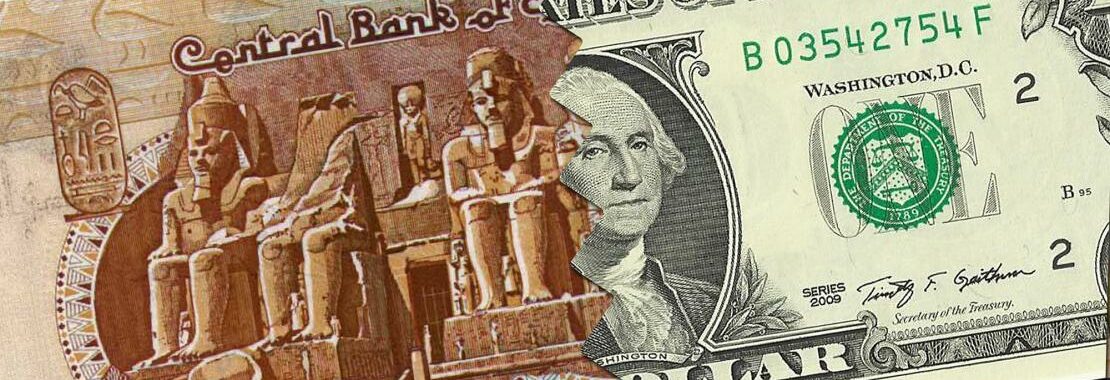
Proscriptions ahead of IMF review: Another dose of devaluation, please
Three months after agreeing to adopt a “flexible” exchange rate, Egypt’s currency continues to be overvalued and primed for a further devaluation.
The flexibility pledge came as one of the terms of the 46-month US$3 billion Extended Fund Facility loan that Egypt and the International Monetary Fund agreed to last year. The other primary commitment would see Egypt marshal forth a number of wide-ranging structural reforms to reduce the state's footprint in the economy and shore up its budget deficit.
These two issues are intertwined. As a recent Morgan Stanley report notes: “a significant real exchange rate adjustment since 2022 should contribute to narrowing of the current account deficit.”
But Egypt has held off on a devaluation for over a month now.
Why is it bucking the conventional wisdom of international finance?
The Egyptian government is looking at things in inverse, trying to secure inflows to halt a rapid erosion of the pound, as it did in the latest devaluation in January, when the Central Bank of Egypt allowed the pound to fall in coordination with a previously agreed upon influx of hot money meant to prevent the currency’s free fall. According to various sources, the government is trying to buy time.
However, the clock is ticking for Egypt to execute its plan, as awareness of the chasm between the value of the pound and its real value grows and its efforts to attract foreign inflows are showing meager results. Without new inflows, the government will be forced to proceed with a devaluation, according to international banks and Egyptian experts.
At the beginning of March, five international banks presented a pessimistic outlook for the Egyptian pound, with four of the five projecting further devaluations as steep as 16 percent, which would bring the exchange rate to LE35 to the dollar. In the long-run, the pound’s value in non-deliverable forward (NDF) contracts with 12 month-maturity was recorded in the range of LE37.9 and LE38 for each dollar, according to data reported by Bloomberg.
Further, the first review in the IMF program, which the government views as more of a “certificate of trust” in the Egyptian economy than a solution to it, is looming on the horizon. At stake is the second disbursement of the loan — worth $347 million — as well as the international lender’s stamp of approval.
The IMF estimated at the end of last year that the financing gap over the course of the 46-month program stood at about $17 billion, including about $5.04 billion until the end of June alone.
Egypt was hoping to fill this deficit by borrowing from international institutions and selling off state-owned firms to investors. The government is supposed to gradually sell $2-billion-worth of assets to foreign investors, specifically from the Gulf, by the end of June. This is planned to be followed by sales of assets valued at $4.6 and $1.8 billion in fiscal years 2023/24 and 2024/25, respectively.
Per that same program, the Egyptian government was supposed to sell public firm assets to the tune of $0.5 billion last year and other assets by the end of March as a prerequisite to accessing the third installment of the loan. This condition will be one of the main issues on the agenda of the IMF’s coming review.
In February, the government announced its intention to offer 32 state-owned companies across 18 economic sectors for partial privatization through public offerings on the stock exchange and by offering stakes to strategic investors within a year of the announcement.
Yet, efforts to sell assets in these companies have not seen any progress so far.
"The announcement of the IMF program late October 2022 was a source of optimism for us for the forecast for the Egyptian economy. However, this optimism evaporated as there has been no progress in applying the flexible exchange rate and the sale of state-owned firms. The absence of details and the disappointing track record keeps any expectation very low,” said Credit Suisse in a report last month on the Egyptian economy that Mada Masr obtained.
In February, the Saudi Public Investment Fund, the kingdom's sovereign wealth fund, halted its plans to acquire United Bank, which is owned by the Central Bank of Egypt (CBE), due to disagreements on how to value the bank. With the value of the pound dropping, the Saudi fund pushed to conduct the valuation in Egyptian pounds and then pay the equivalent in dollars whenever the deal was signed, whereas Egypt wanted the valuation to happen in dollars from the very beginning.
United Bank is only one of many faltering deals. Earlier, talks with the Qatar Investment Authority to take over Telecom Egypt’s shares in Vodafone Egypt faltered, as have talks with the United Arab Emirates to buy a share in Telecom Egypt. In a similar manner, Abu Dhabi National Oil Company (ADNOC) purchased 50 percent of the French company TotalEnergies’ Egypt branch after it failed to finalize a deal to acquire shares in Wataniya, a vast network of gas stations owned by the military’s National Service Projects Organization.
The faltering deals appear to be linked to two main factors, according to a financial analyst who spoke to Mada Masr on condition of anonymity.
“One reason is related to the value of the deals and the method of valuation, such as what happened in the United Bank case. If the Saudi fund thinks the pound’s value will continue to decline, it is in its interest to value the asset in Egyptian pounds and see when the time of payment comes how much it would pay in dollars,” the analyst says. “But if it closed the deal in dollars and then the price of the dollar increases against the pound, the fund would be in for a loss.”
The analyst also pointed to political motives behind the faltering deals, which Bloomberg also noted in a recent report in which it said that Gulf countries are delaying pledged financial aid until Cairo enacts “reform” measures that the Gulf countries deem as necessary.
Bloomberg’s report came at the same time as remarks by Saudi Finance Minister Mohammed al-Jadaan, in which he said that the kingdom is changing the way it provides financial aid to countries, adding that it now expects “reforms” in exchange of funds.
This adds more economic pressure on Cairo ahead of the IMF program’s first review, which will determine whether Egypt will receive the second, $347-million installment of the loan.
However, the faltering sale of assets is not a surprise. Sources close to the offering program who previously spoke to Mada Masr characterized the program as “unfeasible,” having been pursued as a means of “political maneuvering” with the aim of appeasing the IMF and its demands for reform.
A government source told Mada Masr that the proposed scale of offers is unlikely to happen, as the government is currently still taking the initial steps to prepare the companies for the offering, including preparing the tenders to choose the investment banks and legal offices that will handle the share sales for some of the companies.
A high-level source at NI Capital previously told Mada Masr that it would be difficult to complete even 25 percent of the offerings announced by the prime minister within a year, explaining that the process for offering companies on the Egyptian Exchange takes six months for companies still not prepared for an IPO and three months for those that are.
However, it is not only the faltering investments that will affect the imminent review of Egypt’s program at the IMF.
The program also mandated that annual inflation in Egypt not exceed 18 percent in December and that it come in at 16 percent by March.
The December loan agreement includes a monetary policy consultation clause that will “trigger consultations with IMF staff when headline urban CPI inflation (year over year) falls outside the CBE’s inflation target of 7 ±2 percent range (i.e., inflation falls outside 5 to 9 percent), and with the Executive Board if inflation falls outside the outer bands of 3 to 18 percent in December 2022, 3 to 16 percent in March 2023, and 3 to 15 percent in June 2023.”
Year over year inflation exceeded 26 percent in January, the highest level in five years, before it rose to 32.9 percent in February. Inflation is expected to continue rising in the coming period given the CBE’s monetary policy committee’s decision last month not to raise rates, which was criticized in a Societe Generale report.
“The lack of decisively hawkish action by the central bank of Egypt raises questions around the credibility of its commitment to deliver in accordance with its inflation-targeting mandate” the analysts wrote in the report.
The central bank did raise its overnight interest rates by 200 basis points last week, saying it aimed to bring high inflation into check. The bank set the lending rate at 19.25 percent and the deposit rate at 18.25 percent.
But with inflation likely to continue increasing, the real interest rate — the difference between inflation and interest rates — fell to post negative rates, which undermines the attractiveness of Egypt’s debt instruments for foreign investors, who Credit Suisse said want “a clearer pathway for reform.”
Tarek Metwally, a banking expert and Blom Bank Egypt’s former CEO, tells Mada Masr that the sale of state assets was supposed to be a “swift” solution to address shortages in foreign currency in the short-term, whereas “reforms” target the issue in the medium and long term. “Today, I want dollars, so I will sell shares in state firms. Then we can focus on the regular sources of foreign currency, such as investments, tourism and exports,” Metwally says.
Yet, the regular dollar sources are facing various challenges.
The Societe Generale report noted that despite the sharp increase in non-oil exports, the overall share of exports as a percentage of Egypt’s GDP reached its lowest historical point in 2021 at 11.1 percent. Despite a revival in 2022, when Egypt exports hit $45 billion, the percentage remains much less than the 28–32 percent range that Egypt posted in 1981, 1992 and 2008.
When it comes to tourism, Credit Suisse pointed out that Egypt’s revenues from the sector have recently increased, reaching pre-pandemic levels. However, this came as hotel prices were hiked during Egypt’s hosting of the United Nations’ climate summit last year, the report says, adding that it predicts prices will soon drop again and with them, tourism revenues.
Egyptians’ remittances from abroad have not fully recovered, the reports say, despite reaching historic levels, potentially due to the hikes in oil prices, which have benefited many Egyptians living abroad. “The growth of remittances on a year-to-year basis has been weak, whereas foreign direct investment resumed its downward trend after the dollar inflows from Gulf sovereign wealth funds saw a halt,” the report says.
Even non-traditional sources of the dollar have faltered.
One way the government attempted to bring dollars from Egyptians working abroad was through a vehicle import scheme. Per the initiative, one would deposit the customs and import fees in dollars at the central bank for a period of five years, at which point they would receive the value back in Egyptian pounds.
Despite rolling out several measures to incentivize the program, Finance Minister Mohamed Maiet said the initiative’s revenue has not exceeded $202 million over the last three months. The program processed requests for 12,000 vehicles, less than 4 percent of the government’s target, which Maiet had placed at between 300,000 and 500,000 vehicles.
The cash that Egyptians living abroad ultimately pumped in through the initiative did not exceed 8 percent of the $2.5-billion target announced by the government, itself a reduction from an earlier target of $10 billion that was floated ahead of the initiative launch.
This pushed the government and Parliament to extend the initiative for two months and add more incentives, despite Maiet’s repeated remarks that the government does not intend to grant an extension. This approach continued through other policies, such as the incentives rolled out for foreign investors to buy land using dollars and the citizenship-for-dollars initiative.
In the absence of new dollar inflows and new sources of foreign currency, the CBE appears to be stepping in again to balance the supply and demand of the limited quantities of foreign currencies available.
After a short breakthrough period that saw the release of several thousand tons of imports stranded in ports, the import crisis resurfaced in February, affecting strategic goods and medicines, both of which had been prioritized in the government’s push for customs releases since December.
According to the financial analyst who spoke to Made Masr, the CBE is stepping in to slow down imports so that demand for foreign currency is commensurate with the available supply, an effort that comes as the bank attempts to avoid direct involvement via fixing exchange rates as it had done before.
"I do not think the CBE will return to intervening again in that way. First, there are not enough dollars. Second, this is one of the most important conditions of the IMF loan,” the analyst adds.
Banking expert Hany Aboul Fotouh agrees with this opinion. According to Aboul Fotouh, the parallel foreign currency markets did not completely disappear, but they did become less active since the last currency devaluation in January.
“Parallel markets will not disappear unless the supply meets demand and the balance happens without administrative intervention from the CBE,” he says.
Yet, Metwally, Bloom Bank Egypt’s former CEO, believes that perfect balance is impossible.
"There is no 100-percent free market anywhere in the world. Intervention from those who make monetary policy is important to discipline the market. This ultimately depends on the quantities available at the banks, which appear to be falling short during this period,” Metwally says.
Metwally predicts that the government will make a return to the international debt market in an attempt to bring in foreign currency as soon as possible. “I think this method will continue long enough to get the economy back on its feet, then it will be substituted with foreign direct investment,” he says.
However, this comes with risks as well. Last month, the Finance Ministry issued the first Islamic treasury bonds in the country’s history. Although the target was $1.5 billion, the offering garnered $6.1 billion. This demand helped bring the interest rate at the opening of the tender from 11.675 to 11 percent. Nevertheless, this interest rate was very high compared to rates offered by Egypt’s peers, which means that the problem was postponed rather solved, the financial analyst says.
To fill in the gap between the dollar and the Egyptian pound, the CBE needs to let the pound fall to its real value. According to a source in the central bank who spoke to Mada Masr previously, the government is putting the finishing touches on several deals that, upon finalization, will trigger another currency devaluation similar to the one that happened earlier this year when the pound lost a quarter of its value overnight.
تقارير ذات صلة
How will the Israel-Iran war affect the Egyptian economy?
The Egyptian economy continues to tremble with uncertainty in the face of the widening regional war escalated when Israel attacked Iran on Friday night. By the end of Sunday’s trading…
New law to regulate state ownership: Pushing through the IMF review with the same old recipe
Sources say the draft state ownership law aims to appease the IMF
A day afloat
Egypt will be getting another US$5 billion in loans from the International Monetary Fund as an increase to the 2022 $3 billion loan, IMF representative in Egypt Ivanna Vladkova Hollar…
Your support is the only way to ensure independent, progressive journalism survives.
You have a right to access accurate information, be stimulated by innovative and nuanced reporting, and be moved by compelling storytelling. Subscribe now to become part of the growing community of members who help us maintain our editorial independence.
Join us