
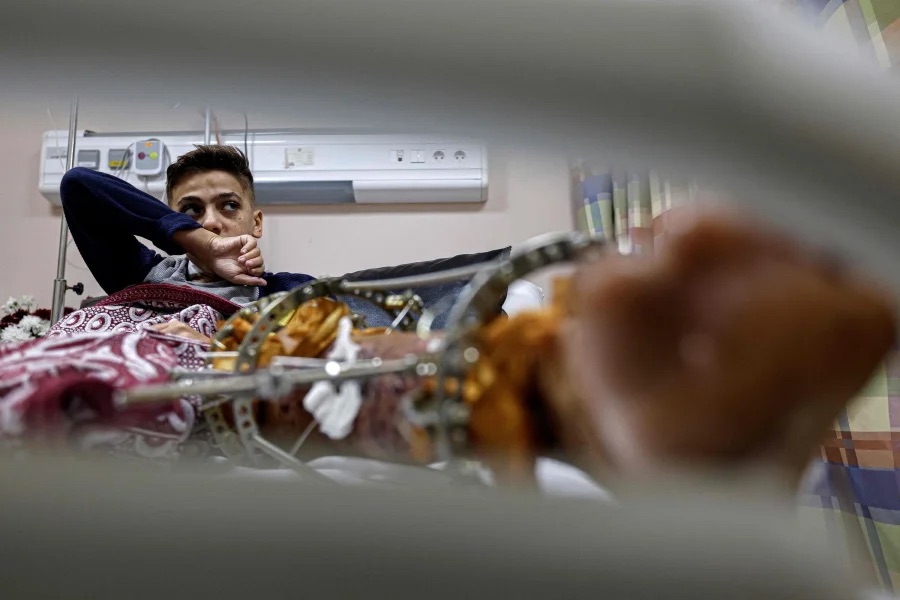
Palestinian patients in Egyptian hospitals: Prisoners without treatment
"We feel like we are in prison" is a phrase echoed by many Palestinians from Gaza who have been referred to Egypt for medical treatment in the wake of the ongoing Israeli aggression on Gaza and the collapse of the strip’s healthcare system.
In recent weeks, several patients have described to Mada Masr the circumstances of their "detention" inside Egyptian healthcare facilities and the challenges they face in accessing medical care.
Mohamed, 45 years old, sustained various injuries from an Israeli F16 missile attack on the Tal al-Hawa neighborhood while he was on his way to buy food during the third day of the aggression on Gaza. His name was listed among those permitted to cross into Egypt for treatment. While in the ambulance taking him to the Rafah border crossing, he was injured again when an Israeli airstrike targeted the vehicle.
In Egypt, Mohamed underwent his first surgery at Sheikh Zuwayed Hospital in North Sinai in November. He was then transferred to Tal al-Kabir Hospital in Ismailia for further treatment.
Throughout his four-month stay at the hospital, Mohamed never left. "I spent four months feeling like I was in prison, never stepping outside for a single day. I felt depressed," he says.
"If we try to get to know any Egyptian person in the hospital, the security staff strictly prohibits it,” Mohamed adds. “There was a security guard who was about to be fired for taking a photo with me."
Health Minister Khaled Abdel Ghaffar stated in a televised interview that there are around 5,500 Palestinians who came to Egypt after the outbreak of the aggression on October 7.
Due to the blockade on the strip, a significant number of patients in Gaza, especially those suffering from conditions like cancer or other chronic illnesses, have to obtain medical referrals, the costs of which are covered by the Palestinian National Authority, to enable them to seek treatment in Egypt.
However, many of those who crossed into Egypt through the border’s medical referral mechanism spoke of their denied access to healthcare services and the security restrictions on patients and their families.
Ahmed Moussa, the director of Tal al-Kabir Hospital in Ismailia, declined to respond to any inquiries regarding the conditions of Palestinian patients under his care. "We receive strict directives not to discuss the injured and patients from Gaza,” Moussa told Mada Masr, “whether regarding their healthcare or security status, but they are definitely receiving their medical services."
Colonel Hatem Saber, a security expert focused on counterterrorism affairs, says that as thousands of Gazans are receiving medical treatment in Egypt, there must be security protocols and considerations, as there may be, among the patients, “individuals affiliated with armed factions.” Thus, complex security measures must be enforced in hospitals, according to Saber, who adds that Egypt has refused the forced displacement of Gazans, so it does not want to project any contradictory image to the public, given the sensitive nature of the issue.
Mohamed's experience at Tal al-Kabir Hospital is no different from other Palestinian patients in hospitals throughout Egypt.
Um Mohamed, a cancer patient, exited Gaza via the Rafah crossing in March after being listed for medical referral. She was admitted to Damietta Fever Hospital, where she describes the situation as "extremely difficult" and has not received any treatment so far.
Despite being informed by Palestinian authorities that they would receive treatment in the United Arab Emirates or Turkey, Um Mohamed and other cancer patients found themselves “detained” at Damietta Fever Hospital without access to the expected care. “The referral was supposed to be to the UAE for chemotherapy and further treatment, but until now, we don't know if we will stay here or leave," she says
The hospital’s security staff prevents Palestinian patients from leaving the facility even to buy food or personal supplies, Um Mohamed says. "We need a security escort to leave. Even for food, we have to order it to be delivered to us so we don't leave the hospital. We buy food at inflated prices compared to the market. By 9 pm, we are required to be in our rooms. No one is allowed downstairs and children can’t play. Our children need breathing space. The bell rings at 6 am and then again at 9 pm, signaling the time to return to our rooms, as if we are in school. We feel like we are in prison."
Inshirah from Bureij in Gaza tells of similar confinement conditions. She arrived in Egypt in Ramadan with her 15-year-old daughter Hala, who is a leukemia patient. They arrived from Gaza and were taken to Damietta Fever Hospital. "We are not allowed to leave the hospital. I had to wait three days to buy food and clothes for my daughter. Permission to leave doesn’t come daily, and lasts from one to two hours. A specific time is set for returning, and we are accompanied by security staff. The last time I tried to leave, I was told, ‘you already went out twice, no more,’” says Inshirah, who also used the term "prison" to describe the hospital.
A former doctor at Tadamun Hospital in Port Said, speaking to Mada Masr on condition of anonymity, says that visits were categorically prohibited for Palestinians at the hospital “to the extent that I got into a quarrel with hospital management to allow visits for the patients, but they insulted me. I wanted to help [the Palestinian patients] but couldn't," the doctor says.
The doctor, who resigned a month ago, added that stringent security measures reached a point where a woman wanted to donate a set of wheelchairs for the injured, but security staff refused, so she had to bribe her way in with the wheelchairs.
On the other hand, the doctor explains the hospital’s rationale behind preventing Palestinian patients from leaving the premises. Hospital management bears responsibility for these cases after their departure from Gaza, he says, and management is concerned that if they leave the premises unattended, they might not return.
The Egypt-Palestine medical referral mechanism involves coordination between Palestinian authorities, border authorities, the Egyptian Health Ministry and security bodies. According to accounts from Palestinians who were referred to Egypt for medical care via this mechanism, patients are required to hand over their passports to the hospital staff as a “guarantee” when they are admitted. When they are discharged, their identification documents are handed over to the Palestinian embassy in Egypt.
Saber says that some patients exited Gaza without passports, which he says justifies the security considerations being taken into account in their handling.
In addition to security restrictions, Mohamed and Um Mohamed say that they cannot access medical treatment. Ashraf Mehanna also shares the same experience. Mehanna’s wife, a thyroid cancer patient, underwent thyroid gland removal surgery in Gaza at the start of the war. She was referred to the Damietta Fever hospital to resume treatment, but she was denied access to the necessary radiation therapy.
Inshirah also says her daughter was not able to receive treatment. "A month and a half without treatment. The hospital tells us ‘the [Palestinian] embassy is the one responsible for your treatment. They’re supposed to find a solution for you.’"
Sami al-Juju, the general manager of Basmat Amal Foundation for Cancer Patients Care in Gaza, tells Mada Masr that cancer patients referred to Egypt are directed to hospitals far from Cairo which are not specialized in cancer treatment. "If a cancer patient has a treatment plan [and does not adhere to it], they relapse. I expect there will be deaths in the coming period due to not receiving the necessary treatment," says Juju.
Mohamed al-Maghrabi, accompanying his brother Ahmed who was injured in an Israeli strike that left him with a torn ligament in his right hand, tells Mada Masr that they were transferred to Egypt on December 6 for surgery. They were first referred to Tadamun Hospital in Port Said. “Unfortunately, the operation was not performed there,” Maghrabi says, “and we were again directed to Damietta Fever Hospital in Ismailia. We stayed there for 45 days without treatment or surgery, they just changed [Ahmed’s] bandages.” They were then transferred to Dar al-Shifa Hospital in Cairo, where they also did not receive treatment.
From Dar al-Shifa Hospital, the Palestinian embassy relocated Mohamed and his brother Ahmed to a senior citizens' hotel in Cairo. "The operation was not performed. We tried to contact the embassy, only to be informed that those were the instructions.” The embassy told Maghrabi that his brother’s treatment had been deemed completed and that they should consider him discharged from the hospital.
According to the health minister's statements last month, the majority of Palestinian patients are distributed across 160 hospitals nationwide, including Tal al-Kabir and Abu Khalifa hospitals in Ismailia; Hayat, Shifa, Tadamun and Chest hospitals in Port Said; Damietta Fever Hospital; Arish, Sheikh Zuwaid, and Bir al-Abd hospitals in North Sinai; and Salam and Nasser Institute hospitals in Cairo.
The former doctor from Tadamun Hospital says that the Palestinian patient or injured person is referred to a healthcare-deficient hospital — merely a waiting area until a spot becomes available in a hospital equipped to receive them. "As a result, some patients are forced to pay for treatment out of their own pockets, which is very costly."
The doctor further adds that the situation is dire in these hospitals for all patients in general. For example, he says, at the Chest Hospital in Port Said, there are patients who have not received any treatment for up to six months despite the severity of their medical conditions.
Um Mohamed says that the Palestinian embassy in Egypt has not facilitated access to treatment or financial support for them. "There are supposed to be funds allocated in our names, and donations, but we don't get any of it."
According to the Palestinian patients who spoke to Mada Masr, there is an assumption that the Palestinian embassy would cover all their treatment expenses, but this has not been the case, and most of them are financing their treatment from their own funds.
The former doctor from Tadamun Hospital also says that they contacted the Palestinian embassy to cover the patients’ treatment costs, but the embassy did not provide them with financial support, only "formal visits" for the patients.
The Palestinian Ambassador to Egypt Diab al-Louh declined to respond to any inquiries regarding the financial support provided by the Palestinian embassy to patients and the injured.
Louh dismissed security restrictions on patients in hospitals as "mere rumors," adding that there is a highly effective system in hospitals, and that Egypt offers Palestinian patients full healthcare services.
Subhi Skaik, the director of the Turkish-Palestinian Friendship Hospital in Gaza specializing in cancer treatment, tells Mada Masr that there have been over 45,000 requests for referring patients for treatment abroad, including 10,000 cancer patients and 11,000 injured individuals. Prior to Egypt’s closure of its side of the Rafah border crossing following the Israeli military’s incursion into Rafah and its takeover of the Palestinian side of the crossing on May 7, between 40 to 43 patients were permitted to travel for treatment per day.
And even with the paltry numbers, there is an inability for patients most in need to make their way to Egypt, Skaik says. The hospital director makes his case by pointing to the fact that there is no mechanism for doctors to speak to those responsible for patient travel approval and equally no designation of “emergency cases,” which he says "does not align with medical and humanitarian standards."
"We know nothing about [the committee responsible for finalizing the travel list], neither its operational procedures nor its members because it is from outside Gaza, and there is no channel for communication with them," he says.
"A large number of patients are denied travel permissions, and some have been waiting since before the start of the war."
تقارير ذات صلة

Gaza’s phase two arrives. Kind of …
Consensus over key questions lags behind the United States' announcement of progress.

Gaza’s child amputees

Israel finally approves Egypt’s gas deal after nail-biting battle
In an unexpected move, Israeli Prime Minister Benjamin Netanyahu announced on Wednesday Israel’s final approval of a controversial gas export deal with Egypt, months after Israeli hesitation following the initial…
Your support is the only way to ensure independent, progressive journalism survives.
You have a right to access accurate information, be stimulated by innovative and nuanced reporting, and be moved by compelling storytelling. Subscribe now to become part of the growing community of members who help us maintain our editorial independence.
Join us