
One story, many faces: How Egypt’s political TV is shaping public opinion
The state of Egypt's media is one manifestation of the decline in civil and political freedoms in the country after the 2011 revolution.
Freedom of expression indicators from both local and international organizations point to a clear deterioration in media freedoms in Egypt after January 25, 2011. Examples of increasing press restrictions include repressive legislation, ongoing imprisonment of journalists and the recent security raid on the Journalists Syndicate.
And while these various forms of censorship aim to silence dissident voices, mainstream media maintains a key role in shaping public opinion.
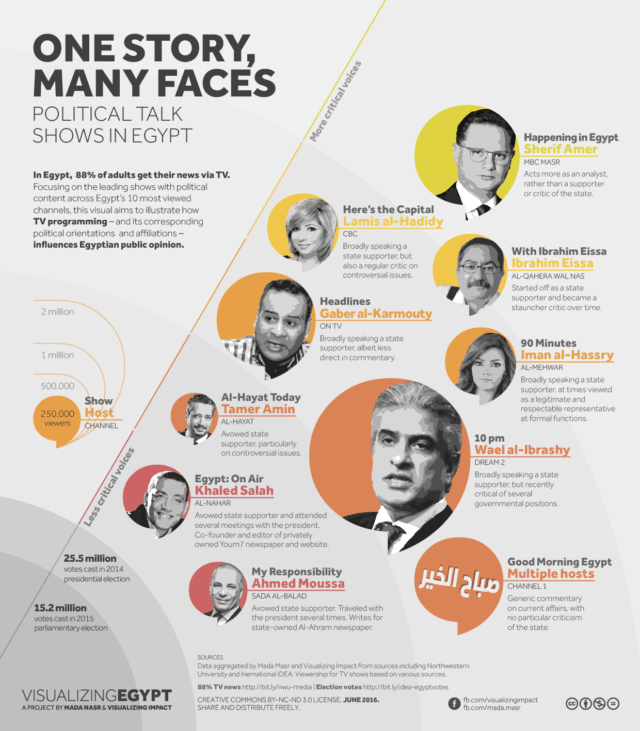
In an attempt to visualize how political TV programming impacts public opinion in Egypt, Visualizing Impact and Mada Masr have collaborated to produce the third visual in our project Visualizing Dissent.
We’ve focused on political talk shows broadcast on local television because an estimated 88 percent of Egyptians receive their news through this highly popular medium, according to surveys conducted by Northwestern University. This is partly due to the long-term ban on news bulletin broadcasting on private channels.
The 10 talk shows featured here represent the most widely viewed political shows on 10 channels, mostly privately owned. Viewership information is based on market research surveys conducted between January and April 2016.
A glance at the histories of these channels’ owners and the talk show hosts provides insight into the kinds of political narratives predominantly disseminated through the country’s most popular mode of communication and news consumption.

The channels and their owners
This is a list of channels featured in the visual, presented in descending order of viewership. We summarize their owners’ histories and relationships to the current government.
MBC Masr: Owned by Dubai-based MBC group, whose chairperson is Saudi Sheikh Waleed Bin Ibrahim. One of his sisters is said to be a widow of the late King Fahd, while other family members are also said to be closely related to the Saudi royal family.
Al-Hayat: Owned by Sayed al-Badawy, head of the liberal Wafd Party and a pharmaceuticals businessman. His party was one of few allowed to exist functionally during the rule of former President Hosni Mubarak. He was a supporter of Abdel Fattah al-Sisi’s bid for presidency and pledged to allocate half of his annual income to Sisi's Tahya Masr (Long Live Egypt) fund. His party participated actively in the 2015 parliamentary elections, by partnering with the pro-state electoral coalition For the Love of Egypt.
Dream TV: Owned by Ahmed Bahgat, who also owns a variety of real estate development and electronics businesses. While he had a turbulent history of business conflicts with Mubarak, he has said he donated 30 percent of his fortune to the Tahya Masr fund.
Al-Qahera Wal Nas: Owned by Tarek Nour, who has built a career in television advertisement, which developed into a fully fledged business in TV production. He started off his ad production agency, Americana, in the 1970s. In 2005, he handled Mubarak’s re-election campaign and did the same for presidential candidate Ahmed Shafiq in 2012, shortly before the former aviation minister lost to Mohamed Morsi. Nour was also one of the managers of Sisi’s presidential campaign.
CBC: Owned by Mohamed al-Amin, an engineer who returned from Kuwait in the early 2000s and began investing in local media post-2011. He acquired Youm7 newspaper, which formerly belonged to relatives of Mubarak-era figures. Amin also established Amer Group with business mogul Mansour Amer. He is said to have coordinated several meetings with businessmen for Sisi, and was one of the main donors to the Tahya Masr fund. The channel was recently merged with Al-Nahar, owned by Alaa al-Kahky, who also owns a major advertising agency.
ONtv: Acquired in May by up-and-coming steel businessman Ahmed Abu Hashima, also a shareholder in Youm7 and a financier of the Future of a Nation Party. Before May ONtv was owned by Egyptian tycoon Naguib Sawiris, whose main investments are in telecommunications and construction. Sawiris was also among the donors to the Tahya Masr fund, with a sum exceeding LE2 billion, according to media reports. His party, the Free Egyptians, was founded shortly after the January 2011 revolution, and took part in the 2015 parliamentary elections, joining state-supported alliance For the Love of Egypt.
Sada al-Balad: Owned by businessman Mohamed Aboul Enein, who owns ceramics, real estate and tourism businesses. He was also a member in the formerly ruling National Democratic Party under ousted President Hosni Mubarak. He was accused of corruption in the aftermath of the 2011 revolution, but resumed normal business activity shortly after. Under President Abdel Fattah al-Sisi’s administration, he has become a key figure in government-organized business meetings, as well as presidential delegations abroad. He has donated to the new Suez Canal project inauguration, as well as the Tahya Masr fund.
Al-Mehwar: Owned by Hassan Rateb, a businessman whose career has focused on the field of cement in Sinai. Rateb has supported presidents Mubarak and Sisi, anddonated LE210 million to the Tahya Masr fund.
The hosts
This is a list of hosts who present the most widely viewed political shows in the country. We give a brief look into their biographies and their positions vis-a-vis three recent controversial issues: the sovereign transfer of two Red Sea islands off the coast of Egypt to Saudi Arabia, allegations that state security bodies were involved in the torture and murder of Italian researcher Guilio Regeni, andthe storming of Egypt’s Journalists Syndicate.
Wael al-Ibrashy, “Al-Ashera Masa'an” (10 pm): Ibrashy is also chief editor of privately owned Sawt al-Umma newspaper. He touches on controversial issues in his show. Although broadly supportive of Sisi’s presidency, he was critical of the Tiran and Sanafir islands transfer and the police raid on the Journalists Syndicate.
Sherif Amer, “Yahdoth Fi Masr” (Happening in Egypt): Amer used to work at the state-owned Nile TV International channel, and is an interviewer known for presenting formal news analysis rather than personal views. He is one of the first hosts to direct detailed questions to Sisi about his vision and political affiliations.
Gaber al-Qarmouty, “Manshet” (Headlines): Qarmouty presents daily commentary on newspapers' coverage, with a focus on public services. Though largely pro-government, he has questioned the regime's handling of the Regeni case, the islands transfer to Saudi Arabia and the Journalists Syndicate raid.
Lamis al-Hadidi, “Hona al-Asema” (Here’s the Capital): Hadidi ran media operations for Mubarak’s 2005 electoral campaign. She was a major critic of both the Muslim Brotherhood and the military-backed government succeeding them in power. She has stated that any official implicated in Regeni’s death should be punished, and slammed the island transfer to Saudi Arabia and the security raid on the syndicate headquarters.
Iman al-Hassry, “90 Daqiqa” (90 Minutes): Hassry has worked for state television since 2002 with a news focus. She is known for some bold stances on current events, but in general is a supporter of the state. She was chosen by the presidency to host the opening of the Suez Canal project. She held no outspoken position on the island transfer, and has hosted mostly pro-state voices to comment on the controversial deal. Hassry was among those who seemed supportive of the Journalists Syndicate raid.
Ibrahim Eissa, “Maa Ibrahim Eissa” (With Ibrahim Eissa): Eissa is also editor of opinion-only newspaper Al-Maqal and was formerly editor-in-chief of privately owned Al-Dostour newspaper, which was known for its opposition to the Mubarak government. Eissa was well known for opposing Mubarak but has been a major voice of support for Sisi, especially around the time of the Muslim Brotherhood’s ouster from power in the summer of 2013. He was a vocal critic of the state’s role in the islands deal, Guilio Regeni's murder and the raid on the Journalists Syndicate.
Khaled Salah, “Masr ‘al Hawa” (Egypt on Air): Salah is founder and editor of the pro-government website and newspaper Youm7. He has adopted the state narrative in coverage related to Regeni's murder, the islands deal and the raid on the Journalists Syndicate.
Ahmed Moussa, “‘Ala Mas’ouleyety” (On My Responsibility): Moussa also writes for state-owned Al-Ahram newspaper. He has pledged his full support to Sisi and adopted the state narrative on controversial issues such as Regeni's murder, the islands transfer and the Journalists Syndicate raid.
Tamer Amin, “Al-Hayat Al-Yom” (Al-Hayat Today): Amin hails from a state TV background and was an avowed supporter of Mubarak. He was critical of the state on the Tiran and Sanafir issue, the raid on the Journalists Syndicate and the state’s handling of Regeni’s death.
--
In the first visual produced for the Visualizing Dissent project, Visualizing Impact and Mada Masr showed how censorship is practiced through formal and informal channels, including killing and imprisoning journalists, shutting out of media personalities, closure of media outlets, and gag orders. In the second visual, we showed that there has been a decline in media freedoms, manifested in the imprisonment and killing of journalists, despite an opening up of media ownership in the 2000s as the state allowed private players to acquire outlet

تقارير ذات صلة
As BBC Cairo workers resume strike over wages, has outlet’s prestige lost its luster amid devaluation?
Former staff have not been met with open arms when they turn to the local market
Public Prosecution summons Lina Attalah, 3 journalists for investigation tomorrow
Mada Masr is requesting that a Journalists Syndicate representative be present during interrogations
This justice is not blind: New amendments to terror laws
Under one amendment, individuals on the terror list may see their syndicate memberships frozen.
Your support is the only way to ensure independent, progressive journalism survives.
You have a right to access accurate information, be stimulated by innovative and nuanced reporting, and be moved by compelling storytelling. Subscribe now to become part of the growing community of members who help us maintain our editorial independence.
Join us