
Lost conversations on engagement and education
On one sunny afternoon in Cairo, 15 participants — including myself — of an “Imaginary School Program,” at what was once Beirut, sat around on the rooftop and discussed whether it was a good idea to invite the neighbors to an exhibition in the making.
One participant, the only foreigner, was adamant about the need to go around knocking on doors and inviting people into our space, opening it up for engagement. The rest of us shot this down. We did not think the neighbors were in need of an art missionary to enlighten them about our noble cause of navel-gazing, nor would they necessarily be interested in theorizing about our particular situations in a context that engulfed us and them in radically different ways. What would we say to them and why should they give anything we’re doing any weight? Weren’t we an audience that Beirut was attempting to engage with, in the form of an educational program, and wasn’t that enough engagement for the day?
This year’s annual March Meeting in Sharjah, now in its 8th year, had two departure points for discussion: engagement and education. The basic questions it set out to ask mostly concerned scale and how different models of institution building, exhibition making and educational programming affect engagement with audiences. But it did not ascribe any meanings to these terms — it wanted speakers to set their own parameters when speaking about engaging audiences through their own experiences.
The 50-plus speakers certainly contributed diversity in terms of content, prototypes and initiatives, but every presentation was boxed in its own history, in its own statement, barely in conversation with the next.
The word “education” has been thoroughly problematized in relation to the arts and the conversation is continuously regenerated. In 2005, a discussion linking education with engagement was recorded in the publication Notes for an Art School, produced in prelude to Manifesta 6, meant to take place in Nicosia the following year. Curators Mai Abu El-Dahab, Anton Vidokle and Florian Waldvogel devised a plan to start a Manifesta 6 School. The project was terminated for political reasons, but the book includes 14 contributions around several crucial questions.
Vidokle asks whether exhibitions are effective vehicles for social engagement. Waldvogel discusses universities as the historical “breeding grounds for protest” and spaces where socially engaged artists could grow. A conversation between Vidokle and Boris Groys reflects on the Moscow Conceptualist circle as a model of alternative learning and organization parallel to a state monopoly over culture. The idea that genuine engagement is more likely to happen in morally ambiguous contexts is explored in depth, as well as the effect of neoliberal policies and the market on education and the production of socially engaged artists.
The same questions are being asked 10 years later. Most of the presentations hosted by the Sharjah Art Foundation for the two days of the March Meeting spoke of initiatives that stemmed out of situations of urgency and localized, impactful debates, and the dialectical countercultures that helped create these models. Palestine’s International Academy of Art and Vietnam’s Sans Art, both represented at the meeting, are two of many initiatives operating within precarious political and legal situations that force improvisation in terms of space, funding, content generation and engaging with a public under state scrutiny.
But the March Meeting’s platform for discussion exists within an assimilated rhetoric of institutionalized cultural buzzwords, circulating in a pristinely scheduled conversation. In such a neutralized political environment, attempts at social analysis were imported and projected onto other contexts, but not on the Sharjah Art Foundation itself, and ideas were only prudently pitched, not broken down or questioned.
Looking at the premise of the meeting, I realize that the word education is one half of too many pairs in current conversations within the contemporary art world. It is circulating through symposiums as a default, underlying framework: residencies as education, exhibitions as education, and biennials as education. In the March Meeting, the word was appropriated by each speaker with a drastically different emphasis.
In the keynote speech, an enthused William Wells (director of Cairo’s Townhouse gallery, where I work) was concerned with education as an instrument of state power and nation building. He said we should be wary of the word and what it represents in the context of a neoliberal, market-oriented and product-generating socioeconomic and political context. Wells pointed out that alternative models of education have existed for centuries and integrated into art institutions.
Christine Tohme reiterated Wells’ statement that it is a moment of crisis for cultural institutions, but spoke from the vantage point of the Home Workspace Program, the educational program Ashkal Alwan runs in Beirut. She described the challenges facing the art scene in Beirut – such as the difficulty of processing paperwork for visiting artists and students – and the region generally.
Elizabeth W. Giorgis, of Ethiopia’s Modern Art Museum: Gebre Kristos Desta Center, chose to stress the importance of politicizing discussions in the classroom and of teaching social theory in a time when artist engagement, she claimed, is more crucial than it has ever been.
Meanwhile, education was like the lost child on a panel titled “Biennials as a Platform for Education and Knowledge Production,” as Reem Fadda explained how curating the Marrakech Biennial was educational for her, but proceeded to just speak about the biennial, in a largely irrelevant presentation of some brilliant work.
It was generally taken for granted that the word “engagement” comes with positive connotations, yet it also appeared that two very different types of engagement were being discussed: artists as activists (whether consciously so or not), and institutional attempts at engagement.
Sandi Hilal, a Palestinian architect and co-founder of Decolonizing Architecture Art Residency, an architectural studio and residency that focuses on spatial interventions in highly politicized spaces, such as refugee camps and abandoned military bases, gave a strongly worded talk about being tired of merely responding to a colonial situation and occupation. The act of responding to these dictated political conditions is a colonial product, and she has become more concerned with conceptually reimagining her context through what she can do as an artist.
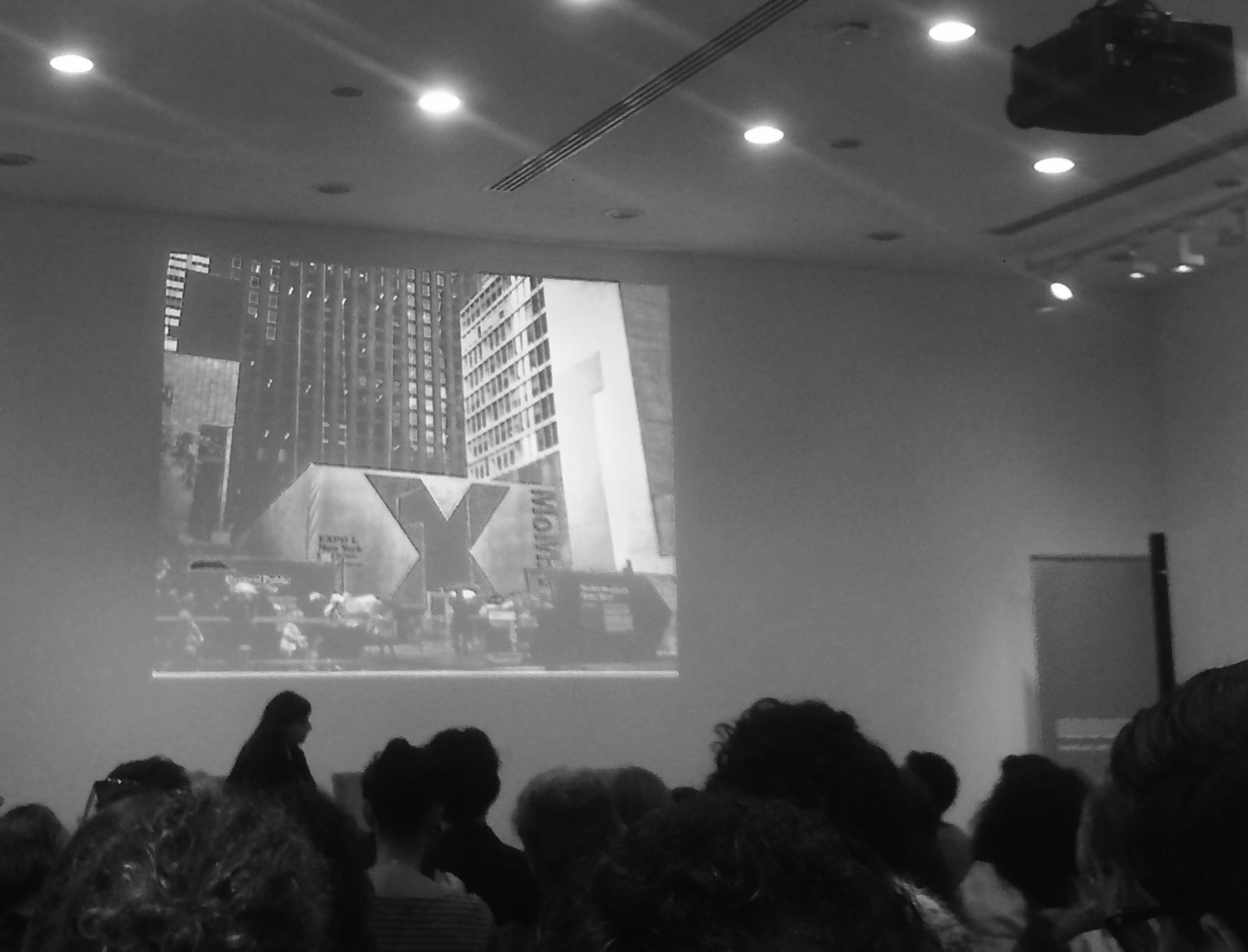
And as Sharjah Art Foundation director Hoor Al Qasimi – on a panel titled “Engagement and the Responsive Institution” – went through a dense 75-picture presentation about SAF’s engagement with its own community, and on restoring heritage and rebuilding memory as important for attracting an audience external to the art world, it seemed reasonable to ask the questions we ask ourselves every day as practitioners and institutions when not in the representational mindset of goodwill ambassadors for our projects, the same questions we shared a year before on that rooftop.
Getting my hands on the microphone for a final question, I tracked back to the value of engagement to begin with, asking what could be the purpose of forming — in some cases — unnatural and forced bonds with an audience that’s not interested in what we do. Why aren’t contemporary art spaces satisfied with a specialized audience? Why do we act as if we manage to integrate different audiences when, in reality, most efforts fail? Why are we ignoring — within the bounds of this conversation — the opportunistic side of engagement and community-based work that turns a community into fetishized subjects? Has the language of engagement become a self-redeeming instrument for the arts, an apology in the face of accusations of elitism?
Unfortunately, time was up before anyone could adequately address any of these questions during the Q&A, although many were keen to raise similar issues during numerous coffee breaks, before we hurried back into air conditioning for more presentations – perhaps a problematic format to begin with, as presenters pitched readymade pieces about their spaces and experiences rather than attempted to provoke discussion. Genuine conversation seemed to me unattainable, although applause was a major activity.
تقارير ذات صلة
On Farouk Wahba’s atelier: Chronicle of a mentor and his students
Alexandrian artist Farouk Wahba created a contemporary art movement which still echoes today
‘The future is here:’ On design education in Egypt
On education's role in Egypt's growing design culture + issues like censorship, documentation & the market.
‘Blink’: A moment of possibility?
“Blink, the moment of unequivocal, uncertain, unspecified and unrealistic judgement, is one which travels through a narrow wormhole to infinite space with no gravity. This moment might also teleport itself…
Your support is the only way to ensure independent, progressive journalism survives.
You have a right to access accurate information, be stimulated by innovative and nuanced reporting, and be moved by compelling storytelling. Subscribe now to become part of the growing community of members who help us maintain our editorial independence.
Join us