
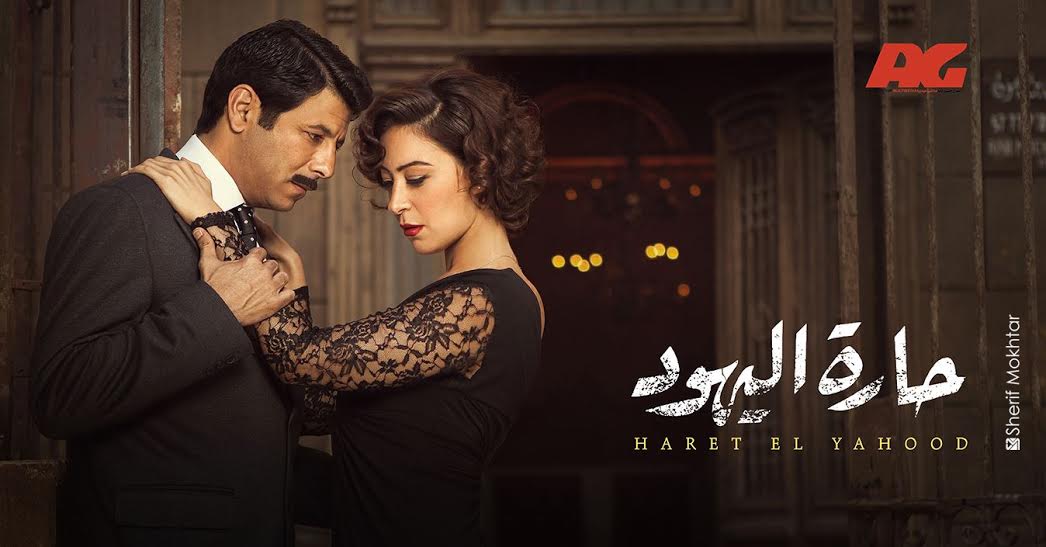
It’s sink-or-swim for Egypt’s TV industry
As Ramadan draws to a close, viewers are still hotly debating several successful serials that premiered this summer, like "Taht al-Saytara" (Under Control) and “Haret el-Yahood" (The Jewish Alley). But that popularity doesn’t necessarily translate into revenue, and Egypt’s TV industry is scrambling to climb out of a financial quagmire — all while trying to regain a faltering grip on its historic place as the regional entertainment powerhouse.
The holy month has become nothing short of an arms race in which advertisers, channels and producers do whatever it takes to push up ratings. But as viewers increasingly spill over to the internet, and ballooning production costs continue to outpace ad revenue, channels and advertisers vying for eyeballs in the Arab world’s most competitive TV market to are forced to explore new ways to stay relevant.
The current model, in which at least 80 percent of the year’s original content airs during the month of Ramadan, is driving channels into the ground financially. And advertisers, fed up with increasing viewer fragmentation and the rising cost of TV spots — the ads that largely fund that content in the first place — are starting to leave the small screen to reach an enormous youth demographic that’s more likely to post on Facebook than to turn on the television.
But that very precarity might be fostering innovation. Local channels and production houses are tentatively starting to experiment with new forms of original content and distribution for the post-Ramadan season, which, if successful, could potentially swerve the television industry away from its downwards trajectory.
Lavish productions
Just a few hours before the controversial series “Haret el-Yahood” is set to premier, 61-year-old writer and producer Medhat El-Adl is sitting in his montage room with the lights dimmed, silently watching a copy of one of the show’s episodes on a double-screen iMac. In the series, a young Jewish woman played by actress Menna Shalaby falls in love with a Muslim army officer fighting in the war against Israel in 1948. A few hours later, Adl calls in to a talk show to defend himself against charges that the show is too sympathetic to Jews.
Adl is responsible for some of Egypt’s most famous film and television productions, and his production company, the El-Adl Group, spent LE120 million producing three major television series this year. The sets alone for “Haret el-Yahood”— which included a replica of the Moses Ben Maimon Synagogue off Muaz Street in Islamic Cairo — cost LE10 million. As usual, all three of Adl’s 2015 series were made to air during Ramadan, the only time of the year when channels will pay high-enough price tags to enable producers to finance big splashy productions.
Channels pay around three times as much for Ramadan content, which gives producers a powerful incentive to stick to series that will air during the holy month. Big local stars like Menna Shalaby and Nelly Karim play the lead roles in Adl’s productions — actresses who would probably keep to the more prestigious and better-paying silver screen if it wasn’t for Egypt’s slumping film industry. This star power, coupled with better equipment and production techniques over the last few years, has given serials a more cinematic feel.
“The kind of content, cinematography, lighting, editing, and musical composition — it’s actually quite impressive now, versus what it was just five or 10 years ago,” says Ahmed Emad, regional media manager for advertising giant Mondolez International.
Unfortunately, with stars and high-quality production values now expected by audiences, these serials cost more and more to produce at a time when channels have less to pay for them. Famed actor Adel Imam reportedly earned a cool LE35 million for his portrayal of an aging leftist agriculture professor who becomes embroiled in politics in “Ostaz Wa Ra’is Qism” (Professor and Head of the Department).
Production costs for this year’s Ramadan serials have been estimated to reach LE1.1 billion, but they’re projected to bring in several hundred million pounds less than that in advertising revenue. Experts say channels are willing to gamble on overspending on Ramadan content in the hopes that the shows become big enough hits to draw viewership in reruns throughout the rest of the year. That enables stations to sell ads in the off-season during shows they’ve already paid for.
Starving artists
Unfortunately, this gamble rarely pays off. As Mohamed Khadr, a general manager at Channel TEN, put it in a recent interview with Aswat Masriya: “There is not a single channel that is making a profit these days.”
The market is now so oversaturated with channels, many airing the same shows, that it’s hardly a surprise they aren’t making money. There are currently at least 20 stations competing for premium content and viewership, and many more lower-tier stations that often air pirated content, and mostly get away with it.
Over the past year, Egyptian channels have begun to show the ill effects of this unprofitable set-up. Media companies have laid off staff, cut salaries, shut down stations and begun airing cheaper content. In March, the CBC network closed its CBC 2 channel and laid off scores of employees. Modern Sports, Mehwar 2 and Mehwar Drama were all shuttered earlier this year. ONtv started letting staff go in 2014, and in early 2015, employees at the Dream network — a satellite pioneer that dominated in the mid-2000s — began complaining that they hadn’t been paid regularly for a year. This recent austerity has been a harsh awakening for channels that were spending more than they were capable of bringing in.
Producers are also suffering the consequences of this insolvency. “The channels still haven’t given me the money they owe for ‘Al-Daeya’ (The Preacher),” grumbles Adl, referring to his hit series from two Ramadans ago about the life of a celebrity Islamist preacher. “They owe me at least LE50 million.”
Tarek al-Ganainy, producer and owner of TVision Production, says he’s gone to court to collect back payments from stations that still haven’t paid him for shows aired during previous holy months. “I’ve stopped selling content to channels that owe me money,” he says.
The lure of the internet
One reason the stations’ Ramadan-centric strategy isn’t working is that it doesn’t take into account the recent seismic shift in the way Egyptians — particularly the coveted youth demographic — are watching these shows.
“My friends and I tend to just watch whatever serials were popular later on, online,” explains Dina Kamel, who’s a representative at a Vodafone call center.
“The minute something airs, it’s everywhere else,” adds CBC’s Rawia Shater. Naturally, this translates into lost revenue for channels and producers. “We don’t have the luck of airing something first on CBC, then selling it to iTunes and then Netflix and then selling it to the Saudi market … and that’s how channels make money on expensive content.”
It’s not that the channels are oblivious to these trends. In recent years, networks like CBC have set up official YouTube pages to post content immediately after it airs, figuring that since shows were going to be illicitly posted on YouTube anyway, stations might as well recoup some ad revenue by posting it themselves. However, 45 percent of the revenue from commercials preceding YouTube videos drops right back into YouTube’s coffers. Moreover, online ad spots command much lower rates than television.
MBC, a network headquartered in Dubai that broadcasts popular Egyptian and international content, set up the Middle East’s first streaming video-on-demand website, shahed.net, in 2010 — but the site hasn’t made much money yet, according to Shater. It’s possible that deep-pocketed MBC is more interested in building an online brand than making money from the site — but not everyone has that luxury.
Channels like CBC and Al-Nahar also say they’re in the process of building view-on-demand online platforms, although they haven’t disclosed many details. What’s clear is that if Egyptian television wants to regain its once dominant role in regional entertainment — or even just hold on to what it has left — it will have to figure out how to evolve beyond old paradigms and stay relevant in a digital age.
“The internet is like this really big prize that we know we have to get to,” says Ganainy. “And most of us don’t know how to get there. But we’re working on it.”
Breaking away
One strategy stations are toying with is promoting new Egyptian serials in the off-season — something that has long been taboo in the local broadcast industry. In previous years, channels aired Turkish soap operas and Bollywood series, both of which were much cheaper than original Egyptian dramas, whenever Ramadan reruns weren’t enough. In the years after 2011, nighttime programming was also dominated by political talk shows, which were cheap to produce and highly profitable.
Recently, though, Egypt’s fraught political relations with Turkey has dimmed the appeal of Turkish soaps, which have also gotten much more costly. And after four years, Egyptians have grown weary of blabbering broadcast pundits.
In April, Al-Nahar, one of the first Egyptian television channels to experiment with airing new dramas during the non-holy months back in 2013 with the second season of “Adam and Gamila” — a Romeo-and-Juliet-type love story about a couple torn apart by the expectations of Egyptian society — added two time slots to its nightly grid for original, first-run Egyptian serials. Al-Nahar’s Ziad believes this new model can save stations money — it’s cheaper than paying for Turkish content these days — and retain viewer interest all year long, though this remains to be tested.
Producers, many of whom have had less work amid the economic slump of the last few years, are warming up to the idea of experimenting with dramas that involve new faces, lower-budget productions and more episodes per season — Ramadan series max out at 30, but off-season serials could have at least 60 episodes to enable channels to pick up more advertising revenue.
Medhat El-Adl is producing two non-Ramadan serials this coming fall, the first two non-holy month television productions his company has made since its beginnings in 1997. Adl says his shows will portray “powerful subjects” that can draw viewers even without the hype of the big-name celebrities that dominate Ramadan lineups.
“Everyone is starting to do it,” says Nagy, Nahar’s ad sales rep. “Channels like CBC, MBC, Dream, Mehwar, TEN, Hayat — they’re all starting to bring Egyptian dramas out of Ramadan.”
Will advertisers eschew the black box?
As Egyptian television looks to remake itself, the companies that keep stations on the air — the advertisers — are considering new ways to reach viewers that may never bother to turn on their televisions at all. This could be terrible news for the TV industry down the road.
For the moment, though, television still firmly remains the dominant advertising medium in Egypt.
“Nothing creates an impact quite like television on consumer awareness — nothing. This is the main source of entertainment for Egyptians, bearing in mind that Egyptians are not just the people who are on the internet. You’re talking about 90 million,” says Universal Media’s Dina Hashem, who says nearly 90 percent of her client’s advertising budgets still go to television. And in Egypt — for now, anyway — the big shows and the big ads air during Ramadan.
Ramadan has become so synonymous with high-budget, ground-breaking commercials that the ads are more eagerly anticipated than the shows. Coke tries to outdo Pepsi; Mobinil tries to outdo Etisalat and Vodafone.
"Every company wants to stand out and do something different to break through the clutter," says Marian Makary, head of communications for Mobinil, which has often set the standard for Ramadan telecom ads, perhaps the fiercest battleground of all. In 2012, taking a page from the iconic 1971 “I’d Like to Buy the World a Coke” ad that became perhaps the most legendary commercial of all time, Mobinil’s “Dayman Ma’a Ba'd” (Always Together) spot — a four-minute song featuring well-known performers from across Egypt singing about the importance of unity in a divided country — became an instant classic.
“The campaign got us millions of views. We even had [former Vice President Mohamed] ElBaradei tweeting, saying that whoever wrote the lyrics of this song should write the constitution,” says Makary.
But even if television remains the focus for now, advertisers are increasingly thinking of more effective ways of spending their money. Firms that advertise during Ramadan spend some 30 percent of their budgets during the holy month, says Hashem. This summer, it cost anywhere from LE5,000 up to LE50,000 per minute to run a commercial, depending on the channel and time slot. Channels are inflating these costs each year — and advertisers are complaining.
“It doesn’t make sense that the cost keeps going higher, from an advertising point of view,” said Ahmed Lasheen, the brands and communications director of Etisalat, at a recent AmCham event on the future of the television sector.
In this context, experts agree that the burgeoning shift to digital advertising is significant. Mobinil’s #fa3el_kheir campaign is a case in point. The campaign started some 10 days before Ramadan, when food-stocked refrigerators, bookshelves full of books and racks full of clothes started mysteriously appearing in Cairo streets with nothing but a curious little hashtag reading, “#fa3el_kheir” (do good).
Social media users immediately began a fervent Twitter debate, asking, “Who is this mysterious #fa3el_kheir?” People posted Facebook photos of themselves adding food to the refrigerator or clothing to the racks; others began snapping shots of other anonymous charitable acts they found around the city and applied the hashtag themselves. “Thank you #fa3el_kheir for restoring our faith in humanity,” wrote a blogger for the website Scoop Empire. “And what is this person asking in return? Absolutely nothing, and that is the beauty of it.”
Well, not quite. In the wee hours of the first night of Ramadan, a commercial flashed on television. A video roved softly lit Cairo streets, zooming in on the random charitable acts that had set social networks abuzz — and at the center of the screen, there again was the now-familiar hashtag, #fa3el_kheir. Only this time it was accompanied by another familiar logo — the orange Mobinil brand name.
The campaign may not have been selfless, but it was effective — and it largely accomplished its mission without relying on the medium of TV.
“You wouldn’t find a company as big as Mobinil launching a campaign based on a hashtag four or five years ago,” says Ahmed Emad of Mondolez.
Mohamed Fouad, a creative director at Leo Burnett, the agency that designed the Mobinil campaign, thinks that advertising will ultimately move away from the TV spots that consume the vast majority of ad budgets.
A precarious future
For now, as the curtain falls on the binge-watching season, forthcoming ratings and revenue tallies will reveal if this year’s gamble on big-budget, controversial serials and splashy commercials paid off. But so far, the channel that’s trumpeting the biggest projected profits for the holy month is MBC Masr — which is based in Dubai. Time will tell if the Egyptian channels will manage to catch up.
This is an edited version of an article that first appeared in Business Monthly.

Eric Knecht
Eric Knecht is a journalist who has been studying and working in Egypt since 2010, when he migrated to the country from a small Atlantic peninsula known as New Jersey. He tends…
تقارير ذات صلة

Ramadan’s stand-out ads: Time to tone down the chauvinism, Birell
The fake beer brought back its famous misogyny and strayed into homophobia too.
Ramadan TV’s stand-out ads: Etisalat is optimistically classist
The new advert from Egypt's youngest telecom company is all about optimism, but many find it problematic.
Ramadan TV’s stand-out ads: Hospital ad causes complex controversy
A coming together of A-listers, a noble cause and a social media spat has generated this year’s hottest Ramadan TV ad.
Your support is the only way to ensure independent, progressive journalism survives.
You have a right to access accurate information, be stimulated by innovative and nuanced reporting, and be moved by compelling storytelling. Subscribe now to become part of the growing community of members who help us maintain our editorial independence.
Join us