
‘It reveals the failure of the occupation:’ Q&A with writer Majd Kayyal on Palestine’s mobilization
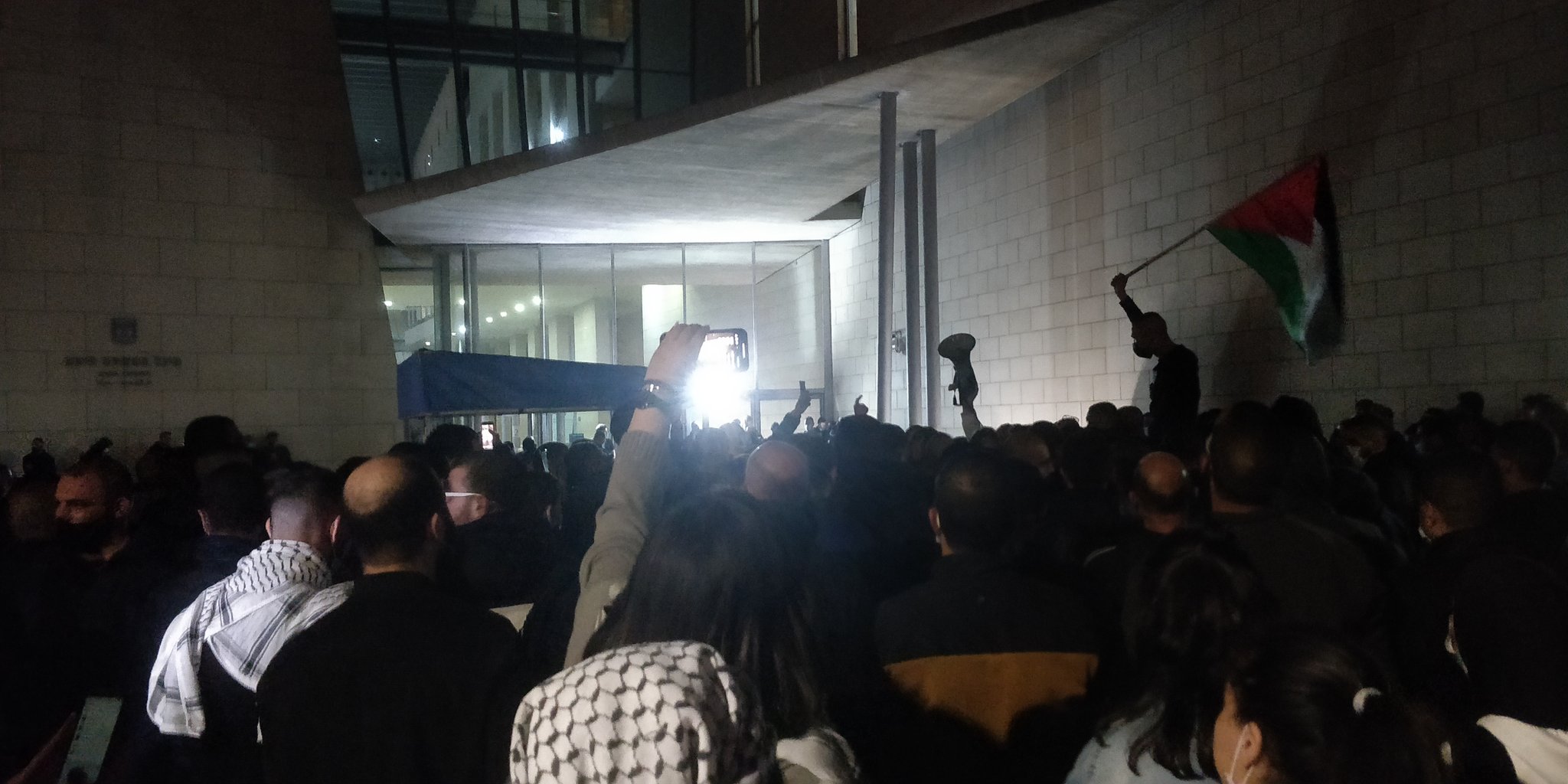
On the first day of Eid, mobilization against the Israeli occupation continued across historic Palestine.
Sparked by Israeli police’s move to forcibly displace Palestinian families living in East Jerusalem’s Sheikh Jarrah, one of the last neighborhoods resisting total Israelization, the mobilization has seen spontaneous protests in communities across Palestine and a barrage of rockets targeting Israeli cities and key infrastructure from oil pipelines to airports.
At the time of writing, prospects for a ceasefire between the resistance in Gaza and Israel remained distant on Thursday evening with an intense Israeli military presence amassing on the border with Gaza. The Gazan Health Ministry reported that 87 people have been killed by Israeli airstrikes in Gaza thus far, a death toll that includes 18 children, while over 500 people have been injured.
The unity of the response to Israeli aggression — as Palestinians with Israeli nationality in areas that were annexed to Israel in 1948 have taken to the streets to protest in solidarity with actions in East Jerusalem and spanning the West Bank and Gaza Strip — is “unprecedented,” Majd Kayyal, a Palestinian journalist, novelist, critic and commentator from Haifa, tells Mada Masr.
In the first of a three-part series in which Mada Masr speaks with writers across Palestine, we ask Kayyal how this moment of unity has arisen from a Palestine that has been splintered by almost a century of occupation.
Mada Masr: The situation in Palestine has escalated from protests against the forced evictions in the East Jerusalem neighborhood of Sheikh Jarrah to a comprehensive confrontation, comprising both a civilian mobilization on the ground and the armed resistance. How did this all develop?
Majd Kayyal: What’s happening right now was born out of a number of different yet interlocking factors. Things began to gain momentum beyond protesting the Sheikh Jarrah evictions when the Israeli police blocked the Damascus Gate entrance to the Old City. It is a place of real importance to Jerusalemites, as much as Tahrir Square is for Egyptians. Once they had attacked Al-Aqsa Mosque courtyards, it was no longer a question for only the families of Sheikh Jarrah but an issue for everyone who cares about Al-Aqsa. We should stress that Al-Aqsa isn’t only of religious significance, but that the mosque sits at the center and represents a sixth of the space of the Old City. If the mosque were captured, the whole of the Old City would fall and Jerusalem would be occupied in its entirety.
While things were developing in Jerusalem, calls for solidarity began to escalate among Palestinians with Israeli citizenship living in Palestinian towns that were annexed to Israel in 1948, and protests and confrontations with settler mobs began, as did activity in the Gaza Strip.
Mada: Can you speak to the conditions Palestinians with Israeli citizenship in those areas live in?
Kayyal: Since 1948, the occupation has imposed a settler majority in cities comprising Palestinians with Israeli nationality and Israeli citizens with Jewish heritage, such as Lyd, Akka, Haifa and Ramla. They aimed not only to expand the settler presence but for the complete eradication of Palestinians. In Akka and Haifa, for instance, settler colonial expansion came not only from the far right, as is usually the case, but also from the Israeli upper class, who perpetuated the longstanding practice of erasure, displacing Palestinians and turning their homes into restaurants and tourist projects. Palestinians there face very harsh economic and social conditions, and that’s before we even consider the securitized oppression.
Mada: How did settlers act during the Israeli aggressions? And how have Palestinian residents handled the settler mobilization?
Kayyal: First, settlers organized systemic waves of aggression, coming together in marches absent of political demands, but with just one refrain: “Death to the Arabs.” The marches attacked and assaulted Palestinian houses. Yesterday, they brutally assaulted a pregnant woman in Lyd, and she’s now in a critical state. Those marches were well protected by occupation forces. The military doesn’t want to be seen attacking people’s homes and women and so forth, which is why settlers are at the front of the scene.
On the Palestinian side, people go out to protect their houses and their families. This began to be coordinated spontaneously within their neighborhoods. People there know each other very well, and that’s a difference between an indigenous community and settlers who mobilize themselves on Telegram by asking, “who wants to kill more Arabs?” Popular coordination within neighborhoods has its downsides, namely being isolated from other neighborhoods, but it does shield the neighborhood from the attacks of settlers and secret police.
Mada Masr: When the armed resistance in Gaza joined the mobilization, it appears to have been a welcomed by young people in Palestinian areas. How do you view this? Some have suggested that the escalation toward armed resistance could strip the cause of international solidarity and the support of public opinion. What are your thoughts on that? And of the view that Hamas wants to dominate the scene?
Kayyal: I am very critical of Hamas, and personally I have greater faith in popular movements and the capacity of people to organize themselves. It’s very problematic, however, to contemplate how international opinion will react, while people are being murdered in their streets and their homes and being shot dead while praying.
On the other hand, since 2006, the Israeli occupation has exerted every effort to separate Gaza from the Palestinian struggle more broadly, as if the issue of Gaza concerns the people of Gaza alone: Things there are propelled by the siege, power cuts and restrictions in the maritime territories where they’re permitted to fish. This is the essence of the desire of the Israeli occupation: to dismantle Palestinian society. And this is the supreme significance of Gaza joining the fray now. It reveals the failure of the occupation, and that the smallest struggle in Sheikh Jarrah is a struggle for all of Gaza, that Lyd is Gaza’s cause, and so forth. This [kind of solidarity] is unprecedented, even during the Second Intifada. Therefore, while I might be more inclined to popular resistance, there remains a dire need to rebuild national unity and a collective goal, to redefine a shared cause and to break the siege on Gaza.
To me, the claim that Hamas is looking to score points is ridiculous. What Hamas has attempted over the past few days is almost suicidal. The movement has exposed itself and its headquarters as a target for the occupying forces. It was people in Gaza who chose to join the resistance, and that decision came directly from the people who are now being targeted and killed as a result of that choice.

تقارير ذات صلة
Mai Serhan imagines Palestine and recounts life after for us
"I have never been to the place where I am from, but I can imagine it for us, Baba, for you and me." This opening line of Mai Serhan's I…
Doha summit: Arab unity in image
Sources tell Mada Masr why the Arab Summit failed to galvanize Arab unity
Palestine in the Claws of Colonialism
Selections from Ahmed Sadeq Saad’s “Palestine in the Claws of Colonialism” (1947)
Your support is the only way to ensure independent, progressive journalism survives.
You have a right to access accurate information, be stimulated by innovative and nuanced reporting, and be moved by compelling storytelling. Subscribe now to become part of the growing community of members who help us maintain our editorial independence.
Join us