
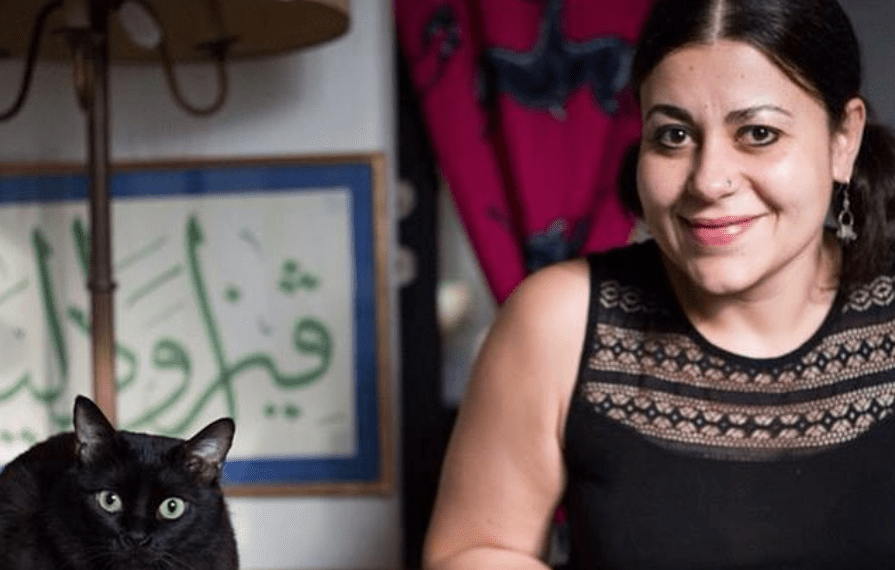
In loving memory of Dalia Suleiman: Cultural worker, friend and cat lover
Dalia Suleiman had been active on the Egyptian cultural scene for almost two decades when she passed away last Sunday, after a three-year struggle with cancer.
Born and raised in Alexandria, Suleiman graduated from Alexandria University’s Faculty of Fine Arts and began her career working at Bibliotheca Alexandrina, before she moved to Cairo in 2005. She spent a year working at performing arts space Studio Emad Eddin before moving on to Townhouse in 2006, where she spent three years as the institution’s office manager. She then joined the staff of Zero Production, an independent production company founded by filmmaker Tamer El Said, where she garnered enough experience and interest in the filmmaking process to spend one year freelancing as a producer on several documentary films. In 2013, she took on the position of managing director at the Contemporary Image Collective (CIC), where she played an integral part in honing and strengthening the framework within which the institution continues to perform today. Since 2016 and up to her death, Suleiman served as the head of the Cairo of office of Pro Helvetia, the Swiss arts council, where she strived to use her years of expertise and the many connections she’d acquired to create meaningful partnerships between artists and institutions in Egypt and their counterparts in Switzerland.
Suleiman, a dedicated champion of the arts, devoted her life to the logistical and administrative side of the cultural production process, a role that is often overlooked but that is nonetheless essential for the sustainability of this and any cultural sector. Her commitment and her passion left an indelible mark on the organizations where she worked, the people she collaborated with, and the independent arts scene as a whole.
She is survived and sorely missed by a brother and a sister, two nephews, and three cats*. She was 41.

Here, we speak with some of Suleiman’s many friends and colleagues about her life and work, and how she impacted their own.
Mona Daoud: “She saw the best in people, and encouraged it. She let art grow.”
Writer and filmmaker Mona Daoud first met Suleiman in 2003, when they were both working in Bibliotheca Alexandrina. “I was a researcher and she was a librarian and I was fascinated by her curly purple hair and nose piercing, which set her apart from everyone else working there,” Daoud recalls. “One day before a holiday we were leaving the Bibliotheca and she invited me to go to Siwa with her and a bunch of other people, and I didn’t hesitate, even though we hadn’t really talked much before that; we’d just had coffee a couple of times in the cafeteria.”
That trip was life-changing for Daoud, she says, as it is where she was introduced to the people who would later become her closest friends, along with Suleiman, making up the members of the group they would dub “BA Confidential” (BA short for Bibliotheca Alexandrina), an integral part of her and Suleiman’s life. “Camping in the desert at night around the fire, gazing at the stars — that was how our relationship started, 17 years ago.”
A year or two later, without much collective planning, Suleiman and Daoud — as well as other members of the group — moved to Cairo, where their friendship continued to grow. Daoud remembers Suleiman’s tiny downtown flat, which she had poured a lot of time and energy into decorating: “She had an interior designer within her; she turned it into a haven for so many people, we used to go and hang out there, we called it El Pension — she loved having wine and cheese gatherings, she just loved connecting people,” Daoud says. “She connected me to so many artists; a network just began to flourish. She had an amazing eye for people, genuine people with genuine talent and good values.”

Daoud recounts that one of the most inspiring things about Suleiman was how, whenever she encountered someone with potential, she would do her best to offer them all kinds of support she could: “She saw the best in people and she encouraged it; she let art grow.” That personal tendency of Suleiman’s, Daoud says, was also part of what made her stand out in her practice as a cultural manager. “She was so good at what she did, it was incredible. She was a visionary; insightful and far-sighted, and she was extremely self-disciplined,” she muses. “And when she got sick, she didn’t stop working. She kept it a secret [from all but her closest friends] for three years because she didn’t want it to affect the work; this is how strong her work ethic was,” she continues, remembering how Suleiman remained focused and organized at the time: “She would take work with her to chemotherapy sessions, she would work at home, she would make her sick days her vacation days; everything was in order, she never left anything uncovered.”
Daoud speaks affectionately of Suleiman’s love for cats, and how it started as a tender appreciation of the creatures and then became a great passion of hers. She started rescuing cats off the streets of Cairo, caring for strays wherever she worked and fighting for them “like a warrior, an activist.” When Suleiman was working at Pro Helvetia, Daoud says, she fed the cats in the garden, protected them, recruited security staff to take care of them, and made it possible for them to stay despite some people’s objections. “I think cats represent Dalia in a way,” Daoud reflects. “They have a reputation of being harsh and self-involved, when in reality they are very loving, beautiful, vulnerable creatures who are very loyal, which is ultimately what Dalia was.”
“She had a wonderful sense of humor. I have never laughed with anyone as much as I laughed with her. She had incredible taste in films, she’d always pick the movies we’d go see together. It was a pleasure to share art with her,” Daoud says of her late friend. Then she adds: “Losing her as a friend is one thing, but losing her as a cultural and art figure is huge — enormous — and I’m not even biased. You can see it in the words of everyone who worked with her. I can’t begin to describe the loss.”

Adel Abdel Wahab: “Her strength and courage were exceptional.”
Theater director Adel Abdel Wahab is a friend of Suleiman’s and a fellow Alexandrian. They met in 2017, when Abdel Wahab applied for a research trip to Switzerland while curating an edition of the annual Theater = A Must Festival he founded. Pro Helvetia sponsored a number of Swiss artists to show their work at the 2018 and 2019 editions of the festival.
“Cultural work in Egypt, especially in the independent sector and particularly the field of contemporary art, is highly unstable due to a number of factors, including legislation, financial sustainability, and the lack of multi-purpose cultural spaces,” Abdel Wahab says. “Dalia, with her years of work on the scene, was of course aware of this, and in her time heading the Pro Helvetia Cairo office, she showed remarkable prowess for developing projects that centered on cultural exchange and artistic residency programs between Egypt and Switzerland, because she knew such partnerships would help Egyptian artists working without a proper infrastructure.”
Because Suleiman knew the local scene so well, and — more importantly — believed in it, Abdel Wahab says, she also saw the benefits for collaborating Swiss artists. “Her impact is evident in how over the past few years the Pro Helvetia team was more engaged with the arts scene, particularly when it came to performance and visual art as well as music. They took part in many diverse events in both the official and independent culture sectors, and under her leadership the foundation’s presence offered insight and encouragement that culminated in true and solid partnerships.”
Abdel Wahab speaks of Suleiman’s ambition, and how she aspired to develop even more projects on the regional scale, partnering with artistic institutions across the Arab world and the Middle East. “Her practical and methodical experience was invaluable, and she had an immense passion for the arts,” he continues. “It hurts talking about her now; I feel helpless. She was a wonderful person; so giving, and she had an endless love for life. Her strength and her courage during her long struggle with illness were exceptional and inspiring.”

Tamer El Said: “She was open and generous; she had the right DNA for this particular culture scene.”
Filmmaker Tamer El Said had met Suleiman before she joined his company, Zero Production, in 2009, but it was during her three-year stint as part of the company’s production team and a crew member on his 2016 film In the Last Days of the City that Said really came to know and value Suleiman as a colleague and a friend.
“One of the most impressive things about Dalia was her ceaseless desire to learn and to experience new things; she was always evolving,” Said says. “When I think about it now it makes me a little sad, because it’s as if she somehow knew that her time here would be brief, so she didn’t want to waste it, she wanted to do everything.”
Said mentions Suleiman’s “captivating and extraordinary” organizational skills, which allowed her to take on various projects while working at Zero Production, take part in establishing Cimatheque (co-founded by Said), and work on the film crew. “She’d be doing one thing and she’d offer to do another simultaneously, like join the film’s wardrobe department, for instance, and she would do it in a spirit of love and giving,” he recalls. “She was very open to experimentation. She also worked on the film’s still photos, and this brought forth a certain energy within her; she developed a love for photography that stayed with her for a long time afterwards.”
Such openness was part of the overall quality that made Suleiman so compatible with the city’s culture scene, Said believes. “I’ve always thought that working on this scene — the ‘independent’ culture scene, or whatever we call it, the circles intent on creating alternatives that challenge the dominating or “official” narrative — requires a certain DNA,” Said says. “It was clear to me from day one that Dalia had that DNA, in a very real and powerful way. This is why she was able to work on so many different projects with so many different artists and accumulate a wealth of experience that allowed her to develop a vision she was able to use in the service of this scene’s actual needs when she came to head Cairo’s Pro Helvetia office.”
What Said also respects about Suleiman is that her dedication to the cultural scene was a clear choice that she made, despite numerous opportunities to steer her life in a different direction. “She could’ve easily worked for corporates or embassies or anywhere else where she would’ve been paid a lot more than what she got working in the independent cultural institutions where she did, because none of them had the resources to compensate her the same way,” Said elaborates. “But the truth is she never even considered it, although I know she received many offers. It was always clear to her what she was doing here, and this awareness of the importance of her role on the culture scene was very striking, and something I truly admire, especially that this was a long time before 2011, when the scene started to grow and have some more to offer those who worked in it.”
As a friend, Suleiman was rare, Said says. He recalls an incident 10 years ago when she used Zero Production’s editing suite to make a video as a gift for her BA Confidential friends, composed of their many memories together over the years. By then they were living in different places around the world, but made it a habit to meet at least once a year to “practice their closeness,” as Said put it, and that time they were spending New Year’s in Ras Sudr, which is where Suleiman showed them the video. “I was lucky enough to witness that moment as I joined them for part of the trip, and it was beautiful because they were all so moved,” he remembers. “She was generous that way, and she didn’t make a show of it — in fact, she was too blunt sometimes, although she always had good intentions — but then her gentle, loving nature would shine through in a gesture like this.”
“I was really looking forward to seeing Dalia continue to grow in the field, and I am extremely saddened that this inspiring journey of hers was cut short. I am sure every success she was yet to achieve would have reflected on the entire scene, because she had such an acute and precise understanding of her role as a cultural manager, which enabled her to create the conditions and the space that allowed artists to do their work,” Said laments. “I still can’t believe she’s gone, especially because she kept the fact that she was sick hidden for so long — another testament to her grace and her strength.”

Adham Bakry: “She was a carer, a matriarch, a giant on the culture scene, but a silent one.”
Graphic artist Adham Bakry spent three years working with Suleiman at Townhouse, where she held the position of office manager. It was then that their lasting friendship and professional partnership began. “She was so diligent when it came to her work, and very critical; she gave no compliments. In my three years in Townhouse only once or twice did she ever say: ‘Bakry, good job,’” Bakry recalls. “But I am all the better for it. She had an incredible influence on my work, because she had an amazing eye and she was an artist herself.”
Bakry and Suleiman would often embark on artistic projects together, from drawing to making collages, and Suleiman would sometimes bring him on board as a freelance graphic designer for the institutions where she worked. “She was so honest, so giving. She’s also the reason why I had a solo exhibition in Townhouse back in 2008, so in a way she made my career.”
Bakry notes that Suleiman’s managerial skills extended to her personal life. “She placed everyone in the right position and put them to work — you could see it in how she decorated her flat, for instance,” he says. “She loved gathering people and hosting dinners and planning shindigs to the tiniest detail. And she was a carer; she would spend time listening to our problems and analyzing them and her advice was always spot-on. She was our matriarch. In a way I feel like I have lost a mother.”
He goes on to speak of Suleiman’s resilience. “Throughout her years working in the field she was faced with many difficulties, but she never stopped, she never mourned, never said she was in pain — she took it all in and she was always in control. She was a giant on the culture scene, but a silent one,” he remembers. “She was a very private person, and that’s also why she kept her diagnosis a secret. She is the strongest woman I know.”

Andrea Thal: “She understood her work as something she did for the local community.”
Artist and curator Andrea Thal joined CIC as artistic director during Suleiman’s time as managing director of the institution. “What really stays with me from witnessing Dalia at work is how she adamantly strived for a cultural scene that wasn’t elitist but that was more widely accessible, something more people could understand and be an active part of,” she says. “She really understood her work as something she did for the local community, and with every project she’d always pose that question: ‘What does it bring to the local community?’ — and I thought that was really beautiful.”
Hussein El-Hajj: “So much of what the scene is today was built through the efforts of people like her.”
Translator and cultural manager Hussein El-Hajj got to know Suleiman while working as a librarian at CIC when she was the space’s managing director. “I was reporting to her and to Andrea, and their presence together created a special kind of balance,” he says. “Dalia had a remarkable interest in management. She once organized a management workshop for the team, and used that to prompt us to write down ideas and to help each one of us delineate their role within the institution — she was always doing things like that.”

What El-Hajj most appreciates about Suleiman was how she gave him space to grow, even though he didn’t have much experience when he applied for the librarian position at CIC. At the time, El-Hajj was working there part-time alongside another job at Cairo’s Institute of Liberal Arts and Sciences, and he recalls how supportive Suleiman was of his dual responsibilities. “She never seemed to mind that I had a commitment to CILAS, in fact she would always ask about my work there and how it was going, and would even allow us to conduct classes in the library sometimes,” he says. “She saw something in me and she encouraged me to pursue that, she enabled me to attend trainings that had to do with library management, for example; she wanted me to learn, to work on myself.”
El-Hajj also highlights Suleiman’s sense of responsibility towards the scene and solidarity with other institutions. “I remember the day the Townhouse building partially collapsed, she was one of the first people there, standing by William’s (Wells, co-founder of Townhouse) side and offering support. She was always present and involved,” he says. “What hurts the most about her passing is the knowledge that so much of what the culture scene is today was built through the efforts of people like her.”
Nahla Soliman: “Her door was always open, to humans and cats alike.”
Pro Helvetia’s communications and public relations manager Nahla Soliman had been working with Suleiman for more than three years before she passed. Soliman speaks of Suleiman’s passion for her work, and how her commitment extended beyond the Egyptian culture scene to include cultural work across the Arab region. “She worked very hard to expand our network of partners in other Arab countries; she was always carrying out business trips in the region to strengthen our existing partnerships and to build new ones,” she says. “And she was always a generous host for Swiss artists interested in the region.”
Naturally, Soliman also mentions Suleiman’s special relationship with cats, as Pro Helvetia was where her love for felines reached its peak. “She used to take care of them and she rescued many. We created a hashtag together to post the cats' pictures on it: #CatsOfProHelvetia,” she says. “Her door was always open, to humans and cats alike.”

*Suleiman’s cats, Visa, Coco and Salvador (pictured below) are currently looking for homes. If you or someone you know is interested in adopting a cat (or two, or three), please contact [email protected].


تقارير ذات صلة

Saif al-Islam: The death of a myth
Saif al-Islam Qadhafi, from power’s pinnacle to Zintan’s mountains and the shadows of myth

linuxawy: Let’s free the world
To see the moment it all began, you have to get in a time machine, back to a now defunct blog
Hossam Shabat’s last article
Hours before he was killed in an Israeli airstrike targeting his car, journalist Hossam Shabat wrote about Israel's resumption of its scorched earth policy in Beit Hanoun, his hometown. This…
Your support is the only way to ensure independent, progressive journalism survives.
You have a right to access accurate information, be stimulated by innovative and nuanced reporting, and be moved by compelling storytelling. Subscribe now to become part of the growing community of members who help us maintain our editorial independence.
Join us