
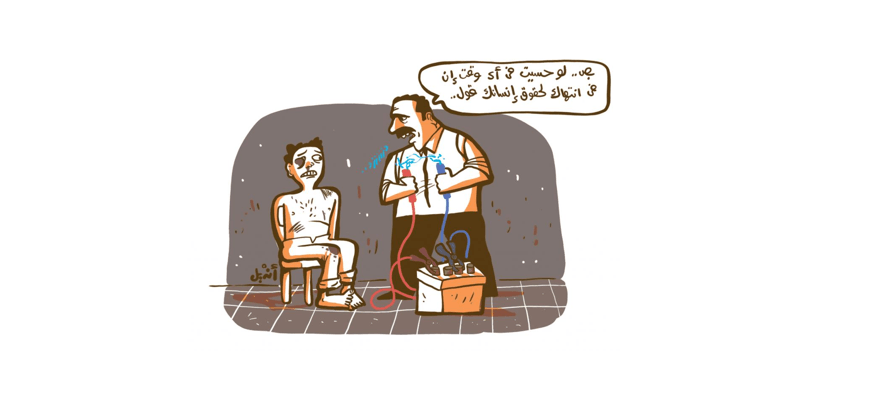

In the summer of 2014, state-owned newspapers published a government-sponsored ultimatum to all NGOs working outside the scope of the NGO law, threatening them with legal action and dissolution.
The warning came amid a systematic crackdown on freedoms and any form of opposition to President Abdel Fattah al-Sisi's administration. It was followed by a media campaign against rights organizations that presents a challenge to the state's persistent violations.
In December, the Egyptian Initiative for Personal Rights (EIPR), a major player in Egyptian civil society, decided to register according to the law, in reaction to what was perceived as a threat to its existence. However, this conversation with Gasser Abdel Razek, executive director of EIPR, explains that the decision to register was essentially a form of resistance.
Mada Masr: Let’s start with this — the decision by EIPR to register according to the NGO Law (2002), a decision that came after much consideration about the organization’s stance in light of the threats imposed by the Ministry of Social Solidarity on civil- and rights-related work. What is the strategy behind this decision, and what does it mean to register?
Gasser Abdel Razek: I think the board of trustees and the administration of EIPR acted responsibly. After the Ministry of Social Solidarity imposed an initial time limit for registration, we met and discussed all possible options, one of which was shutting down in protest — meaning EIPR would stop its work in light of the current conditions. For some of us, this was unacceptable. We also discussed changing EIPR’s decision not to register, which was taken more than ten years ago, as well as continuing with our work in the same way we have done for the past twelve years.
During our discussions, there were a number of people, including myself, who began to see the idea of registration not only as a way to solve the current problem regarding the time limit and the pressures placed on civil society by the state, but as a step in progressing the struggle and confronting the state.
The decision robs the state of clinging to the idea of registration as a tactic. They can’t continue to question our registration status. They can’t continue to question why a company works in the field of human rights. Having our legal status resolved also addresses the issue of foreign funding and needing approval for the money we get. As a result, I imagine that in the next battle, even if our registration is accepted, and we are able to build a local funding base that facilitates most of our work, there will be an issue with the research and work EIPR produces, and our criticism of the human rights record in Egypt, without reference to our legal situation or to the sources of our funding.
This is an option that not many organizations can afford to adopt. EIPR, at least in my opinion, has a reputation and a level of professionalism that allows it to hold this kind of challenge. There may be smaller, lesser-known organizations for whom it is more difficult to register, because their legal registration would allow the state a high degree of interference in their work. Not many would be able to put up with or resist this kind of interference.
The last thing I want to add is that EIPR made this decision on the basis that citizens have the right to organize in different ways, whether they choose to found a company, a lawyer’s office, a medical clinic, work in groups, or whatever. Citizens have the right to choose and organize in the manner that suits them. The state does not have the right to intervene in this organization, except to provide assistance. As a result, our decision to register does not mean that we accept this as the only appropriate way for people to organize, but just this is the way we have chosen to confront the state.
MM: In the statement EIPR published to announce your decision to register, you said you would continue to scrutinize and criticize the law, despite your decision to abide by it.
Abdel Razek: Right. Our critical stance against the current law has not changed. We also don’t have much hope in the current political climate that the proposed new legislation will result in a better legal outcome.
It is evident that the state insists on this idea of instating a coordinating committee that consists of National Security and many ministries to monitor the funding of organizations. It does not seem that they will back away from this approach, or from the methods they have in mind for governing civil society. As a result, we will continue to resist this law.
Registration could ensure an opportunity that was not available to us before. We will be able to engage with the state in a direct legal manner, giving us different options for appealing the law. We have an adequate constitutional article that governs the right to organize. Our ambition is to have a constitution that is legally effective within five years, which enables citizens to organize independently in different ways.
MM: We talked about how the registration process will give you a different approach to theoretically opposing the law. How much space is there to negotiate in a decision like this, and at the same time, what is the level of confrontation involved?
Abdel Razek: The issue is not only about negotiating. I don’t think that this exists as an option. As we decided, if EIPR continues to issue its critical professional reports, this will close many doors for potential negotiation and place us in a confrontational position with the state. This is not, theoretically, a position of confrontation with the Ministry of Social Solidarity, where we are registered; but we will use the ministry in place of the security apparatus to wage the fight. As a result, there will always be a degree of negotiation, as we have some contractual obligations by virtue of registration.
MM: Let's go back in time and discuss the various attempts by the state to organize the work of civil society and human rights organizations, especially seeing that this is a battle you have fought previously at different times. What does history tell us about the development of state mechanisms to control the field of human rights, and about the evolution of the struggle for rights?
Abdel Razek: In my estimation, the fundamental difference has to do with legislation regarding the relationship of the state to civil society.
The law 64 that governed Egyptian civil society for 35 years, from 1964 until 1999, contained no mention of a security role. Law 99, which lasted until 2002, existed for three years until the Constitutional Court annulled it. It also contained no security stipulations. The current law, issued in 2002, and which lasted 12 years till now, also contains no mention of the role of security. However, such interventions have been secretly practiced since 1964.
I believe that the situation after the January 25 revolution, specifically in the last year and a half — with its emphasis on threats and conspiracies, and the perception that every intelligence agency in the world is interfering in Egypt’s affairs and funding the work of civil society organizations — has allowed the state to intervene in a manner that is acceptable to many people. A coordinating committee consisting of the Interior Ministry and other intelligence bodies has been tasked with examining the work of civil society organizations. I don’t think such a thing would have been possible without the general context in which we find ourselves currently. This is a fundamental change. On the other hand, I believe that we now have more support and tools that were not available to us in the 1990s or in the early 2000s.
The revolution opened up areas that were previously closed. Although we feel defeated now, we cannot deny there have been gains from the revolution. I think there is stronger awareness among a wider base today. Also, despite the current siege on media, and regardless of the relationship between the state, the security apparatus and capital, which owns most media, we still have the tools and means to reach a wider audience. This limits the state’s repression in the manner that existed before.
The concept of the state that was propagated since the 1960s has been broken — for example, the projection of its role as a father figure. Something broke ideologically in January 2011 that cannot be reversed, despite attempts by the state to do so. As a result, the state is forced to negotiate. I mean they are forced at different moments, despite their antagonistic approach, to sit down and take into account suggestions from civil society organizations, other effective political actors and general democratic forces.
MM: Can you tell us exactly what happened in 1999?
Abdel Razek: There is a battle that started in 1994 against Law 64 governing the work of civil society, which was issued at the time of Gamal Abdel Nasser. The campaign escalated from 1994 to 1998, the period it took the state to decide that the law was not adequate.
The state then formed a committee, the board of which was mandated to include four independent activists. A better law — Law 99 — was issued, but it was not fully appropriate for the context of the late 1990s, and is fundamentally different to what we have now. The Constitutional Court cancelled it in 2000 for technical reasons. They re-introduced Law 99 in 2002 again, in the same spirit and with almost the same articles.
The battle that took place in 1998 and 1999 is relevant because it forced the state to accept our existence. For the first time, the committee drafted legislation in consultation with activists and had to negotiate. For the first time, we were able, in small numbers of around 100 or 125, to stage protests in front of the People’s Assembly. Protests of this nature were not common at the time.
Discussion surrounding Law 99 quickly escalated due to a hunger strike by four female rights activists in one of their organizations’ headquarters. A new law was issued, and on the same day, the state set a date for a press conference to defend it, headed by the minister at the time, Mervat al-Talawy. I think the debate about the constitutionality of the law stems from the fact that the state could not apply the law in the oppressive manner it had imagined. Because the campaign immediately exposed its flaws, it was essentially stillborn.
Maybe the context in 2002 was slightly different, because the space for civil work had expanded and the number of organizations had increased, so not many people were not concerned with the details of the law.
In the last three months, there have been attempts by the state to apply the law in a way that has not happened for over 12 years, by making all entities working in this field subject to the law. I still don’t think the state will be able to enforce it. There will continue to be entities that practice in different manners and evade state repression.
MM: It is a bit strange to think that the Egyptian state is betting on its ability to organize, especially as many things in Egypt lack organization.
Abdel Razek: The state is insulting the law by issuing decrees that are impossible to enforce. Even if they know how to apply these laws, they will only be able to do so selectively, thus destroying the concept of the rule of law. We have legislation on things related to freedoms that are impossible to enforce. It just doesn’t work. I mean, there are interventions in the personal lives of people, whereby the state is attempting to protect morals, religion and so on. This is impossible to enforce.
MM: EIPR has set an important example in terms of institutional development in the field of human rights work, where you have expanded the scope of the organization beyond legal aid, in the areas of advocacy, litigation and research. How much do you think the recent battle over registration will affect this expansion?
Abdel Razek: The expansion of EIPR was generally related to the revolution, which opened up spaces that were not available before. It created a public that did not exist previously. It made people care about this kind of work, people we were unable to engage before.
For a long time there have been people among us who left the Egyptian Ministry of Foreign Affairs or the Arab league and joined us. There were people who left international financial organizations and started to work with us. All of this was related to a certain moment, which is now receding. This will affect EIPR and wider society.
In any case, and regardless of the decision to register, we hope to expand. However, with the losses and defeats of the revolution since 2012, this expansion has not taken place in the way we envisioned. We had imagined that by the end of 2013 we would have a presence in every governorate, not necessarily in the form of offices, but at least a number of researchers and lawyers to work on local issues and local human rights cases. We were not able to do this. This will be the main challenge for us, which is a different story from that of registration.
Our challenge is to maintain our work, to continue to produce research and to monitor cases. It is clear to us that the number of cases we will be able to handle will be affected, but we can prioritize. Not that there are some rights that are more important than others, but EIPR should focus on cases that the rest of society will not handle.
There are important cases we take on that no one else handles, like our work on religion and society. We deal with sectarian violence, official religious discourse, and religion in education. Recently we have researched the administration of mosques, for example. This is something not many others are tackling from the perspective of rights and freedoms. Our health work did not receive much media coverage, but we did achieve several small achievements in terms of state health policies.
There is another important file in which we did not achieve a lot, but that I see as a priority in this period for EIPR, as it is to do with the fight against terrorism. There are many people who deal partially with the violations related to the war on terror, as the state calls it, but no one deals with it as a comprehensive file that contains analysis of policies, discourse, practices and violations.
As for our work on the economy and corruption, I believe that if EIPR does not deal with it from the perspective of human rights, then no one else will. This includes the issues of reclaiming stolen money, important contracts and deals that affect the lives of people, those related to corruption, the state budget, and the policies of the state that deal with poverty.
MM: Regardless of the state’s desire to have you organize in a specific way, you have played a big role in presenting new ideas and strategies regarding institutional organization and collective work. To what extent have you succeeded in creating a new institutional culture, and in what ways have you failed?
Abdel Razek: In general, EIPR has taken steps that are related to institutional building, and tried to build an organization that is on a similar level to rights work internationally. However, for a long time, our employees worked without health insurance or contracts, and much of the work largely depended on the character of the researcher. After the revolution, we tried to make improvements in this regard, and also tried more to connect different streams of work.
We had a strategic vision for EIPR, much of which is no longer viable after the political developments in the last two years. But at least now we have a clear work plan. The board of trustees has been meeting regularly.
We hope to continue in this way, and to increase our base of support to the extent that it will influence our strategic approach, help select board members and fund the organization. This will be a huge achievement for us.
MM: With the state taking issue with organizations receiving foreign funding, how do you react without becoming defensive? Do you think EIPR can be sustainable through popular support and other funding mechanisms?
Abdel Razek: We all know that Egypt is a funded state, meaning that over the past 35 years, the country has received billions of dollars annually for its military and development. In the later half of the 1990s, the Ford Foundation funded the Egyptian Ministry of Foreign Affairs to conduct negotiations between Palestine and Israel.
There are a large number of research institutions and international organizations who are close to the state that are receiving funds without being harassed by anyone. The ministers of social solidarity have said over the years that they accept grants for specific projects. However, those who criticize the government get no approval for such grants. Likewise, Egyptian media is largely owned by businessmen with ties to the state, whose interests are aligned, and who actually violate the rights of their own employees.
But, people are sympathetic to the discourse against foreign funding, so we must come up with a discourse that is palatable for our support base.
This takes me to the second question, because these issues are closely related. I would imagine that having partial funding coming from an Egyptian local base, even with the continuation of some foreign funding, could solve a big part of our problem.
I think we committed a major mistake, and I am also referring here to myself. While we expanded conceptually, geographically, and in terms of the issues we deal with, we failed to expand our funding sources. We failed to work on attracting local funding as well as funding from Egyptian citizens overseas.
MM: The development of civil society in Egypt has been shaped by many elements over time. What role does the human rights movement have within this development?
Abdel Razek: Civil society in Egypt is largely composed of actors who are involved in several fields of political work. Many were previously members of Marxist or Nasserist opposition groups, and were or still are political or media figures and academics.
This combination is a problem for civil society to a certain degree. If you look at the groups that work with us, such as the researchers and lawyers, most of them are involved in other forms of public work. Many of them played a fundamental role in street movements, which in my opinion have been very close to the discourse presented by the rights movement in the 30 years leading up to the 2011 revolution.
--
This interview is published jointly with Status Hour, the audio journal.
This is part of a series of interviews by Mada Masr with human rights workers in Egypt.

تقارير ذات صلة
Long-delayed bylaws regulating civil society spark concern over restrictive potential
Granting the unit wide powers over the NGO registration process circumvents the Constitution.

Mugamma revisited: Reimagining the building and the square
We propose a range of activities: a library, affordable housing, a hotel, government headquarters.
New NGO law criticized as mere cosmetic change
In a statement, 10 rights groups rejected the new law. Others viewed it as a qualified victory.
Your support is the only way to ensure independent, progressive journalism survives.
You have a right to access accurate information, be stimulated by innovative and nuanced reporting, and be moved by compelling storytelling. Subscribe now to become part of the growing community of members who help us maintain our editorial independence.
Join us