
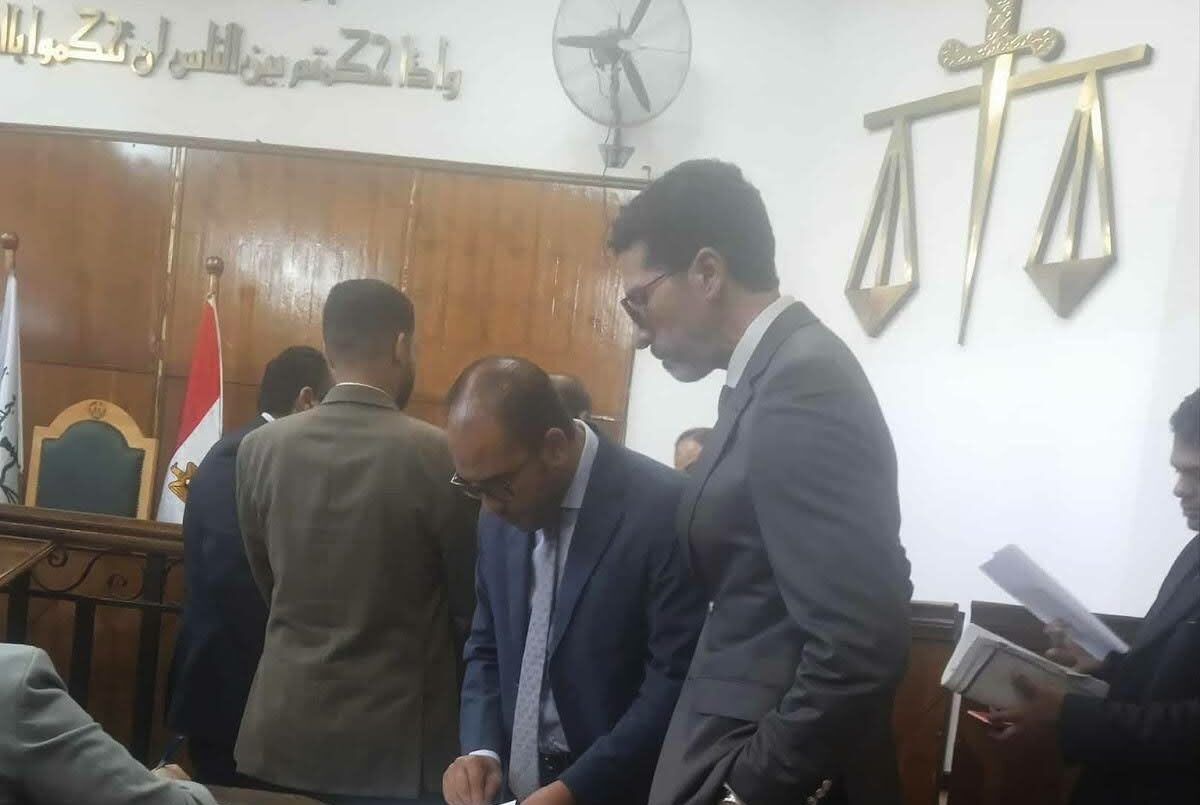
Haitham al-Hariry: Sentenced to political death solely because my father was an opposition politician
Mada Masr met with former MP Haitham al-Hariry last week inside a courtroom where the politician had just been disqualified from running in next month’s House of Representatives elections.
The final ruling issued by the Supreme Administrative Court threatens to put a sudden end to the political career Hariry began over a decade ago.
Hariry gained a parliamentary seat as an independent for Alexandria in 2015, the first elections after the ouster of Muslim Brotherhood President Mohamed Morsi.
In the House’s 2015 session, he and several other politicians formed the 25-30 Alliance, a small minority bloc that gave voice to critical sentiment in the political mainstream during five years of extremely controversial developments — from the cession of Egyptian sovereignty over the Red Sea islands of Tiran and Sanafir to the extension of constitutional limits on presidential terms and reelection.
Hariry later joined the Socialist Popular Alliance Party to field a campaign for election in December 2020.
Despite substantial popular support, his bid was cut short when voters heading to the ballot faced substantial security harassment.
Now, Hariry has become one of at least six politicians to be disqualified from the 2025 parliamentary race on the grounds of their military service status — a matter that prevented none of them from nomination and success in previous elections.
The wave of disqualifications is rooted in the National Elections Authority’s (NEA) new interpretation of the military service law; an opinion that collapses the legal distinction between those excluded from the obligatory draft by ministerial decree and those evading service.
Egyptians who present to the military for conscription may be excluded from service on various grounds, including connection to significant political figures, security considerations such as being married to particular foreign nationals, or family circumstances.
Those who do not present for service, however, are considered to have evaded the draft and are therefore barred from running for office.
In a conversation ranging from the state of Egypt’s opposition politics and the need for grassroots candidates, to issues in the existing electoral laws and the dwindling horizon for Egypt’s voters in future, Hariry shared his insights with us as he contemplated the consequences of a court ruling that could cut short not only his own political aspirations, but those of thousands.
The full interview, lightly edited for clarity, is below. To read more about the National Elections Authority’s new round of disqualifications and their backing from the Supreme Administrative Court, you can see our feature, here.
***
Mada Masr: How do you interpret the Supreme Administrative Court’s ruling upholding your exclusion from running for the House of Representatives?
Haitham al-Hariry: My conviction — and that of all Egyptians — is that my legal position was a hundred percent sound, and that the National Elections Authority’s decision represents a major transgression and a violation of constitutional provisions.
Unfortunately, in my view, the Supreme Administrative Court’s ruling is unjust. I will consult with my legal team on how we can continue our legal battle against it, because it will deprive a large number of citizens — both those who were excluded from military service in the past and those who may face the same situation in the future, as well as their families — of their political right to stand for election.
MM: Who do you think is behind your exclusion from the parliamentary elections?
HH: I want to draw a distinction between what happened to me in the 2020 elections and what is happening now. In 2020, the security apparatus intervened against me and knocked me out of the running in the second round of voting. I had a major lead in the first round, after which a large number of citizens were prevented — in all sorts of ways — from casting their votes, specifically in the Moharram Bey district, which I represented in 2015.
What’s happening now, however, is completely different. I don’t see this as a security-driven exclusion. I haven’t faced any problems over the past two months. I was out in the streets, running tours, meeting people, handing out informational leaflets, doing outreach, and nothing went wrong at all. I even submitted my paperwork to the elections authority smoothly, unlike other candidates who faced difficulties.
That is why I do not view what is happening now as a politically-motivated or security-driven exclusion, but rather an egregious overreach by the authority. By imposing requirements that don’t exist in the House of Representatives elections law, they are stretching their interpretation in a way that shuts the door on countless citizens who otherwise have every right to run.
MM: Does that mean that your exclusion from running for the House — along with candidates of the Nour Party — was a judicial rather than a political decision?
HH: Since the Senate elections earlier this year, the NEA has decided to bar anyone excluded from military service from running for office. Before me, seven candidates from the Nour Party were disqualified on the same grounds. This decision stems from the NEA’s misinterpretation of the law, adding an invented provision that effectively strips me, and anyone else who has been or will be excluded from military service, of our constitutional right to political participation.
I have always said that the law sets out two clear and explicit conditions: either one performs military service or is exempted from it. The two cases are entirely different, but what they have in common is that every Egyptian citizen should present himself to the Armed Forces to complete his compulsory service. At that point, it is up to the military to decide. Either it grants him the honor of serving, in which case he completes his service and receives a certificate of completion, or it determines, for reasons related to the interests of the Armed Forces and the state, that this person should not serve, and issues a certificate of exemption instead.
The reasons for exemption can vary: family circumstances, security concerns, criminal records or charges, or even political reasons.
In my case, I am certain that the only reason I was excluded from military service — both when I applied to the Military Technical College after high school and after graduating from the Faculty of Engineering — was my father’s political profile as a prominent opposition figure. The view within the Armed Forces is that the military is no place for politics and it is therefore preferable that no one from a politically active family serves as an officer or soldier. That decision lies entirely within the Armed Forces’ discretion — we have never sought to interfere in it, and it has never previously served as grounds for exclusion. The NEA itself previously accepted my parliamentary candidacy papers twice.
So, the sudden move to deny me my political rights under the pretext of not fulfilling the military service requirement can only be understood as an arbitrary act, an encroachment upon the law.
MM: Given that the elections authority applied the same legal interpretation regarding military service to several other candidates, why do you think your disqualification was targeted?
HH: This isn’t about me personally — it’s much broader than that.
The NEA’s decision — and its endorsement by the Supreme Administrative Court — will affect my entire family, preventing any of us from running in future elections. More dangerously, it sets a precedent that will bar any citizen who has ever been excluded from performing military service, for any reason, from running for office for life.
Let me give an example: suppose someone was excluded from military service because he’s married to a Syrian woman. Two years later, his wife would obtain Egyptian citizenship, and five years after that, she would be legally eligible to run for office. Yet her husband, under this new interpretation by the NEA, would be banned from running for any election for the rest of his life — whether it’s a parliamentary seat, a union post, or even a club board election.
So, all of a sudden, a Defense Ministry decision to include or exclude someone from service determines that person’s fate, even though they have no say in the matter. We all go through the process, but the final decision rests with the army. This isn’t a purely judicial ruling, its consequences amount to a lifetime ban from political life.
Such political bans were never imposed on the National Democratic Party or its key figures before the revolution. But by disqualifying all those excluded from service by a ministerial decree, the NEA is now effectively sentencing me to political death simply because my father was a well-known opposition figure — even though the state itself has honored and celebrated his role many times.
MM: What do you make of the current elections coming up, of opposition parties choosing to join pro-government lists in Parliament, for example?
HH: I reject the entire “engineering” of Parliament. What we need is a real opposition, one that grows out of the street and speaks for it.
But with the insistence on the so-called “National List,” and with some opposition parties, whom I respect, choosing or being compelled to join it, no matter how many candidates they manage to make it through, I can’t see that as a legitimate mechanism.
The National List represents only the regime, and when opposition parties join it, they give it a seal of legitimacy — as if it represents all political currents, which is simply untrue.
From where I stand, no opposition party should boast that it has succeeded in putting forward twenty MPs through that list, because those seats are actually appointments, not elections.
An opposition worthy of the name shouldn’t take part in the list, it should always serve as a reminder that the list represents the regime alone.
I won’t grant it legitimacy or consent to a token share of seats. I won’t validate it with participation or compromise. And I will not accept a seat that is granted to me. The only thing that grants me the honor of representing people in Parliament is the ballot box, not the pro-regime parties or the institutions behind them.
MM: Do you believe your exclusion from the 2020 and 2025 parliamentary races is related to your refusal — and that of the Socialist Popular Alliance Party — to participate in the National Dialogue, and to your opposition to the constitutional amendments and the Tiran and Sanafir agreement?
HH: I was never opposed to the idea of the National Dialogue itself, but we had — and still have — some basic demands that were never met, foremost among them the release of innocent people held in prison. We expressed that we wanted to sit down with the government to actually talk and see what could be changed or reformed, but before any meaningful dialogue can take place, people who have spent years in remand must be released.
Prison releases were painfully slow — and for every few people who walked free, others were arrested, sometimes even more. So we said at the time: you can’t have a dialogue between the government and the opposition while innocent people remain behind bars. It wasn’t a condition, but a legitimate demand. Unfortunately, it was ignored.
Even so, our party didn’t reject the concept of dialogue. We just chose not to take part in it. Other parties joined, as did public figures, some even close to us politically, and they spoke their minds.
But if you ask anyone today what came out of the National Dialogue, even government officials would tell you the answer is nothing.
The electoral law came out unchanged. The supposed goal of the dialogue was to find the best articulation for an electoral system that would ensure fair representation for all segments of society in proportion to their real weight on the ground.
But the opposite happened. Take the Senate for example, almost all 300 members are [effectively] appointed, not elected*. In the House of Representatives, half the seats go to a single, closed list with no competitors. That’s neither fair nor representative. Add to that the influence of political spending and the buying of seats, and the outcome is obvious: the National Dialogue produced nothing of substance.
MM: Under the current electoral law, and on the topic of the influence of political spending, did you feel you had any realistic chance of winning an individual seat?
HH: If there were genuine transparency or credible opinion polls, I’m confident they’d show that I represent the people — that I speak for them, serve them and stand up for what’s right inside Parliament. That’s all any citizen wants from their representative.
Regardless of political spending — which I am entirely against — I still won in 2015, when some of my competitors were spending millions in the district.
The determining factor is whether there’s interference in the electoral process, outside the ballot box or inside it. If there is, it doesn’t matter how popular or well-funded you are; you’ll lose. But if there isn’t, even without spending a single pound, people will choose you.
All we’re asking for is an honest ballot box. In 2015, the vote reflected the people’s will. In 2020, it didn’t, there was no transparency, no integrity and the results bore little resemblance to reality. But the elections came and went, as they always do.
I see elections as a series of rounds: you win some, you lose some. But in every case, we are not adversaries — not of the state, not of the government and certainly not of the people.
MM: You mentioned “pro-regime parties.” What do you make of the recent surge in their number — like the National Front, Nation’s Future, Homeland Defenders, and others?
HH: At a time when the opposition has become, I won’t say domesticated, but certainly closer to the ruling camp, the state is moving in the opposite direction, multiplying its own parties.
What we’re witnessing isn’t the birth of genuinely new political parties with new leadership, new members, or even new ideas or political programs. No, what’s happening is a kind of political cloning. The same figures jump from one ship to another, recycled endlessly within the pro-state bloc, leaving one party only to resurface in another. In the end, all these parties are, to me, one and the same, different faces of a single entity.
Even when some names are replaced by new ones, the real question remains: are these “new faces” bringing political alternatives and fresh programs, or are they simply extensions of the same line? Most often, it’s just swapping one player for another, maybe to absorb public anger, maybe because someone’s usefulness has run its course, or because they didn’t perform the role expected of them. Frankly, some MPs have never even visited their constituencies or know the first thing about them. So they’re replaced — but the game itself doesn’t change.
MM: You had a parliamentary experience in 2015, and your name and that of other MPs, such as Ahmed Tantawi, rose to prominence through the 25-30 Alliance. In light of both of your exclusion from running as of late, do you think it's possible that an opposition bloc like that could re-emerge?
HH: I don’t believe politics ever repeats itself in exactly the same form. The next parliament might yet produce a stronger bloc than ours was in 2015, one that forges a more powerful political presence, because it’s not about numbers, it’s about spirit, intent and independence.
Back then, the 25-30 bloc was small — our core group didn’t exceed ten MPs — but others would join us occasionally, depending on the issue at stake. What distinguished us was that we worked as one team. We’d meet, prepare for every session in advance and decide collectively and freely on our positions. No one acted alone, even if they personally thought they were right. We moved as a unit.
Each of us had a different style of expression and that was a source of strength, not weakness. Diaa, for example, was a strong orator and took the floor in certain debates; Tantawi focused on other issues; I spoke on others still. But in the end, each of us represented the bloc’s position, just in his own voice, his own terms.
MM: Why were only three MPs from the 25-30 bloc allowed to remain in parliament afterward?
Hariry: That was the price of our positions.
We were tested early in our parliamentary life with two of the toughest battles imaginable, ones unlikely to coincide again in a single parliamentary session. We came out of the Tiran and Sanafir case convinced that those islands were 100 percent Egyptian and defended that conviction to the end. Then came the constitutional amendments, which in our view undermined the revolution’s most important gains.
We couldn’t have said anything other than what we believed, so our stance was firm, principled and unmistakably clear.
MM: If you had been allowed to run and won, what would have been the main features of your 2025 parliamentary platform?
HH: Honestly, it wouldn’t have differed much from my 2015 platform, simply because the same demands we raised back then remain unresolved. Not one has been meaningfully addressed.
I always divide my focus into two parts: one concerning citizens’ daily lives and the other concerning Parliament’s role in legislation and government oversight.
Today, the average citizen still lacks their most basic rights: healthcare, education and decent job opportunities, whether in agriculture, industry or tourism. I’ve always believed that if we begin by fixing these five core sectors, Egypt could move forward by leaps and bounds. But the reality is grim: the education system is deteriorating and the healthcare system is collapsing.
Take the health insurance law passed in 2018. By law, it should already be implemented nationwide, but the rollout has been painfully slow, leaving citizens to struggle in every aspect of daily life with shortages of medicine, doctors, nurses and substandard hospitals.
As for education, the suffering continues, too few schools, overcrowded classrooms, a shortage of teachers and unstable curricula. We’ve been living in one long experiment that has stretched from Tarek Shawki to Reda Hegazy to Mohamed Abdel Latif, each minister starts from scratch and so we’ve been going in circles for a decade, unable to take even one real step forward.
MM: If the 2025 Parliament were to propose amending the Constitution again, as it did before, what would your stance be if you were in Parliament?
HH: My position is firm. My rejection of constitutional amendments is not tied to a specific person, but rather to a principle.
The entire world speaks of the importance of peaceful transfer of power — so is it reasonable that the 2014 Constitution, which was adopted after a revolution and clearly limited presidential terms to two four-year periods, should be amended again and again?
The first time, we extended the term by two years without holding elections. Then we opened the door for a third term and stretched each term to six years. Is it logical to repeat the same thing once more? This isn’t about trust in a particular person because, tomorrow, someone else who may not have the same capacity could come along. Would we remain silent then too?
Let’s honestly ask ourselves: if Mohamed Morsi were the one in office today, would we have accepted the amendment? Certainly not. So the issue isn’t who holds power, it’s about the principle itself, and about the future of the state.
Egypt needs political renewal, new blood. We need former presidents who live among the people, who serve as respected national figures, not figures confined to the pages of history. I believe that change in and of itself is a necessity. When a leader knows their time in office is limited, they work harder to leave behind real achievements and depart with dignity. But when they are guaranteed to remain indefinitely, it’s only natural that their motivation fades over time. That’s simply human nature, even if the person in question is good.
Simply put, I oppose any constitutional amendment that extends terms in office, and I stand firmly for the rotation of power at every level from the presidency down to the smallest government post.
***
*Editorial note: There are 300 seats in the Senate. One hundred of these are elected by a closed list system. Voters cast their ballot for all 100 names on the list at a time. The majority-holding party, Nation’s Future, has been the only list coordinator in the last two rounds of elections. Another 100 seats are allocated to direct appointments at the discretion of the presidency. Only 100 seats are open to competition.

تقارير ذات صلة
Presidential reckoning: The story of an election
Sources agreed that Monday’s rare presidential intervention is only the tip of the iceberg

Socialist Popular Alliance’s Haitham al-Hariry becomes latest candidate disqualified from 2025 House election
The list of nominees disqualified from the 2025 ballot is growing
9 senior figures dismissed from Wafd Party in purge of opposition faction
Ousted member Abd Elaleem Dawood called the move “baseless” and “an act of political thuggery”
Your support is the only way to ensure independent, progressive journalism survives.
You have a right to access accurate information, be stimulated by innovative and nuanced reporting, and be moved by compelling storytelling. Subscribe now to become part of the growing community of members who help us maintain our editorial independence.
Join us