
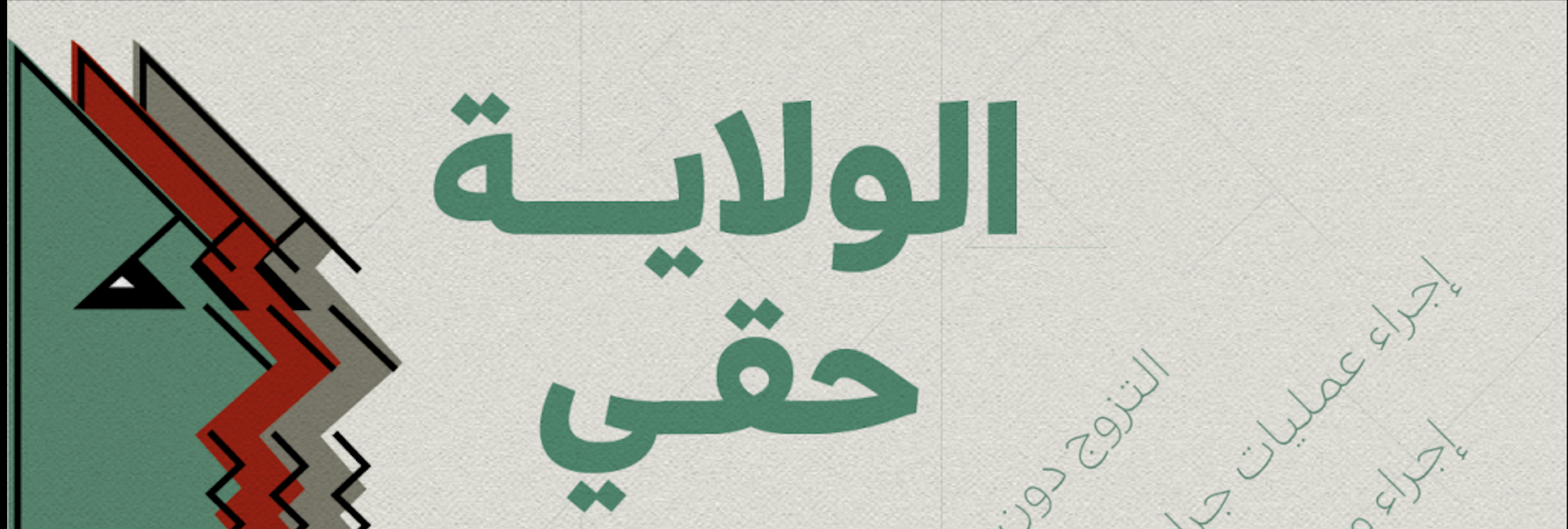
#Guardianshipismyright: Women call for greater legal rights over their children and themselves
An online campaign criticizing the personal status bill over provisions that are set to further limit women’s rights to guardianship over their children and themselves spread on social media in recent days.
Women flooded the social media with personal testimonies under the hashtag #الولاية_حقي, which translates to “guardianship is my right,” about incidents where the current personal status law and other social, and real and de-facto legal practices prevented them from making decisions on behalf of their children or themselves in educational, banking and health sectors, even in cases where it concerns their own reproductive and sexual health, without the approval of a male guardian.
The campaign comes as the House of Representatives works on a new personal status bill that was submitted to the legislature by the Cabinet in February and is currently under review by the House Constitutional and Legislative Committee.
The personal status law regulates marriage, divorce, issues of custody and guardianship over children, among a variety of other family-related issues.
Egyptian laws, including the personal status law, the child law and financial guardianship law, outline a starkly gendered division of guardianship rights and duties between the mother and the father. The majority of legal decision-making rights are given to the father, regardless of whether the parents are married or divorced, granting women only what is classified as “caretaking guardianship,” where the mother’s legally granted rights are limited to caring for the children at home. Fathers, on the other hand, control the majority of other aspects of guardianship on behalf of their children, such as financial, educational, and health-related issues.
The current law has been a topic of contention after years of conversation over a potential overhaul have stalled repeatedly. The previous Parliament, whose term ended in January, failed to tackle the law despite numerous proposals submitted by different groups of MPs and tense competition between several state institutions, with Al-Azhar, the Cabinet, and the National Council for Women all trying to move forward with their versions of the law.
In February, the Cabinet bill was submitted to the House, without public comment by institutions that had submitted earlier draft laws, such as Al-Azhar and the National Council for Women.
The Cabinet version of the bill “duplicates” Al-Azhar’s previously submitted draft, Mohamed Abu Hamed, a former MP, told Mada Masr at the close of February. According to Hamed, the bill is “predominantly strict and reactionary.”
Initial press coverage highlighted new clauses in the law seeking to penalize men who pursue second marriages without informing their first wives with a prison sentence and a fine. After this initial coverage, the draft of the bill was published on Youm7 but was shortly brought down from the website amid a public backlash against the bill ensued. Several women’s rights organizations and activists blasted the bill, saying it would further entrench aspects of the current law that undermine women’s agency over their bodies and children.
According to the draft published in Youm7, the bill would allow male guardians to annul marriages of their women relatives within the first year of marriage.
Hamed told Mada Masr that “if the current Parliament has one iota of wisdom, it must now say that it will not discuss the Cabinet’s bill before conducting public consultations and community dialogue” in order to reach a version that balances the rights of women, men and children, that is based on “reality and practical application on the ground, not a narrow interpretation of Islamic law.”
The anger of the law has not died down, in recent weeks. In light of the social media campaign, Mada Masr spoke to four human rights lawyers about the situations in which many women find themselves in legal and social contexts related to matters of personal status. The lawyers said that women are granted little to no autonomy within the Egyptian judicial system, adding that this oppressive system is entrenched and mirrored in several laws and in many social practices.
How women’s autonomy over the decision over whom to marry or how they to tend to their sexual reproductive health is restricted:
According to Egyptian law, women above the age of 21 have the right to marry without the approval of a guardian, a rule that is in step with the tenets of the Hanafi school of Islamic jurisprudence. However, most Islamic marriage officiants refuse to marry women without the presence of a male guardian from the family. Although there are no legal provisions depriving women from signing their own marriage contract in the absence of a male guardian, the Justice Ministry issued a de facto ban on the practice, according to lawyer Azza Soliman, who spoke to a number of marriage officiants. In the absence of a legal male guardian, women intending to marry can seek the assistance of a neighbor to preside over their marriage, according to Abdullah al-Saeed, a marriage officiant in the Giza district of Imbaba.
When it comes to their own reproductive health, women may also need to secure the approval of their husbands to move forward with medical procedures.
Abortion is illegal in Egypt, and any other procedure deemed as potentially threatening to a potential future pregnancy requires the consent of her husband, brother or son, except in emergency situations that represent a direct threat to her life. There is no law enforcing this restriction, several lawyers told Mada Masr. But, according to medical practitioners, this practice is widely adhered to out of fear of disputes that may arise with the woman’s husband or family if they were to carry out a procedure without their knowledge.
How women are deprived of legal decision-making power over their own children
According to the provisions of financial guardianship law, the father is considered the legal guardian of a child, the three lawyers told Mada Masr. The mother, in turn, is termed their “caretaker.” While the law furnishes the guardian with the powers of the main legal custodian, the caretaker is a person who may play the role of” guardian” exceptionally, Ahmed Ragheb explains.
Thus, the father is granted the right to represent the child before the law, without consideration for the mother, according to Ragheb, who notes that this is in keeping with Islamic law. Women are not entitled to file lawsuits, sign contracts, or consent to surgery on behalf of their children, according to Ragheb.
A mother also cannot register the birth of her child without the approval of the father or one of his first-degree relatives, despite the provisions of article 15 of child law which gives the mother the right to register the birth of her child provided that she presents her marriage contract. According to an employee at the Belqas Health Department, who spoke to Mada Masr on condition of anonymity, employees at the department require the father or the grandfather to register the birth of a child as proof of paternity. In some cases where the father has been traveling or denies paternity of the child, some mothers have been forced to file paternity suits in order to register the birth of their child, according to lawyer Lamia Lotfi.
A woman cannot open a bank account or a passbook savings account at the post office for her child, unless she obtains power of attorney from the father or through a court ruling that gives her financial guardianship. For the ruling to be viable, the bank’s legal affairs team must approve the guardianship. A woman cannot manage her child’s money even if she is the main breadwinner, because according to article 1 of the financial guardianship law, a father is the first financial guardian followed by the paternal grandfather.
In the event of the father’s death, guardianship is not transferred to the mother, but to the paternal grandfather. The mother is deprived of guardianship rights, unless her father-in-law grants her custody. ”The legislator treats the mother as a mere vessel that bears the children,” according to Soliman.
If a mother passes away her wealth is inherited by her children, the father still exercises legal and financial guardianship over the children. This occurs with minimal restrictions compared to those that are placed on women in similar cases. The law only holds the father accountable in cases of serious legal mistakes related to the management of his children's wealth, Ragheb points out.
A married woman cannot enroll her children in a school or transfer them to another unless she has obtained educational guardianship via court ruling.
Educational guardianship is transferred to a mother automatically in case of divorce, without the need for a court ruling based on article 54 of the child law. However, school administrations often request a court ruling to prove educational guardianship as a condition for admittance. “Many schools deprive women of educational guardianship in the event of divorce—in violation of the law,” Ragheb told Mada Masr. As long as the father and mother are married, the father has exclusive educational guardianship over his children, he explains.
The father has the right to appeal any of his ex-wife's decisions regarding children's education through a lawsuit, according to Ragheb.

تقارير ذات صلة

Rights advocates: Patriarchy governs new personal status bill
Like its previous iterations, the unified bill references the Hanafi school of Islamic jurisprudence

Innocence behind bars: The fate of Egypt’s minors at the mercy of criminal and military courts
Mada Masr looked into 35 cases of minors who have appeared before criminal and military courts

Proving paternity: A prolonged struggle for thousands of Egyptian mothers
For mothers who choose to file paternity lawsuits, proceedings can take years
Your support is the only way to ensure independent, progressive journalism survives.
You have a right to access accurate information, be stimulated by innovative and nuanced reporting, and be moved by compelling storytelling. Subscribe now to become part of the growing community of members who help us maintain our editorial independence.
Join us