
Gaza: ‘A fireball being tossed around by everyone’
On the eve of his father in law’s reelection to the highest office in the United States and as Gaza and Lebanon were being bombed relentlessly by Israel, Jared Kushner took to X to express excitement at the fortuitous situation he saw in a Middle East that had resisted his efforts to change it when he was an architect of the Abraham Accords and the Deal of the Century nearly five years ago.
“The Middle East is too often a solid where little changes. Today, it is a liquid and the ability to reshape is unlimited. Do not squander this moment,” Kushner cajoled officials in power in late September.
While brief, Kushner’s comment was an ideological seed that writers close to the new administration of US President Donald Trump have sowed since he came into office.
Writing in Foreign Affairs in early February, Elliott Abrams, Trump’s special representative for Iran and Venezuela during his first term, argued that the US can take advantage of the current situation if it is “willing to abandon Washington’s habitual goal in the Middle East — ‘stability’ — and presses instead for dramatic changes that will benefit the security of the United States and its allies.”
“Stability,” Abrams argued, has meant nothing more than “the preservation of the situation in which Gaza was entirely under Hamas control, Hezbollah dominated Lebanon and Iran’s nuclear program advanced.”
What has followed in the wake of the rollout of this ideological groundwork is a shock and awe campaign by the US administration that has dispensed with any politeness that once colored American foreign policy.
In repeated statements since the end of January, Trump has advocated for the forced displacement of Palestinians from the war-torn Gaza Strip and jettisoned long-held US pro forma language about the necessity of a Palestinian state, saying instead that the United States should “own” the coastal enclave. In the process, he has threatened to suspend the aid that is paid out as part of totemic peace agreements between Jordan and Egypt with Israel as leverage if they don’t cooperate in “taking” in Palestinians. Arab nations, he has added, could finance the resettlement of Gazans to “a good, fresh, beautiful piece of land” that would provide better living conditions.
The US president’s brash comments have caused turmoil among Arab countries. Egypt and Jordan have each issued a flurry of statements rejecting forced displacement and upholding their commitment to the “Palestinian cause.” Saudi Arabia has dismissed the move and reaffirmed that it will not discuss normalization with Israel without the establishment of an independent Palestinian state with East Jerusalem as its capital.
But beyond the public comments on either side, shifting geopolitical realities wrought by and preceding the war on Gaza and a desire by Arab states to secure a foothold with the new United States administration have prompted all parties to soberly grapple with the increasingly “liquid” reality of the region.
While Trump’s stated plan is as grotesque as it is farfetched, 11 Egyptian officials, a European diplomat in touch with regional capitals and a researcher at a state-run research center who have spoken to Mada Masr in recent weeks acknowledge that change has long been afoot. And while the current plan is unrealistic, an alternative that may come to pass in its place will see a rewriting of the main pillars of regional politics.
***
“I don’t think people should be going back to Gaza,” Trump said on February 4. “I heard that Gaza has been very unlucky for them. They live like hell. They live like they’re living in hell. Gaza is not a place for people to be living, and the only reason they want to go back, and I believe this strongly, is because they have no alternative.”
By the time Trump was uttering these words standing beside Israeli Prime Minister Benjamin Netanyahu for a joint press conference, he had already called for Palestinians to be displaced to Egypt and Jordan five times, slightly changing the details each time. What started as temporary displacement had become by February 4 a push for permanent resettlement.
While flying in the face of Palestinians’ steadfast commitment to remain on their land, the shifting nature of Trump’s comments were seen by analysts and statesmen alike as a call for Arab states to fill the void and propose an “alternative.”
Writing in the pro-Israel think tank The Washington Institute, former US diplomat Dennis Ross presented the displacement plan as moving “the goalposts on Gaza negotiations, very much in line with Trump’s established playbook of upping the ante, creating a pressurized situation and putting the onus on others to offer workable solutions. In his view, ‘workable solutions’ do not require full-scale policy changes — for example, when Colombia, Mexico and Canada responded to his recent pressure with modest adjustments to resource investments and cooperative language, the president eased off.”
It is an assessment that an Egyptian official directly involved in the management of Cairo’s position on Gaza agreed with.
“Displacement is an old, renewed topic whose purpose is to raise the ceiling of demands related to eliminating Hamas, disarming the resistance and managing Gaza with a moderate authority,” the official tells Mada Masr. What Trump is doing is “inherently provocative for all parties, whether for the resistance and Hamas, which will refuse, or for regional parties that want to play a prominent role in this issue, especially the Emirates.”
Both understanding the nature of Trump’s boardroom dealing and trying to curb public opinion over the implication that Egypt would be made to accept forcibly displaced Palestinians, Foreign Minister Badr Abdel Atty announced on February 2 that Egypt had a plan to rebuild Gaza that would not require Palestinians to leave their land.
The details of the Egyptian proposal have been slow to make their way to the public. According to four Egyptian officials, a source at state-affiliated research institutions and a European diplomat, the plan has several key axes.
The first would see Hamas and Islamic Jihad excluded from political, administrative and military affairs in Gaza. Hamas would announce that it is "temporarily stepping down to give Gaza and its people a new opportunity." The resistance factions would also pledge not to use their weapons and place them under the supervision of a joint-Arab monitoring committee.
In place of the current Hamas-led governance, the proposal makes provision for a communal committee of prominent Palestinian families and former elements of the Palestinian Authority from Gaza to run the strip’s affairs.
The committee’s remit would include receiving and distributing aid, tracking and registering the official death toll, arranging medically permitted travel outside Gaza, holding discussions with Egyptian and European authorities on the management of the Rafah crossing and coordinating with private security teams that are carrying out inspections of Palestinians moving from the strip’s south to its north.
As for reconstruction, Egyptian and Turkish companies would take the lead in leading construction work financed by Gulf states. Palestinians would be moved away from areas close to Gaza’s borders with Israel and placed in “secure zones” in the strip while construction takes place.
While this plan is still in the works, it has already faced significant hurdles from many sides on its technical details.
At the level of coordination within Palestine and Israel, Israel has struck out against a plan that would offer anything less than the complete disarmament of Hamas.
When Egypt and Qatar proposed that Hamas’s missiles be placed under the supervision of a joint Egyptian-Qatari monitoring committee during a 10 to 20-year ceasefire, Israel and the US rejected the initiative, according to one of the four Egyptian officials briefed on the proposal.
Equally, when it comes to the administration of Gaza, Israel has indicated that it is not willing to accept anything less than the removal of all Hamas leaders from the strip. Hamas, on the other hand, absolutely refuses to take any steps that represent the end of its political presence and the right to resistance for the Palestinian factions.
From his side, PA President Mahmoud Abbas has categorically refused the creation of an entity to administer civil affairs in Gaza that is not affiliated with the Palestinian Authority. While Hamas and other Palestinian factions in Gaza have agreed not to join the committee, they have rejected Israel’s demand to review information obtained by the administrative committee. Hamas and the other factions also want a clear timeline to hold general elections for Gaza and the West Bank.
Egypt has also tried to engage Arab states on its plan, having first called for an extraordinary Arab League meeting on February 27 to present the plan.
However, due to gaps between states for a unified Arab position, Egypt had to reschedule the meeting for March 4.
According to the same Egyptian official, Egypt moved to delay the meeting to try to build a wider consensus, as the UAE, Morocco and Bahrain are not fully opposed to the Trump plan and because all states within the Gulf Cooperation Council (GCC) — except for Qatar and Kuwait — want reassurances on how Hamas will act to avoid investing money into the strip only to see it destroyed again by Israel.
The UAE, in particular, had already given public voice to some of its assent to Trump’s plan. UAE Ambassador to the US Yousef al-Otaiba was asked about an alternative to the displacement plan at the World Governments Summit in Dubai on February 13. Despite the fact that Egypt had already come out to announce its plan and was working to build confidence around it, Otaiba said, "I don't see an alternative to what's being proposed [by Trump]. I really don't. So if someone has one, we're happy to discuss it. We're happy to explore it, but it hasn't surfaced yet.”
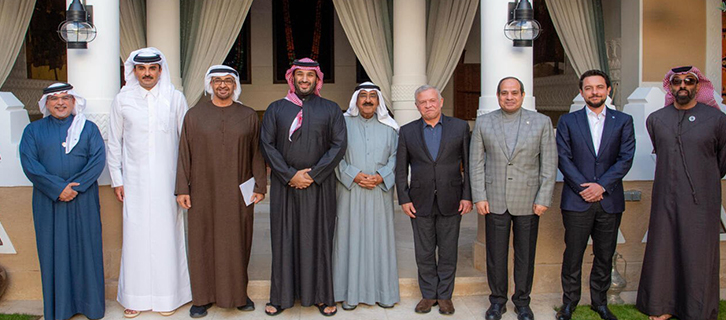
In the wake of the Arab League meeting’s postponement, Saudi Arabia announced it would hold an emergency summit on February 20, which the Egyptian official says was intended to allow the Egyptian proposal to be passable to all parties. President Abdel Fattah al-Sisi arrived in Riyadh on February 19 for preliminary talks with Saudi Crown Prince Mohamed bin Salman and was followed the next day by heads of state from Jordan and the GCC.
Describing the meeting as an “informal brotherly gathering,” the official Saudi state news agency, SPA, reported that the “meeting included consultations on various regional and international issues, with a focus on joint efforts to support the Palestinian cause and address developments in the Gaza Strip. The leaders welcomed the emergency Arab summit scheduled for Cairo on March 4, 2025.”
However, according to another Egyptian official with inroads in DC, brotherly spirit wasn’t enough to overcome some of the differences. Following the meeting in Riyadh, the Emirates communicated to the Trump administration that the Egyptian proposal is more or less a plan whereby Cairo is just trying to get major financial gains through the reconstruction process, but the political basis for the proposal is “very weak,” the source says. The plan, the Emiratis said, does not guarantee the full uprooting of Hamas and other Palestinian factions in Gaza, nor does it offer a comprehensive vision to reform the PA and allow it to gain traction in Gaza.
***
While Egypt attempts to work toward a viable alternative to Trump’s plan, it is also trying to navigate the parallel implications that changes in Gaza would have for its wider regional role and historic relations with the US.
Asked by reporters on February 10 whether he would consider withholding aid from Jordan and Egypt if they don’t agree to take in Palestinians from Gaza, Trump made a veiled threat to withhold aid that the US provides Jordan and Egypt as part of their respective normalization agreements with Israel.
“Yeah, maybe, sure, why not? If they don’t, I would conceivably withhold aid, yes,” the US president said.
What was particularly disturbing to different parties, a high-level Egyptian official says, is that Trump was taking backdoor conversations out in the public.
According to the official, as the normalization talks with Saudi Arabia have proceeded behind closed doors in the last year, US and Israeli officials have made it clear that the Gulf will be receiving political, security and economic privileges “that may reduce those that Egypt enjoyed under Camp David.”
US and Israeli officials told their counterparts in Cairo that the “UAE has offered its services and assistance in a number of sensitive and important regional files for the United States and Israel in the Middle East, North Africa and [the rest of] Africa, including security, political and economic projects,” the official says.
Since the late 1970s, Washington has sent Cairo up to US$1.3 billion each year as a legacy of the 1979 peace agreement in which Egypt became the first Arab country to establish formal diplomatic ties with Israel.
The decision to normalize had brought Egypt money, yes, but by putting aside opposition to the creation of a Jewish state — which had been the unified position of the Arab League in the 1948 war with Israel and animated subsequent aggressions and diplomatic moves — former President Anwar al-Sadat had effectively converted the threat of Egypt’s military into a new regional, political power based on alignment with the US.
The equation of the relations created in 1979, according to an Egyptian researcher of American foreign policy toward the Middle East, had it that “Egypt as the biggest military in the Middle East threatens Israel's security and thus a treaty between the two is the main cornerstone of peace in the Middle East. Based on this equation, Egypt is a regional partner to the US, not only in keeping the peace with Israel, but also in creating peace in the region.”
But throughout the decades since signing the treaty, Egypt’s strategic choice was that any relationship with Israel has to go through the US. At the same time, Egyptian official discourse maintained that Israel is the enemy, in order to make sure that the US will stay committed to supporting Egypt to maintain peace, as Nael Shama writes in his 2013 book Egyptian Foreign Policy From Mubarak to Morsi. This is why, at times, the relationship between Egypt and Israel “was not always satisfactory to policy-makers in Washington. Indeed, the American administration and members of Congress regularly expressed their irritation at Egypt’s ‘cold’ attitude towards Israel,” Shama writes.
From that point on, as Shama writes, “any disagreement between Cairo and Washington from the late 1970s to Mubarak’s fall in 2011 was no longer on strategies, but instead was on tactics. The direction, in other words, was set and both parties happened to just differ sometimes on the pace or details.”
While the fading of the Palestinian question and the recentering of US policy on Iran and China in the new millennium began to change the equation and diminished Egypt’s influence, according to the researcher, he points to closer relations between Egypt and Israel as a driver for transformation.
“Egypt committed a strategic mistake in its close rapprochement with Israel after 2013,” the researcher says. “There was no strategic reason to achieve this rapprochement and the damage occurred when some Egyptian officials told their American counterparts that Egyptian-American relations are trilateral relations, impacted by Egyptian-Israeli relations,” the researcher says, citing conversations with diplomats at the time.
The rapprochement with Israel showed that Egypt’s role “downsized from a peace process mediator to a Gaza Strip security guarantor, as was clear in all wars since 2014,” the researcher says.
But even Egypt’s role as a security guarantor has come under scrutiny over the course of the war on Gaza. Israel has repeatedly expressed distrust that Egypt was adequately screening incoming aid shipments for potential weapons and that it had done enough to prevent smuggling through tunnels that traverse the Egypt-Gaza border.
According to the last source and another two Egyptian officials informed on the matter, this has resulted in a steadfast position by Israel to minimize Egypt’s role in security arrangements for any post-war scenario.
That is in part why, two of the three officials and another official say, US and Israeli officials discussed with their Egyptian counterparts over the course of the last year a range of possible amendments to the security annex of Camp David, which divides Sinai and the border with Gaza into four zones (A, B, C and D), limits the type and quantity of Egyptian and Israeli security deployment in each zone and created the Multinational Force Observers, who monitor the treaty and negotiate disputes and exceptions to its enforcement.
When negotiators met in Rome last July, according to the sources, members of the multinational force that observes the 1979 peace treaty, whose headquarters are in the Italian capital, and senior officials discussed securing the border between Egypt and Gaza, the possibility of doubling the size of the multinational force in the northern part of the border, and increasing the number of international civilian observers to ensure the commitment of all parties and monitor the implementation of the security agreement in a neutral manner.
When Egypt rejected Israel’s proposal on maintaining the presence of the Israeli military in the Philadelphi Corridor or deploying the Multinational Force and Observers (MFO) to manage the border, the United States proposed that the UAE be the mediator between Egypt and Israel in dealing with the management of the border with Gaza.
The three Egyptian officials aware of the meeting expressed that there was a prevailing suspicion toward the proposal on Cairo’s part, even as it tries to balance its relations with the UAE, which it understands plays a vital role in the region that Egypt cannot refute.
The issue was not resolved during the July meeting though and no agreement has been reached until now.
This is why, beyond Trump’s comments, the issue of Camp David has entered public discussion in recent weeks, as Israeli officials and members of the US Congress have cast doubt on Egypt’s compliance with the accords.
In mid February, Israeli Ambassador to the US Yechiel Leiter told leaders of Jewish organizations in the US that Sisi has breached the US-brokered peace agreement between Cairo and Tel Aviv. Leiter said that Sisi was profiting from “the desperation of Palestinians who seek to flee Gaza” and “duplicitously operating to benefit Hamas.”
“We have bases being built that can only be used for offensive operations, for offensive weapons — that’s a clear violation,” Leiter said. “For a long time, it’s been shunted aside, and this continues. This is going to be an issue that we’re going to put on the table very soon and very emphatically.”
Equally, some members of the US Congress have claimed that Egypt has been in violation of the peace treaty terms, according to another Egyptian official, who says that the embassy in DC is pushing against this rhetoric.
The Israeli press also noted that imagery from “Egypt’s Sinai Peninsula in recent weeks shows a massive build-up of troops and tanks.”
One of the sources who spoke about the minimization of Egypt’s security role says the new reinforcements to Sinai are not for the purpose of war, but rather an internal message to emphasize the military’s readiness to defend and confront any violations that may occur in light of Israel's persistence in its aggression against Gaza.
Israel’s distrust taken together with Egypt’s attenuating regional clout has set off what another one of the sources in the same group says is a “regional competition” to usurp Egypt’s role, many of which are centered on the numerous and competing post-war governance plans that have emerged in the last year.
The first Egyptian official tells Mada Masr that in November 2023, some Arab states proposed to the US that it take security responsibility for managing Gaza. Washington responded by conditioning its involvement on the formation of a joint force composed of Egypt, Jordan, the UAE, Morocco and Indonesia to secure the strip. However, Arab states’ concerns about putting boots on the ground have so far prevented serious discussion of the US proposal at the Arab and Islamic levels, especially since, last summer, the Biden administration revised its vision for Gaza, making it resemble the post-2003 Iraq model, the official says.
Under this plan, which was leaked to the American press last year, a senior US military officer would command the joint force, while US diplomats and senior officials would oversee local affairs, effectively having the United States take the lead in Gaza. The proposal has yet to gain approval, except for the UAE, which agreed to participate in the joint force, according to the official.
The official adds that one of the proposals presented involved giving control over Gaza’s security to NATO. However, this idea faced reservations, just like the joint force did, due to US conditions regarding the force’s operational framework. Washington insisted that the force’s command headquarters be based in Sinai, specifically in the city of Arish, to utilize its airport and maritime port for the international force’s operations in the strip, the official and an informed source close to the official quarters in North Sinai say. Egypt, however, rejected this on the grounds that it would open up Sinai to military and administrative issues for Gaza, instead offering the United States an alternative: to station the force at Gorah Airport, the current base of the MFO.
According to the first Egyptian official, these arrangements remain under extensive discussion between the US, Egypt, Israel and Arab states, and have yet to be decided on.
One of the sources who spoke about the minimization of Egypt’s security role, however, says “only if Palestinians themselves assume control over Gaza, could the peace treaty remain intact.”
***
The clock is ticking to find a solution, both due to Arab states’ awareness that the Netanyahu government is highly volatile, but also because of internal divides within Arab countries, says the same official.
“The UAE promised the US and Israel to convince more Arab countries of the feasibility of normalization with Israel and to try to present itself as an indispensable regional interlocutor,” the official adds.
The Emiratis’ aspirations will be the biggest motivation for normalization between Saudi Arabia and Israel, the source says, due to the quiet competition between Riyadh and Abu Dhabi and their growing divergence on many regional matters — from bilateral disputes regarding shared borders, to Yemen, Africa and the Middle East. This may eventually push Saudi Arabia toward normalization to maintain its regional leadership. This, in turn, could increase pressure on Egypt, which has maintained strong ties with both countries since 2013 and will need to carefully balance its relationships in the coming period.
Both another high-ranking Egyptian official and a European diplomat coordinating directly with the Saudis think that the Arab states on one side and the US and Israel on the other will have to compromise on their demands.
“Israel will be forced to make concessions when it becomes a burden on its Western allies,” whose interests may be harmed if Israel sparks a new regional escalation by trying to reshape the region in its favor, the Egyptian official says. “What matters to Trump is completing the Abraham Accords project and normalizing relations between Saudi Arabia and Israel, which is why he is keen to hear the Kingdom's stance on displacement and whether it will bear the cost of rebuilding Gaza.”
And on the other side, the Western diplomat thinks that parts of the Trump plan will ultimately have to be incorporated into the Egyptian proposal. “Inevitably, some people will be leaving Gaza,” the diplomat says.
The European diplomat and multiple Egyptian sources in the corridors of political power in Egypt acknowledge that regional countries could use a workaround that would entail “voluntary family reunification” operations for residents of the strip who have relatives outside Gaza. In the end, Palestinians who wish to travel outside of Gaza have the right and should be given the opportunity to do so, according to the sources, especially if there are countries that wish to host them and grant them citizenship or long-term residencies, provided that the Gulf provides financial support to some countries that are prepared to participate in the hosting and provided that this does not lead to the complete evacuation of Gaza.
For some, all this “negotiation” is a good thing.
“The silver lining of Trump’s proposal is that Gaza’s dire conditions and postwar fate are now a front-page, front-burner issue,” Ross wrote for The Washington Institute.
There is flame involved, according to the official close to Egypt’s management of Gaza, but he opts for a more incandescent image: Gaza as a “fireball being tossed around by everyone.” Who will get burned remains to be seen.
تقارير ذات صلة

40 years on: What did Egyptians make of peace with Israel?
A look at popular sentiment surrounding the peace treaty four decades after Egypt signed the Camp David Accords with Israel

Gaza’s phase two arrives. Kind of …
Consensus over key questions lags behind the United States' announcement of progress.

Gaza’s child amputees
Your support is the only way to ensure independent, progressive journalism survives.
You have a right to access accurate information, be stimulated by innovative and nuanced reporting, and be moved by compelling storytelling. Subscribe now to become part of the growing community of members who help us maintain our editorial independence.
Join us