
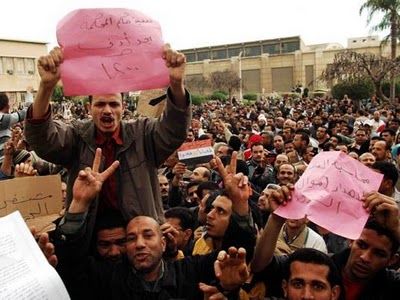
From Mahalla
A horse-drawn cart sends ripples down a flooded street in one of Mahalla's many working-class neighborhoods. Around the corner, a group of men stand quietly chatting at the gates of the Misr Spinning and Weaving Company, the imposing textile factory with its own special symbolism in Egyptian history.
After the strike at the Misr Spinning and Weaving Company began in mid-February, the neighborhood was quieter than usual; the machines off, the shops nearby bundled with factory fabrics not so busy. The street leading to the factory, normally rammed with vendors' stalls, was almost empty.
“The whole town depends on this factory,” said local independent trade union leader, Ahmed Ramadan, speaking inside a secluded café around the corner. His deputy, Hany Abu Leila, agreed. “This place fuels the town.”
A factory worker, Iman Khali, walked by. Ramadan waved her over.
“This is like our home,” she said, gesturing towards the graffiti-painted walls surrounding the factory. And, like a home, Khali wants to preserve it.
Intermittent strikes over delayed bonus payments, and an alleged below-half production rate, mean workers are taking longer hours — for the money, they say, but also for the survival of the factory. “I used to work eight-hour days,” Khali explained, “but recently I've been working 12 hours a day. I have no time with my family, but I will accept the price of neglecting my family as part of our collective efforts to save the company.”
For workers in Mahalla, “saving the company” means removing the controversial chairman of the Public Holding Company, Fouad Abdel-Aleem, whose leadership — they say — has cost the factory millions through rising debts, financial mismanagement and corruption.
“We've managed to get rid of two regimes,” Khali said. “How come we can't get rid of [Abdel-Aleem]? Who's behind him?”
There is a creeping fear that this may be some ruse to devalue Mahalla's textile operations and then sell them off to the private sector. Local media recently reported that the government was in talks with foreign consultancy firms to assess how Egyptian textiles could benefit from a revamp. The news was treated with suspicion by workers.
Sitting nearby, textile mechanic Tamer Fayed compared Misr Spinning and Weaving today to an old Egyptian film, “The Land of Hypocrisy.” In it, a government employee explains that bureaucracy, corruption and mismanagement are not a sign of the problem, they're a sign the system is working.
On February 22, workers announced they would suspend their latest industrial action, giving the government two months to fulfill their central demands — the removal of Abdel-Aleem and the application of a LE1,200 public sector minimum wage originally promised for the end of January.
However the effect of this strike, the most significant since former President Mohamed Morsi was overthrown in July, is being felt beyond the Nile Delta. Egypt looks like a different country than on this year's January 25 anniversary, when in Tahrir Square supporters of military commander and probably president-to-be Abdel Fattah al-Sisi cheered on a regime that was simultaneously gunning down unarmed protesters in other parts of the city.
Since then Mahalla has arguably given the Egyptian economy another industrial process — a catalyst. While the strike has come and gone (for now), a wave of industrial unrest continues in its wake.
Everyone from police, doctors and medical professionals, street cleaners and garbage collectors, bus drivers and public transport workers, postal workers, government employees — in Cairo, Alexandria, Helwan, Tanta, Kafr al-Dawa and Suez — all have staged walk-outs and protests in recent weeks.
Ramadan is wary of overtly politicizing the strike, a common tactic in labor action in Egypt. “We are [staging] an independent strike with very specific demands,” explains Ramadan, when asked where Mahalla fits in to this fresh wave of industrial unrest.
Yet there is a consciousness that Mahalla falls within a wider context of labor unrest. “We're one part of the Egyptian workers' movement, and we will continue until a better life is given to the workers, and power back to the people.”
Whether Ramadan and others like it or not, the industrial actions in Mahalla and beyond have contributed to the destabilization of consecutive regimes. While Egypt is not in the throes of some looming workers' revolution, labor is helping break the silence.
On April 6, 2008, workers at the Misr Spinning and Weaving Company tore down images of deposed President Hosni Mubarak, stamping on them and setting them on fire. “Down with the regime!” the chants went.
Mostafa Wafa, a 23-year-0ld from Giza who participated in the revolution, remembers seeing the images on TV. “Before that, I was angry at the government but scared to show my anger.”
“Mahalla was the first time in my life I saw a picture of Mubarak being burned,” Wafa smiled. “After that I decided to join the political movement.”
That strike became a major event in the pre-revolution wave against Mubarak's regime. The date, April 6 — the day after workers collected their monthly pay cheques — birthed an activist group key to the January 2011 uprising and one now under attack all over again by the authorities.
The two-month strike hiatus at Misr Spinning and Weaving will be a real test for a government looking to smooth over the early signs of a society that appears less diffident, new and — according to the patriarchal appeals of those in power — patriotic.
Here you actually notice the posters of Sisi, (the army chief's side-profile smile is part of the furniture in Cairo nowadays), because there are comparatively so few.
And it is strikes like those seen in Egypt in recent months that are challenging the idea of Sisi's irresistible rise to the presidency.
Those in government will likely not have forgotten the thousands of socio-economic protests which dogged Mubarak's final decade, as well as Morsi's 12 months in power.
Stanford University history professor Joel Beinin wrote soon after the 18 days how workers “in textiles, military production, transportation, petroleum, cement, iron and steel, hospitals, universities, telecommunications and the Suez Canal” joined together. “The demographic and economic weight of workers in the popular uprising was likely one of the factors that persuaded Egypt’s military chiefs to ask Mubarak to step aside,” Beinin claimed.
Egypt in 2012 saw 3,817 nationwide socio-economic protests (with 282 in Mahalla and 684 in Cairo), according to Egyptian Centre of Economic and Social Rights (ECESR) figures, before another 2,400 social and economic protests in the first quarter of 2013. The latest ECESR figures also show a steady flow of workers' protests in governorates across the country for the first quarter of 2014.
Still, little has changed, Ramadan argued. “Until now we haven't got what we asked for.”
The feeling that workers are still demanding the same things as in 2008, (and before: in 2006 Mahalla workers first demanded the LE1,200 minimum wage), is not lost on them. “After 2006, the strikes came one after another … strike followed strike,” Ramadan claimed.
“Now is worse than 2008,” said Kamal al-Fayoumi, one of the organizers of the April 6 protests in Mahalla. “[Today] we're seeing the total neglect of workers' demands.”
From the government’s side, there is no indication of a radical change in policy from the Mubarak regime’s labor interventions, commonly described as cosmetic at best.
Egypt's new prime minister — National Democratic Party Mubarakist and former housing minister Ibrahim Mehleb — has so far combined vague promises of concessions with jingoistic appeals to Egyptian workers' patriotism.
The government has repeatedly stressed the importance of Egypt's national interests above all else. “I think what's been impressive has been the consistency of these reactions from the regime,” argued Ian Hartshorn, a doctoral researcher in Arab trade union movements at the University of Pennsylvania. “This has been a consistent [claim], that these are partisan or specialized interests … But these specialized interests are representing millions of workers.”
“Making demands that exceed logic will destroy the country,” Mehleb was quoted as saying at a press conference announcing his new leadership a fortnight ago. “We’re betting on the patriotism of the Egyptian workers.” The next day Mehleb selected Nahed al-Ashry, a career civil servant regarded by some workers as a Mubarak-era stalwart, to replace leftist Kamal Abu Eita as manpower minister.
“I don't know what else the prime minister wants to tell the workers,” Fayed said in response, “except that the Mubarak regime is back.” Workers from Tanta Flax & Oils Company meanwhile claim Ashry earned a reputation for “screwing over workers” in her past role as ministry negotiations chief, presiding over deals that lead to forced resignations and sackings.
Meanwhile a growing range of industrial demands continues to spread through the Egyptian economy: the minimum wage, better pay and conditions, contracted employment, the removal of allegedly corrupt management. Workers from six companies protested outside the Cabinet on Saturday to demand the reopening of closed-down and out-of-action factories. The more unrest grows, the likelihood of a universally applied minimum wage providing a catchall solution for industrial disputes looks more distant. Would the minimum wage end this latest restive chapter in the history of the Egyptian workers' movement?
“Ad hoc injections of capital have been used since the wave of labor protests started in 2006 and they haven't succeeded in changing the fundamentals,” argued Hartshorn.
“You can give a bonus, you can give back pay, but time and again we've seen these problems resurface because the fundamentals haven't been addressed.”

تقارير ذات صلة
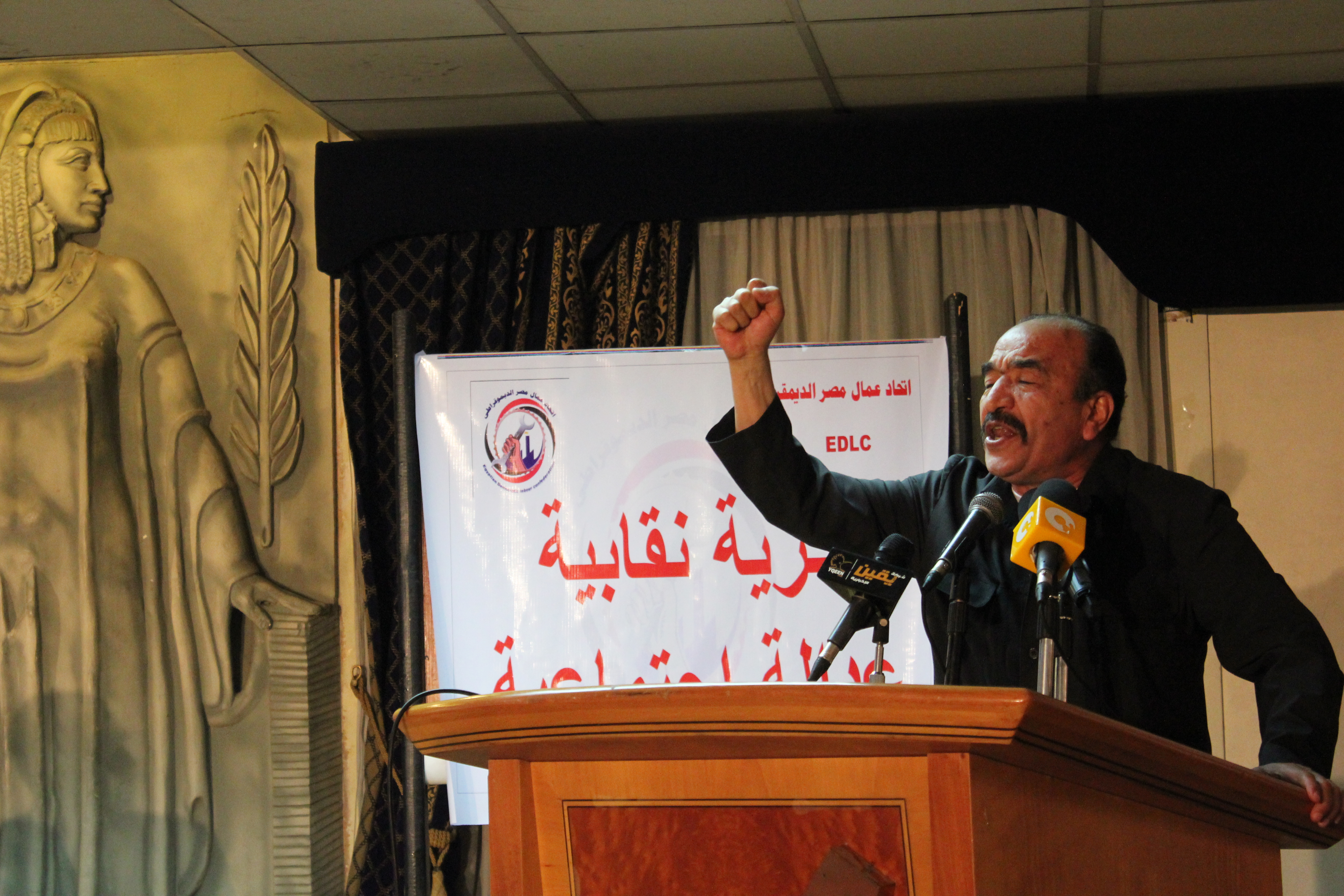
Labor activist wades into the deep state
In 2007, renowned trade unionist and opposition figure Kamal Abu Eita led thousands of workers on strikes and sit-ins outside the Cabinet. One uprising and an election later, more mass…
A revolution free government
Following the formation of the current government headed by Prime Minister Hazem al-Beblawi, hopes were high for a brief moment as many thought that revolutionary elements within the Cabinet might lead the…
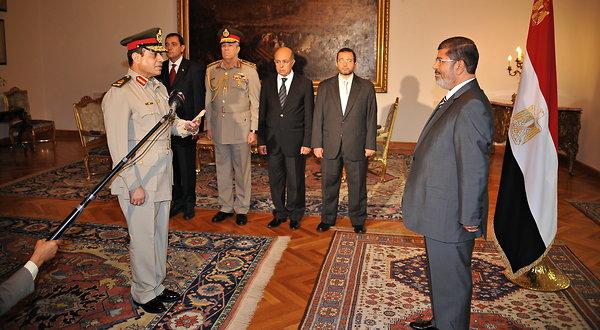
And where do the workers stand?
Since the events of June 30, divisive fault lines have emerged within the country’s trade unions and professional syndicates, with leading members of these associations taking sides with the new…
Your support is the only way to ensure independent, progressive journalism survives.
You have a right to access accurate information, be stimulated by innovative and nuanced reporting, and be moved by compelling storytelling. Subscribe now to become part of the growing community of members who help us maintain our editorial independence.
Join us