
Folk life, new data, a moment of danger: Stories about art and writing in Egypt in the 1990s
Toward the end of the interview, Samir Gharib says: I applaud you for being enthusiastic about something like this, because, girls, art is a thermometer for progress. That is, the more art spreads and grows, it means that the general state of the country is advancing, so it is important to write about art. It is the summer of 2022, and Mai ElWakil and Nour El Safoury are speaking with Gharib in his house in Cairo for our project on art writing, especially art criticism, in Cairo and Beirut at the turn of the 21st century. Mai, Nour, and I were born between 1982 and 1992, and Gharib, the oldest critic we have spoken to, was born in 1954 and studied journalism at Cairo University in the early 1970s.
Art criticism begins with the artist’s imagination but it ends with the reader’s imagination, Gharib continues,[1] and if the reader does not have an imagination, they will not get much from the writing. This is especially the case, he feels, in writing about art. You’re writing in the Arabic alphabet, or any other alphabet, about another language, the language of photography, of sculpture, of ceramics, or whatever visual medium. How do you translate a painting made with different colors and materials into an alphabetical language? That’s the problem with writing about art in any context, Gharib explains to us. You’re talking about a language different from the language in which you are writing to a reader who has not seen the works you are writing about.
Folk life and new data
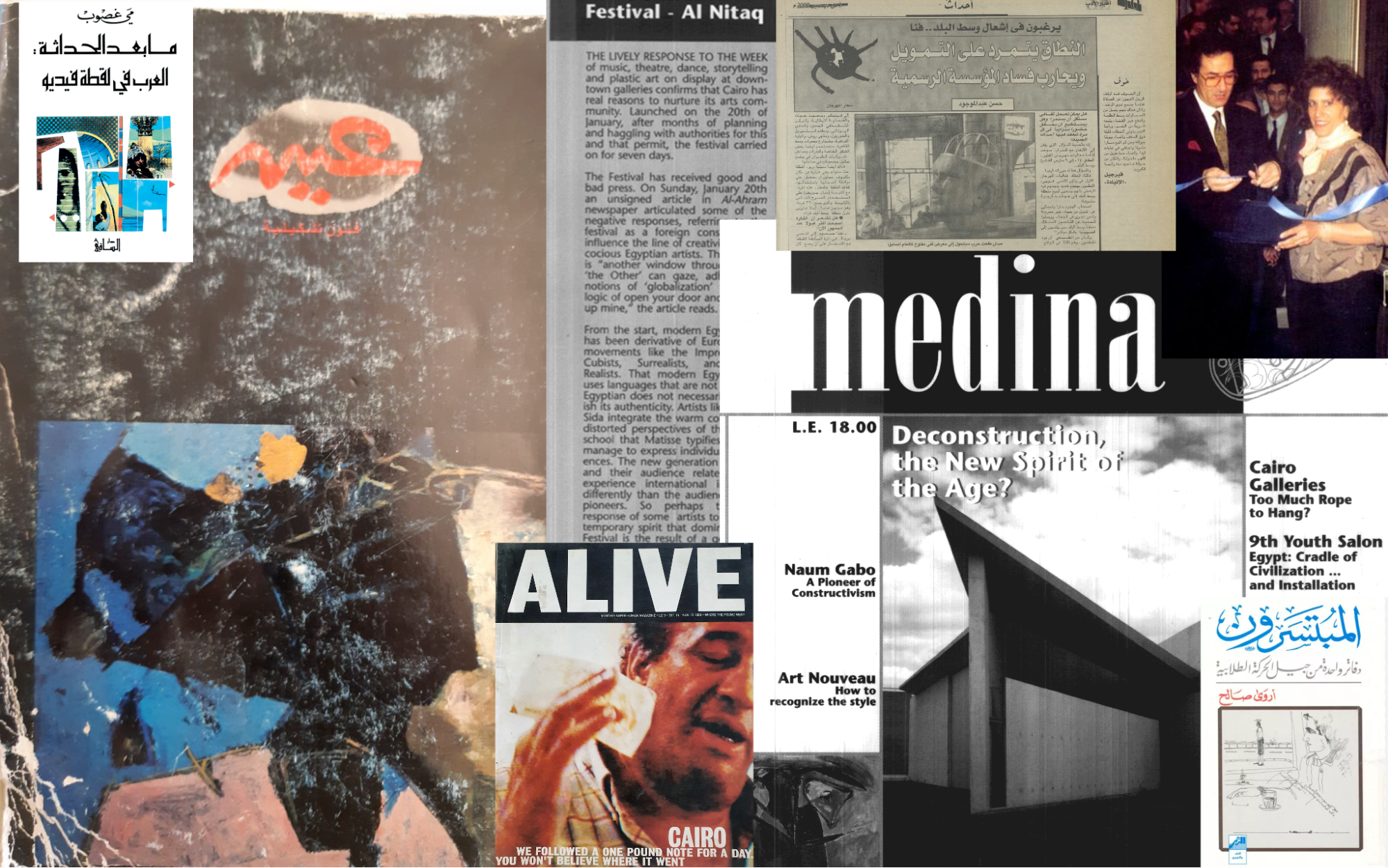
Embarking on our project, we have no ready-made story to tell about the role or trajectory of art criticism, and one starting point is to ask various stakeholders what they were reading in the 1990s and how they got to that reading. When Nour and Mai ask Sayyed Mahmoud, a poet and art critic born in 1969, he specifically remembers being handed a book, a small book of 100 or 120 pages, but when he read it, he thought: What is this? This is something new. It was the mid-1990s, and a group of them had been sitting with the artist Adel al-Siwi in Cairo, which they liked to do because they had not studied art. Mahmoud himself had studied at Cairo University’s Faculty of History and been part of the university’s Literary Group. Siwi and Mohamed Abla, both painters born in the early 1950s, actively sought to include these younger writers. Mahmoud says that they were sitting there and a poet by the name of Ahmed had taken the book from Siwi, and Siwi then gave it to Mahmoud. It was the 1992 publication by Lebanese writer, artist, and publisher Mai Ghoussoub (1925–2007), ما بعد الحداثة: العرب في لقطة فيديو (Postmodernism: The Arabs in a Video Clip). Mahmoud explains what he remembers learning when he read it: There is no such thing as avant-garde art. And there is no such thing as elitist art. He remembers how Ghoussoub dismantled both notions, discussing how certain strata of society listened, or did not listen, to Umm Kulthum and Adawiya. Ghossoub traced the origins of contemporary art to the aftermath of the Gulf War in the early 1990s, he says. And she wrote about the effects of the collapse of the Berlin Wall.
On a Zoom call from Beirut, Angela Harutyunyan, an art historian born around 1975, tells me and my fellow interviewers about growing up in the 1990s in formerly Soviet Armenia. In a sense, her childhood was replete with a sense of cataclysmic transformation that the old world was collapsing and the new hadn’t arrived yet, but it was also a time of hope, with the idea that suddenly a liberated sphere had opened up, that the future was in the air. Looking back in 2023, she reckons that there was a short period of becoming, of possibility, in the 1990s. She remembers young kids, children, opening little self-made shops on the street selling goods. In her hometown of Gyumri, the collapse of the centralized state and its integrated economy and then the shocking arrival of a market economy, not yet realized at the cognitive level, had brought about possibilities for activism and activities that would be inconceivable in the 2000s, with the rapid encroachment of neoliberalism — for example, when she was 13, she walked into a local TV station and said she wanted her own show. The editor asked her to bring in a concept, she drafted a proposal on the concerns of young people in the city, and the show aired for about two years. “Did critics who grew up in Cairo feel the same sense of possibility?” my co-interviewers and I ask ourselves after that interview. Nour feels that some art-related texts we have found from the late 1990s give a sense of anachronism, of having to catch up before it was too late.
When Hassan Khan, an artist, writer, and musician born in 1975, is asked what he was reading in the 1990s, he mentions that he studied English and comparative literature at the American University in Cairo (AUC) and cites the influence of US sci-fi writer Philip K. Dick before mentioning Lebanese journalist Hazem Saghieh’s 1991 book الهوى دون أهله (Desire without its People). Khan believes that when he was in his late teens his father, filmmaker Mohamed Khan, must have met Saghieh and obtained copies of the book in Cairo. It was his first time reading a scathing but analytical criticism of the Umm Kulthum phenomenon, and because it was very compatible with his own position — he had always disliked Umm Kulthum — he was very happy to see it.
I later discover that Saghieh’s book argues that Umm Kulthum, with her glorification of Gamal Abdel Nasser, was an instrument of a totalitarian state. Around the same time, again through a family connection, Khan also read المبتسرون (The Stillborn), written by Arwa Saleh (1951–97) in 1991 and published in 1996.[2] When he read the book — which I know deals primarily with the political conditions underpinning the eruption and decline of the Egyptian student movement in the 1970s and the movement’s relationship with the leftist intellectuals of the 1960s — he was very excited. He unexpectedly had a feeling of convergence, that there were other voices. For him, the self-conceit of adolescence in the 1990s was the feeling that one had attitudes and ideas that no one else had — that the entire cultural context was devoid of them. This was partly related to age and not having seen many things, he says, and partly because the strong presence of the dominant culture led one to imagine that that was all there was, even though of course that was not the case.
Here is an excerpt of Saleh’s book, which may also provide some historical context for the conditions that defined Egypt in the 1990s. On the 1973 October War, Saleh wrote:
[Anwar] Sadat was at his most honest and apposite and pragmatic, when he said that the details were essentially unimportant so long as there were no substantial differences between the bourgeoisie and its strategists over the necessity of making peace with Israel and of opening up our markets to the invasion of foreign capital. These two basic and interdependent principles were at the heart of the whole ruckus. It didn’t matter whether Sadat decided to cross the Mitla Pass or whether he went to Jerusalem or met with the Israelis in Geneva: peace and market liberalization were our manifest destiny because this was exactly what was being prepared for us from 1967 onwards. The October War wasn’t fought to change the roadmap of 1967 but to turn it for the first time into a hard reality. It insults our intelligence to be told that it all came to pass as a result of the negotiators’ stupidity or miscalculations. Claims like this are the product of individuals who, unlike Sadat himself, lacked the courage to bear the consequences of the plans they had carefully laid for years. As far as the bourgeoisie was concerned, there was simply no alternative. And when the nightmare overtook them, they quaked in their boots. The making of this history required an insufferable level of corruption and contemptibility on the part of intellectuals who worked as the regime’s propagandists and who lost their shadows the moment ‘the great leader and teacher’ [Nasser] passed away. Sadat served his class in the best way possible in light of its non-existent choices. (p. 45–46)
One of our interviewees, who arrived in Cairo around 1990, suggests that very little appeared to be happening in the city’s art scene then: there was the official scene overseen by the Culture Ministry, which had not long since been the Culture Ministry and National Guidance,[3] and everything on that level seemed to be tied into that “national guidance” component, a Nasserist view of culture as defining the parameters of an Egyptian identity. This perception reminds Nour of the columns of art criticism that Sobhi al-Sharouni, born in 1933 and having graduated from Cairo University’s Fine Arts Faculty in 1958, wrote for the state-run المساء (The Evening) newspaper in the year 2000. Sharouni’s column, titled الوان وتماثيل (Colours and Statues), showed an interest in the writing of a history of Egyptian plastic art, with an emphasis on the linear progression of history; Nour feels that this might reflect the interest of the entire generation whose intellectual project began with the 1952 revolution. In her opinion, their project was forced to end with the 20th century’s end as completely new data entered the intellectual discourse.
In the early 1990s, Mahmoud concurs, visual arts were largely made up of state-run spaces, especially the very active Zamalek Arts Complex around the Opera House, he says, which hosted the Cairo Biennale (founded in 1984), Youth Salon (founded in 1989 under then Culture Minister Farouk Hosni), and the Experimental Theater Festival (started in 1988, also under Hosni). Interviewees remember a few non-official spaces, such as the Mashrabia Gallery in downtown Cairo and Extra Gallery in Zamalek. Khan recalls a 1990 exhibition of painter Abdel Hadi al-Gazzar (1925–66) at Mashrabia, and especially the accompanying book, as a very big event. He says that the book, edited by Christine and Alain Roussillon, was important because of its images of Gazzar’s work rather than its textual content. This was the first time Khan encountered that work, and he recalls the book having a profound impact on the art scene; people were talking about it a lot. While the three of us have not seen the book, we know that Gazzar, who moved with his family from Alexandria to Cairo at age 15 in 1940, was a founder of the Contemporary Art Group and interested in “folk life.” In a text from his notebooks titled لا غموض إلا عند من لم يعرف خفايا الحياة الشعبية (There is no mystery except for those who do not know the secrets of folk life), published in Akhbar al-Adab (Literary News) in 2012, Gazzar described folk life as “the life lived by the vast majority of the people who live in their own way.”
Locusts and margins
An interviewee whose experience of art criticism in Cairo around 1990 was limited to state-run press says the discourse was likewise tied to the notion of art delineating and policing the parameters of a national identity. The criticism he read was formulaic, name-dropping, pointing to lineages and connections, and he knew critics who would review exhibitions without having seen them – it wasn’t a serious endeavor. Mahmoud recalls that even when an exhibition at the Zamalek Arts Complex, led by artist Ahmed Fouad Selim (born in 1936 and director of the complex until 2000), sought to showcase video or performance art, it faced criticism in some media. Some critics responded to the Youth Salon by accusing the state of promoting suspicious art that was hostile to nationalism and identity. For a long time, Mahmoud adds, Selim and his undersecretary, the critic Fatima Ismail, were accused of sponsoring postmodern arts.
This is the generation of the locusts, says Mahmoud, and I use the term locust in the positive and negative sense, in that it eats green and dry things.” He first points to the magazine الكتابة الأخرى (The Other Writing, 1991–2001, published by the poet Hisham Qishta at his own expense; the first editorial was titled الحرافيش يفعلون الكتابة, meaning The Rabble Do Writing). It was part of a new wave of cultural magazines that also featured translated articles. While its main focus was literature, a significant portion was dedicated to art, and that’s where the legacy of the Egyptian surrealist movement was rediscovered — it was the first time we knew about it, says Mahmoud. I read elsewhere that, particularly in its first year, The Other Writing revisited the avant-garde heritage of Egyptian literature,[4] reprinting articles from now-defunct magazines.[5] Mahmoud notes that, in a way, it echoed Samir Gharib’s book Surrealism in Egypt and Plastic Arts (Cairo: Ministry of Culture, 1986), which examines the impact of the anti-fascist Art and Liberty group, founded in 1938. Compared to many of its peers, according to Mahmoud, The Other Writing endured for several years.[6]
He continues his discussion of new, often short-lived magazines in the 1990s in Cairo: الجراد (Al-Garad, or The Locusts) magazine, edited by the poet Ahmed Taha (b. 1950), appeared in 1994, with its March issue featuring a translation by Ahmed Hassan of US philosopher Frederic Jameson’s Postmodernism: The Cultural Logic of Late Capitalism. This was followed by الفعل الشعري (The Poetic Act), founded by Amgad Rayyan (b. 1953), which printed only three issues,[7] and later امكنة (Places), founded in 1999 by writer Alaa Khaled and photographer Salwa Rashad at their own expense. Mahmoud adds that, before these, there were magazines in Alexandria, all claiming that the public scene was taking shape. On the website Arab World Books, founded in Geneva in March 1998 by Amani Amin, I read the following in a biography of the poet Iman Mersal, born in 1966:
Mersal and other poets of the “1990s generation” adopted [a] new genre that came to be known as qasidat al-nathr or prose poem. The new form freed them from the grandiose rhetoric and large ideological focus of modern Arabic poetry, enabling them to explore the details of daily life. Because of resistance from the mainstream, the nascent movement found its home in independent magazines, often small and struggling, including Al-Garad (The Locusts) and Al-Kitaba al-Ukhra (The Other Writing).
Khan recalls some of those magazines as well: there were critical writings in Arabic, publications related to free poetry, and other relevant topics, such as The Locusts and الاربعيون (People in the Forties), run by Alexandrian poets Mohab Nasr (1962–2023) and Alaa Khaled before they became involved with Places. He read them, and while they had no direct impact on him they were exciting. It was a strange feeling to know these things were happening, yet although he felt a personal connection to free poetry he did not know these people at the time and had nothing to do with them. They were living in their own ark, engaged in their own cultural battle, while he was in a different phase of life, connected to other things.
Mahmoud remembers these periodicals constituting a crucial challenge and describes his generation of writers and artists as the children of independent publications. He remembers extremely well the impact of the single issue of Ain magazine in 1996, because he was part of a faction close to its founders, Siwi, Abla, and Ahmed Yamani. At the time, Ain was a very important magazine for them all; they were witnessing the emergence of the only magazine that said it was for visual arts. When asked when he began writing, Mahmoud recalls starting around 1997 in the theater field during university. While he was serving in the military, a play he co-wrote won a prize at the Free Theater Festival. He remembers standing around outside the Hanager Arts Center in military fatigues. Amid discussions in the cafeteria, he was invited to write for The Theater, edited by Hazem Shehata. Mahmoud soon found himself working as an arts writer for the about-to-launch Al-Dustour newspaper, after tagging along with a friend interviewing for a translator job. Privately funded and launched in 1995, Al-Dustour has been described in retrospect as having wanted to “do something that’s new and close to the street.”
An aside from myself on the Free Theater Movement: I read that it emerged in 1990 as a response to the cancellation of the third edition of the official Experimental Theater Festival due to the first Gulf War. At the closing ceremony of the first Free Theater Festival, organizers unsuccessfully petitioned the culture minister at the time, Hosni, for access to a theater. By the third festival in 1993, participants had formed a free theater union, which eventually found a home at the Hanager Arts Center. Among its founders were the critic Nehad Selaiha and Hazem Shehata. Shehata pushed for theater’s decentralization and the adoption of new technologies, helping establish a website for Egyptian theater before his death in the 2005 Beni Suef Culture Palace fire.
For the October 1999 edition of Egypt’s Insight, in an article titled “Drawing the line at bureaucracy: Today’s young artists are attempting to free themselves of state control,” actor-director Khaled Essawi told journalist Niall Kishtainy that: “From the 1980s, some theater groups were trying to work independently of the central system. Even though Sadat was pro-America, he was continuing the Nasserite administration. At the time, you could only join theaters via the government’s theater association.” Kishtainy continued: “In 1990, when the independent theater staged their first festival, the government was unsure about how to deal with these new elements in cultural life. ‘The state does not allow an independent cell to grow except if you’re a company that follows the rules of the market,’ argues Essawi.”
Speaking to Maru Pabón in September 2023 for Bidoun magazine, poet Iman Mersal said:
In the first half of the 1990s, my young poet friends and I were obsessed with the idea of creating our own language. It was born out of a fascination with words and our discomfort with the language of power. We would sit around in cafés and bars in downtown Cairo — places like Le Grillon or Estoril — inventing words, carrying on conversations that others couldn’t understand. Some of us were better at creating these sorts of words, like Yasser Abdellatif and Ahmad Yamani. [...] So, this image of the private dictionary expressed our alienation from society at large. It captures for me the moment of the 1990s, when I was a young female poet hanging out with other poets of my generation — mostly male, of course — feeling isolated from society but also scared to confront it.
For Mahmoud, pursuing a less familiar and comprehensible language was crucial, and the internet provided him with greater opportunities to do that.[8] The truth is that any talk about nationalism and identity, for him, is old talk that he doesn’t know how to believe — stiff talk. With the advent of blogging things started to become clearer. For instance, he used to read articles by curator and writer Bassam al-Baroni (born 1974, a graduate of Alexandria University’s photography department in 1998), based in Alexandria. He also encountered texts he struggled to understand, such as those by video artist Sherif El-Azma (who was born in 1975 and alongside Khan would be one of nine artists from Lebanon, Syria, Jordan, Egypt, and Iran to participate in Transit Visa, a video workshop led by Akram Zaatari and Mahmoud Hojeijin in Beirut in May 2001). In the early days of the internet, during the mid- to late 1990s, forums emerged, followed by blogs, and eventually the era of Facebook. You certainly couldn’t have conceived of such forums in the past, Mahmoud says — something called “mailing groups” appeared on Yahoo. You could link up with a theater group and find articles on theater. You could connect with a group interested in the arts and find art-related pieces. Even if you didn’t write, newsletters let you find out how many articles were being written — ideas, short things.
Other interviewees also specifically mention the architecture-focused yet interdisciplinary magazine Places, published intermittently, along with Medina Magazine: Architecture, Interiors, Fine Arts. Bilingual in Arabic and English, Medina was published out of the British Virgin Islands from 1997 to 2002 by artists, architects, and designers Amr Abdel Kawi, Tamer al-Khorazaty, Ali Labib Gabr, Hazem al-Mestikawy, and Said Sorour. Its first issue featured a “Gallery Overview” by Nur ElMesseri and Nigel Ryan, a review of the Cairo Youth Salon, and profiles of Russian sculptor Naum Gabo (1890–1977) and Egyptian modernist artist Kamal Khalifa (1926–68). In 1998, Khan became editor of the English-language ALIVE magazine, founded by Basil Ramzy and Sherif al-Hosaini. The magazine ceased publication in 2000 after its financier, Tamer Ahmed Sayed, withdrew his support. Khan points out that Sayed was involved in financing the city guide Croc and the sports magazine FilGoal and served as head of TheWayOut, an internet service provider established in 1995.
Neoliberalization and its lingua franca
During the 1990s, the state-run press institution Al-Ahram continuously launched new magazines, Mahmoud notes. These included the women’s weekly نصف الدنيا (Half of the World, launched in 1989), الأهرام الرياضي (Al-Ahram Sports, launched in 1990), the political weekly الأهرام العربي (Al-Ahram al-Arabi, launched in 1997), and later لغة العصر (Language of the Age, launched in 2001), specializing in communications, information technology, the internet, social networks, entrepreneurship, and creativity. The state-owned Akhbar Al-Youm also introduced أخبار الأدب (Literary News) in 1993 and a weekly that published poetry, fiction, translations, cultural news, criticism of writing and cultural policy, and interviews with writers from Egypt and the region about their craft. Mahmoud believes these publications reshaped the media landscape. Editor Lina Attalah (born 1982) recalls reading Literary News extensively in the early 2000s when it was led by its founding editor Gamal al-Ghitani and later by Abla al-Roweiny from 2011. Through the magazine, she became familiar with figures such as novelists Nael Eltoukhy and Ahmed Naji. Literary News grew out of a page of the same name that Ghitani had established in Akhbar al-Youm in 1985, featuring poetry, fiction, translations, and cultural commentary. Ghitani himself had been involved with Gallery 68, an experimental literary magazine that ran from 1968 to 1971 as a response to Egypt’s 1967 defeat by Israel.
The English-language Al-Ahram Weekly launched in 1990, producing its zero issue in a moment of openness before Iraq invaded Kuwait in 1990. Edward Said wrote a column, Noam Chomsky as well. Attalah remembers reading Said in the Weekly and suggests that the publication was very faithful to the possibility that English-language publishing was offering: the moment of postcolonialism and orientalism started in the 1980s, and the Weekly under the editorship of well-connected journalist Gamal Nkrumah was a home for that project.[9]
Harutyunyan draws a connection between shifts in Egypt’s art scene in the late 1990s and the 1956 thaw in the Soviet Union, marked by the turn away from the Stalinist cultural policies of the 1930s that had centralized culture under socialist realism — a shift that was part of First Secretary Nikita Khrushchev’s de-Stalinization drive. She says that at that time a second cultural sphere began to form within the interstices of the official, centralized cultural sphere. This new sphere identified itself with Western ideas of freedom, the modern art idioms, and artistic autonomy. It was a time when the artist began to be conceived as a free-thinking, free-creating individual, as opposed to the Soviet socialist-realist notion of the artist as a wage laborer serving the state and the public. This reminds me of what Mersal told Pabón: “I didn’t think about it this way at the time, but I now think that the 1990s debate about prose poetry or free verse — Sargon Boulous, an older poet whose work inspired us, referred to the poems he wrote in those years as free verse — was not actually about poetry. It was a political debate. Those strongly opposed to it held to the notion that an Arab poet had to be a public intellectual, a prophet with a vision, contributing to the formation of nations and collective identities, speaking out against colonialism, religious conservatism, poverty, dictatorship — otherwise they were not a poet.”
When asked what else she was reading around the year 2000, Attalah mentions a fragmented consumption of philosophical texts alongside fiction. Walter Benjamin was brought into the art world in a big way in the early 2000s, especially his exploration of history’s non-linearity, and there was something really fascinating about Gilles Deleuze, his conceptualization of the horizontalization of knowledge and rhizomatic thinking, but also his thinking around rationality and madness. These were all ways to think outside the prism of modernity. Attalah thinks that what was interesting about the art world for her was that it contained, in a very foresighted way, an attempt to show that there are other ways to see the world. A pivotal moment occurred during a curatorial practices workshop Attalah attended, where writer and curator Rasha Salti (born 1969) observed that while orientalism is an important framework, it cannot be the sole lens for interpretation. And what remains from a discourse if it's not confined to modernity or resistant to modernity? That’s what started Attalah’s more methodological interest in critical theory: an investigation into this remainder, into that which escapes the big meta-narrative and the opposition to the big meta-narrative.
Khan doesn’t recall the first thing he published, though it might have been for Cairo Times under the cultural editorship of Richard Woffenden. In around 1993, at age 18, he recalls visiting Al-Ahram Weekly and meeting deputy editor-in-chief Mona Anis, hoping to write for them. She told him, “Okay, on the cultural page,” so he said, “I'll write a review about a band called Masque,” a metal band — sort of metal. He laughs, recalling how he wrote something “letterist,” with letters flying across a whole page, which was of course rejected. During the 1990s, he mainly wrote for Medina and Egypt’s Insight and annually contributed to The Experimental, the English-language edition of the Experimental Theater Festival’s daily internal newsletter. A 1999 masthead lists Hazem Azmy (1967–2018) as editor; Azmy later earned a PhD on post-9/11 Arab performance realities and became a critic and dramaturg. Highlighting the enduring significance of experimental theater, Woffenden wrote in the February 2000 issue of Cairo Times: “One of the most encouraging aspects of the art scene in Cairo at the moment is the evolution of an independent theater movement propelled by 20- and 30-something actors and directors.”
Iman Issa, an artist and writer born in 1979, remembers being hired by Medina magazine as a student while studying philosophy and political science at the American University in Cairo. She worked daily as the visual arts section writer under artist and Medina co-founder Hazem al-Mestikawy. Issa doesn’t remember much in the way of developmental editing, just language editing. For the first year, she could do what she wanted, but later, Yasmine M. Siddiqui — now founder of New York-based feminist art press Minerva Projects, and a critic and curator — joined as senior editor, bringing a clear vision on what to cover. Issa describes Medina as a great experiment and an open space. Artist Rana al-Nemr appeared on the masthead as a photographer for some issues, and Heba Farid as art director for others; both would co-found Cairo’s Contemporary Image Collective in 2004.
Khan observes that English-language magazines in Egypt peaked during the late 1990s and early 2000s. Now that everything has changed with the internet, he feels these publications have lost much of their former significance. In the late 1990s and early 2000s, they featured a lot of lifestyle pieces but they also had a voice: something was changing socially and politically, and as part of that context these publications were on the rise. He recalls the United States and its allies canceling half of Egypt’s debt in 1991 in recognition of its support during the Gulf War, followed by discussions among the cohort of Gamal “Jimmy” Mubarak, whose Future Generation Foundation was established in 1998, about Egypt’s future. These events opened up some space. Khan suggests that while it was probably legally easier to establish an English-language press at the time, such publications had political weight and an audience, as they were socially influential and connected to the faction emerging alongside Gamal Mubarak’s neoliberalism. So they had an impact. Khan considers Egypt Today, launched in 1979 by US businessman William Harrison, as their predecessor. Harrison had previously worked as an educator with the Ford Foundation and was vice president of AUC.
Attalah situates these pivotal years of opening in the media ecosystem within the broader move toward neoliberalization. The government no longer owned all the media, so you had all these new private-owned newspapers and TV channels, with English-language publications serving as an extension of this trend. If you have your own private media you have political power, but you also add a layer of prestige by having an English-speaking outlet. In many ways, Al-Masry Al-Youm English, which Attalah edited from 2010 until 2013, was meant to be that: a nice chic English-speaking project. But many leveraged this opening to pursue something different, she says. For instance, Cairo Times, where she interned in 2002, was fundamentally a political project. It was basically making use of the fact that you could do stuff in English that you could not do in Arabic in terms of censorship. It was using language as a home for fugitive content.
Online, I find a Committee to Protect Journalists report from 1998:
On 30 May 1998, Cairo Times publisher Hisham Kassem was informed by his printer, Sahara Printing House, that his magazine could no longer be printed in Egypt by order of the General Authority for Investment and Free Zones (GAFI). Like several other publications, the English-language Cairo Times has been printing in the free investment zone established in Nasser City [sic], which is the only place where it may print in Egypt due to the fact that it is licensed abroad — a measure adopted by the magazine in order to circumvent government restrictions on printing licenses. The apparent justification for the printing ban on Cairo Times is that authorities consider the magazine a “political” publication and hence not able to publish in the zone, according to current regulations. As a result of the recent printing ban, Cairo Times will again be forced to hire printing services abroad, a measure that drives up costs and production time. The magazine estimates that it has lost US$30-50,000 since March as a result of government censorship and increased costs from being forced to print in Cyprus previously.
Art spaces, political life, fluidity
Mahmoud says that by the year 2000, journalism had become engaged with the arts — the cultural scene was complete. While only four or five years earlier, contemporary art had still been misunderstood, new art practices were now proliferating. During this period, Mahmoud was a journalist with Al-Ahram, though much of his work appeared in the Saudi-owned, London-based newspaper Al-Hayat, where he sometimes contributed two to three times per week, as well as in literary and art magazines. If journalism was responding to the many changes the arts were undergoing, it was the emergence of independent spaces that was the crucial change. Even though the Culture Ministry worked in an official manner, it was a very good manner because those in leadership positions came from cultural backgrounds. Figures such as Arabic professor Gaber Asfour at the Culture Council, his advisor Emad Abu Ghazi in the censorship office, film critic Ali Abu Shadi at the National Cinema Center, and filmmaker Madkour Thabet. The ministry’s fine arts sector was headed by artist Ahmed Nawar (1988 to 2006) with Ahmed Fouad Selim as advisor. Even the official places were staffed by competent and capable professionals, says the poet-critic, but for him the rise of independent art spaces was the most significant shift.
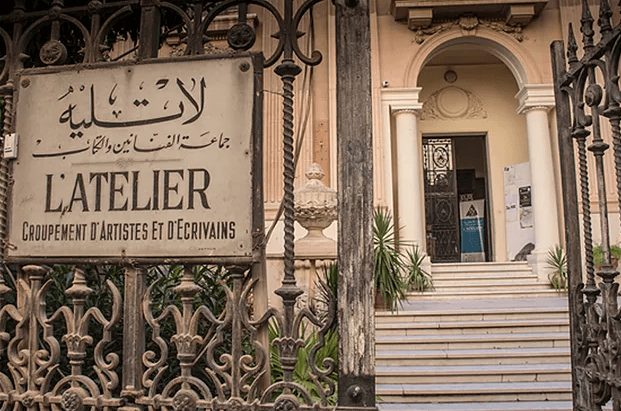
Issa also remembers things happening in the 1990s state-run art scene, in the Cairo Biennale, the annual Youth Salon, the Palace of Arts, and the Gezira Art Center, where she had her first exhibition. The Cairo Biennale is the old biennial model where state representatives pick the artists, she points out — its funding was limited and it lacked in many other aspects, but she would always go to see it; it’s not like you would ignore it and sometimes you would come across very interesting works. (A 2008 article by Selim indicates that beginning with its sixth edition, in 1996, the biennale attempted to move beyond its embassy-driven approach, with the fine arts sector and the biennale itself inviting half the participants.[10]) There was no particular state-run space one could count on to go and see something interesting, Issa says, for they were inconsistent and you felt constrained by certain bureaucracies and structures a lot more than in the spaces in downtown, for example, where you felt you could do things and no one really asked you why you were doing them or what they meant. Khan recalls presenting an audiovisual piece one night in 1995 at the Cairo Atelier (a non-governmental space in downtown Cairo founded in 1953, where members could rent space for a nominal fee) and getting a negative response. But his first solo exhibition, at the Gezira Art Center in 1999 and also audiovisual, was met with much more enthusiasm, including at least five reviews in English or Arabic. Something had changed socially, he feels — a new and different art audience had begun to emerge.
By that time, interest from outside Egypt in the country’s contemporary art scene had grown significantly. Our interviewees attribute this shift to various factors, including the aftermath of the first Gulf War, which made contemporary art practice in the Arab world interesting to international curators, with Cairo becoming a focal point. Mahmoud and other interviewees recall the 1993 opening of the Cairo-Berlin gallery by a German woman named Renata Jordan, a small space off Huda Shaarawi Street, now a pizza place. In 1990, the Italian gallerist Stefania Angarano took over Mashrabia Gallery from Christine Roussillon (who had started it in 1982) and gallerist Karim Francis opened L’espace downtown in 1995. William Wells, a former teacher from Canada, started Townhouse in 1998. When we interview curator Mai Abu ElDahab (born around 1976), who earned a degree in political science and philosophy from AUC in 1997 and whose first job was as a copyeditor at Egypt Today, she says she volunteered at Townhouse during its first two years — she knew Wells from when he was an inspiring history teacher at her high school — while also working as arts program associate at the Ford Foundation under Basma al-Husseiny. Abu ElDahab remembers how press releases and other texts were collaboratively generated through discussions including herself, Wells, and the artists involved. Asked whether Townhouse cultivated arts journalists, she recalls that for years, when one would enter the building in downtown, Wells had an office just on the side on the ground floor, that door was open, and there was a constant flow of people. She thinks those relationships with writers were therefore very strong.
Around 2000, Issa says, art felt relevant and timely, which is not something you always feel about art. Back then it really felt you were doing something relevant. It had meaning, it seemed to respond to the moment in which it was taking place. It was inspiring to be participating in something which you felt was contributing to or was part of a discourse that other people got. What was exciting about that time was that you felt a sense of community and you felt that art was doing something. Sarah Rifky, a writer and curator born in 1981, likewise remembers a small budding community of people who were passionate. She recalls that her cohort was the first to officially graduate with an art degree from AUC. She knows she spent an insane amount of time at the Cairo Atelier. She was exposed to modernist art at Mashrabia and Karim Francis galleries without having the context, the history, or the knowledge; she was really just trying to understand it on the fly. She would get bits and pieces, but had no discursive historical understanding. By the time she graduated in 2003, she knew all the names, she just didn't know how that history sits together.
It's hard to speak of 2000 without speaking of 2001, 2002, and 2003, Rifky says. It was completely eclipsed by the following three years, she says, in part because of massive global moments, including 9/11 and how that cut up and pulled out a lot of change that eventually led to the invasion of Iraq in 2003. That entire moment contained a specific experience politically on the popular level that was also happening in art — in the early 2000s, she had her first encounters with political life, namely the demonstrations in support of the Second Intifada, which took place from 2000 to 2005. AUC, where she studied, was downtown at that point, so there was also a slow-growing sense of a mishmash hybrid, some form of progressive-in-hindsight Marxist left, bits and pieces of movement that flit in and around communities that were both visible and invisible. That had to do with art but primarily with journalism and activism. She thinks making those distinctions in vocational capacity is only something done in retrospect; they didn’t exist then. It wasn't like you're a writer and I'm an artist and you're a critic and you're a curator and I'm a journalist. They were just there and they just did stuff and it was fluid — she’d be assisting AP journalists in the morning, writing a text at Townhouse in the evening, and then reviewing maybe that same show in Cairo Times the next day. It was almost incestuous. Later on things got so calcified, she says, in terms of vocational specificity. But at the time when she started practicing, there were no curators. That word did not exist.
Issa agrees that there definitely was something about that moment, and she wouldn't say it was only Cairo — Alexandria was very important as well. A lot of interesting artists were coming from Alexandria, many having studied together, like Wael Shawky, Amina Mansour and Mona Marzouk (who studied at the atelier of Wahba, born in 1942). There were interesting things happening in Beirut and Istanbul, Issa says, and people like Christine Tohme of Ashkal Alwan[11] and Vasif Kartoun of SALT Istanbul were coming to Cairo, and artists were also going to Istanbul and Beirut. Attalah, whose own visits to Lebanon came from volunteering in Palestinian refugee camps as part of the Cairo to Camps initiative under the auspices of AUC’s Forced Migration and Refugee Studies program, also says that Cairo was bringing all cities to it — Beirut, Dakar. There was that energy, Issa says, and for the first time you didn’t have to go through the Culture Ministry to show your work. And as longer-standing commercial galleries like Mashrabia and Karim Francis were weighed down by finances and limited space, Townhouse made a difference. Issa thinks the Nitaq Festival, organized by Karim Francis, Mashrabia, and Townhouse and held in 2000 and 2001, was quite important too. It introduced a lot of people to these artists; creating a space in downtown Cairo became important.[12] In a 2000 issue of Medina, Issa wrote a lengthy review of the first edition, starting:
The lively response to the week of music, theater, dance, storytelling and plastic art on display at downtown galleries confirms that Cairo has real reasons to nurture its art community. Launched on the 20th of January, after months of planning and haggling with authorities for this and that permit, the festival carried on for seven days. [It] has received good and bad press. On Sunday, January 20th, an unsigned article in Al-Ahram newspaper articulated some of the negative responses, referring to the festival as a foreign conspiracy to influence the line of creativity of precocious Egyptian artists. This festival is “another window through which ‘the Other’ can gaze, adhering to notions of ‘globalization’ from the logic of open your door and I’ll open up mine.”
Abu ElDahab recalls the first edition of Nitaq as being transformative in the amount of energy around making the event happen. This was before the Second Intifada and before 9/11 — she felt it was the first moment in which a lot of people from Cairo University’s Fine Arts Faculty met peers outside their direct community, people who came into the arts independently. Critic Ismail Fayed, who studied political science and economics at Cairo University, graduating in 2004, and entered the contemporary art scene around 2006 through experimental theater at the Zamalek Arts Complex, also points to the demographics of that general moment, to the changing form in which a certain discourse and type of artists were presented, to a change in which artists could show their work: they could be from outside the official scene or even have no artistic background, especially not the education of the artists exhibiting in the General Exhibition or the Youth Salon. That diversity was relatively new, he says, and it is what created that state of momentum. Attalah, who studied at AUC and decided to major in journalism in 2001 during the Intifada, remembers discovering art-related events just because AUC was in downtown and Townhouse was next door, with cafes around it — a natural act of community-making. One of the first art people she met was Negar Azimi, who was doing projects at Townhouse and would ask Attalah’s help in translation, English to Arabic. Attalah’s engagement with art was thus a lateral engagement using language, which is the main thing she now works with, in journalism. Azimi got her writing for Bidoun (founded in 2003, and where Azimi continues as editor-in-chief), and she found that editing process very enriching, partly because of being asked to read stuff.
Azimi remembers starting work at Townhouse to stand in for Abu ElDahab, who was going away to study. She says she was a sort of jack-of-all trades, doing everything from liaising with a graphic designer and coming up with exhibition invites to making selections of work for shows and working with artists on fundraising. Azimi had studied biology and international relations — when she first came to Cairo in 2002, one of the things she was doing was working with Barbara Harrell-Bond (1932–2018) at the Refugee Legal Aid Project,[13] for example, taking down the case narratives of Sudanese and Afghan refugees. Working with Wells didn't feel that far removed from that kind of work. William is in many ways an anthropologist, she says, and she was really taken with how he ran space and was responsive to both the city and audiences in multiple demographics. Relatedly, when asked about her own writing style, Azimi says that it’s non-specialist writing on art that she enjoys the most and that she doesn't distrust storytelling as a mode; her writing tends to be narratively driven and when she writes about artists she often reaches for the biographical. A lot of people might be skeptical of that approach and want criticism to be engaged formally, independent of biography, but she feels more invested in a practice and an artist if she knows where it's coming from, understands the topology, the political stakes, the debates around it, and the life story; that's her personal entry point.
Articulating something into being
For SITE magazine in 2003, Azimi wrote:
A new generation of Egyptian artists is, for better or worse, intimately tied to the march of globalization, with access to a wider pool of references born of increased travel, internet, satellite-television and cinema. This generation is better educated than those of the past, while rampant economic liberalizations and the ascendance of a rabid consumer culture have further tied young Egyptians into discourses that transcend the realms of geography, time and place. Doubtless, such a global vocabulary has found its home in much of the artistic production emerging from the country at large, whether visual, performative or literary in nature.
Art for her was drawing and painting and sculpture, says Issa, and she likes to do all these things, but it wasn't until she was maybe 18 or 19 that she discovered artists working in ways that she didn't know artists did, and that was quite a revelation. She was in the United States at the time, in the 1990s, but when she went back to Cairo she started meeting people who were already doing things like what she’d encountered there. Between 1999 and 2001, she met people like Khan, Shawky, Mansour, Marzouk, and Baroni. There was this world she hadn’t known existed and it was rich and interesting, and people were doing things that seemed relevant but also not weighed down by academism or allegiance to any of the artists working before. There seemed to be a lot of freedom in it. Khan told Azimi, for the piece in SITE, that it might be “the lack of substantive historicity behind the form that in fact makes video a potentially powerful candidate for expression in Egypt."
Discussing Wahba’s atelier in Alexandria, which operated between 1988 and 1995, Ali Hussein al-Adawy (born in 1985) has written in Mada Masr about what he calls the beginnings of performance art in Egypt. In 1994, the Goethe Institut approached Selim and Fatima Ismail, who in turn involved two of Wahba’s students, Reem Hassan and Aliaa al-Gereidy. The idea was to commission two performances, one Egyptian and the other German, each the result of a collaboration between an art critic and artists around “the unity between artist and artist-critic in the creative work.” Adawy writes: “Ismail, Hassan, and Gereidy presented a performance [at Akhenaten Gallery in Cairo and at the Alexandria Atelier] based on the notion of transforming abstract ideas into visible material and written language, under the title Creative Mentality in the Frame of Readymade Form. They presented large glass containers and filled them with differently colored waters to reflect on the idea of readymade templates. They also collaborated on a soundtrack with Moataz al-Safty, who used a microphone and mixer to create sound from the flow of water in a nearby bathroom.”
Rifky says she didn't care about art as leisure but almost as a thinking space. The early 2000s was a moment when she realized that there was something about the practice where maybe aesthetics or form or the plastic dimension of it was a gateway to something much more fundamental and critical and for which they didn't have a language, a discourse. Rifky suggests that there was not actually that much art writing to read. There was a lack and you could sense it, agrees Issa, it felt really behind what was happening — there were artists and interesting works being produced, but almost no interesting writers writing about art. The writing didn't seem on par with what was happening or doing justice to it. When people wrote about the work, it mostly felt superficial, Issa says. The Cairo Art Index website, which she set up with Brian Kuan Wood in 2002, presenting six English-language interviews with artists, was one way to address this lack.
Cairo Art Index: So there's no sense of judgment or criticism in your approach?
Amina Mansour: It's totally detached. It's a state of complete belief where the artist is not aware of whether the subject matter is fantasy or whether it is currently occurring.
CAI: So you invite the viewer to take a similar stance?
AM: I do. I think it's a lot more complicated than an artist having a particular position or providing a solution to a problem. It questions where you stand in relation to all of this.
Something that has often happened in Egypt that’s always interesting, says Abu ElDahab, is when certain fields are so small that they end up overlapping extensively with others — for example, thinking about architecture magazines and cinema having a close relationship with visual arts. The flipside of that smallness, she reckons, is an insufficiency of institutions, publications, or exhibitions. And she brings up the very loose, imprecise, and vacuous writing that can happen in the art world; this is not an Egypt-specific problem, but she thinks there is a poverty of skill that has to do with an incomplete ecology: where the art schools are, where the art writing is, where the museum is, where the archive is, and how all those vocabularies mix to create a language that you can use in a situation. Here, it's not solid because it’s only built on bits of this and that, a bit of history, a bit of philosophy. In general, in the arts, she says, there is often a very scattered field of knowledge that is difficult to grasp into a reflection.
Rifky thinks there could have been art writing but that it was largely oral. That is another aspect of that time: her experience of so many things was aural — discussions, interviews, and talking; lots of talking at the Cairo Atelier and lots of discursive settings; lots of it undocumented. That occupied the space of writing, she guesses. She and her milieu didn't all sit down and read a Catherine David text — they'd all read it, they all knew what was annoying about it, they were discussing things all the time, but they didn't have a textual practice. Maybe people read alone. They didn't have writing or reading groups. Rather than going back to a piece of paper, it was a stammering with that extreme effort of trying to articulate something that had not yet been into being — that was a lot of work that really built community. She might even beg to expand the definition of art writing to include all these other things that are not traditionally or conventionally considered writing per se. She thinks the description of the medium — writing — is in itself extremely frustrating, as it maintains that that kind of knowledge is a priori the way in which we move things forward. There was no writing, she says.
“What I want to say is that it is an orphan practice,” Yasser Sultan — an arts writer born in 1972 who studied art education and started off as a cartoonist while working at the Culture Ministry — tells us in 2022, in conversation about art criticism. He sometimes feels he is ignorant about the vocabulary that has to do with photography, drawing, and new practices, contemporary and even modern ones. Sometimes he feels a lack of knowledge or unfamiliarity with these matters even at the level of intellectuals. Like many of the people spoken to for this project, he says he came to art writing by chance. He identifies as a journalist who covers artistic activities, but not as a critic. He thinks criticism is something other than what he does; it needs a little deeper vision. (Sultan also says that when he shifted more toward writing about contemporary practices after 2011 in a conscious effort to build awareness, his editors at Al-Hayat were most receptive, but also Fatima Ali at Al-Qahira was very open, while at other publications he always had to fight.) Reflecting on this point, my fellow interviewer Nour says that she feels we are probing at how a counter discourse in the art field developed in Cairo around the turn of the century, and that it is interesting that a foundational myth for this counter-sphere was the lack or absence of a suitable language.
Anger, a moment of danger
On encountering the art scene in Cairo later in the 2000s, what struck Harutyunyan was the cultural politics resulting from contradictions between state-sponsored culture and that of contemporary art institutions and artists. She perceived a clash on the level of artworks, publishing, press conferences, fistfights and other modes, brutal and not-so-brutal confrontations, and she saw that contemporary artists were very much invested in the transformation of their own context. If we were to situate the transnationalization and institutionalization of contemporary art, she says, we can see that the trend started in the late 1990s and early 2000s, probably also fueled by 9/11 and the US-American cultural interest in the Middle East, but we cannot reduce it to one geopolitical moment.
For Rifky, her experience of Cairo at the time was that people were outspokenly and continuously angry everywhere. People making art were angry at not having infrastructure, not having enough representation, not having enough opportunity, and not having enough money. They were angry that when they did have opportunities they were being misrepresented, that they had no voice, that they were being pigeonholed in identity-based pigeonholes. Her motivational anger for writing was located specifically at how to prick the shitty curatorial practices that were emerging in the early 2000s around toxically topographic exhibitions and a certain kind of Western liberal multiculturalism and essentialism that she was very easily able to tackle in a particular linguistic and intellectual spectrum. Lebanese artist and writer Walid Sadeq, born in 1966, tells us on Zoom that on a visual level, the art that he and his peers were producing in the 1990s was close to contemporary art that was happening in other places around the world, especially in the West, and that this was a problem because it disguised the fact that the starting points of their art were very different. It was necessary for him to write in order to emphasize these different starting points — so that he and his peers could read about the forms they were using: an artistic language based on this bias that they themselves were working with.
I wonder if anger is a theme in the art-related texts we have read by younger artists and critics in Cairo and Beirut from around the year 2000. Anger at neocolonial violence in the region, most specifically the reasons for and the suppression of the Second Intifada against the Israeli occupation of Palestine and, in parallel, the US invasion of Iraq; anger at the ethnic marketing and identity-related conditions attached by funders to opportunities in the art world; but also anger at an older generation of artists and critics who saw themselves less as free-creating subjects looking at the daily life around them than as wage-laborers looking up at and bolstering the state, who came of age with the relative certainty of a monthly salary and fewer social and geopolitical unknowns — critics who insisted on progress and the linear continuity of art history?
Was it anger more than anything that drew so many of those younger critics to grapple with what the oldest critic suggested consists fundamentally of the problem of writing to a reader who has not necessarily seen the works you are writing about in a language other than the language in which those works were made? Was there something in the combination of abstraction and concreteness of this exercise that seemed to contain the potential to build a new kind of aesthetic? In my memory, says Attalah, looking back in early 2024, the early 2000s moments of art in the backdrop of big political events were shaped by an oscillation between the phantasmagoric and the real. Acknowledging the risk of overusing the analogy, she mentions Benjamin's angel of history resurfacing from the past, back to the future in a moment of danger — this iteration of Israel’s war on Gaza and its repercussions throughout the region and its diaspora — and trying to say: remember, something can be whispered through art, and it will be useful to listen in.
Why We Write: Art Criticism in Cairo and Beirut at the turn of the 21st Century is an ongoing project supported by the Arab Fund for Arts and Culture (AFAC). Any feedback, input, or corrections would be appreciated. Please email [email protected].
***
[1] The interviewees who generously shared their insights for this project did so in Egyptian Arabic, Lebanese Arabic, or English. All Arabic translations were provided by the author with assistance from the editor.
[2] Quotes used in this feature were selected from Samah Selim’s 2017 translation of Arwa Saleh’s book, titled The Stillborn: Notebooks of a Woman from the Student-Movement Generation in Egypt (Seagull Books, 2018).
[3] Checking online, I find that they had separated into two ministries in 1970 (the year of Nasser’s death), with the National Guidance turning into the Information Ministry, but were combined again in 1979 before separating permanently in 1982.
[4] For more information, see Ibrahim Dawar in Al-Dustour and Mahmoud al-Wardany in Al Akhbar al-Youm.
[5] Such as Gallery 68, Al-Tatawur, and Al-Kateb al-Masry.
[6] I find online that it was not operational for some years before starting again in the wake of 2011.
[7] For more information, see Al-Safir.
[8] “With about 55,000 internet subscribers and an estimated 220,000 users as of mid 2000, Egypt lies in fourth place in the region behind Lebanon, Saudi Arabia, and the United Arab Emirates in terms of internet penetration,” according to a 2001 report by the International Telecommunication Union. “Internet access in Egypt dates back to 1993, mainly through governmental and educational organizations. Commercial internet access was also available from around mid-1993. In January 1996, the government made an official address authorizing the private sector to step into the provision of internet services,” according to a 1999 research by Mohamed al-Nawawy.
[9] Studies available online indicate that its circulation in 2000 was 50,000 copies, which, while considered a fraction of the circulation of Arabic-language peers in a country of 60 million, can be seen as a high number where English is a niche language.
[10] This article is featured in his book titled Al-Fann wa Ahwaluh (Art and its Conditions), published by the General Organization of Culture Palaces in 2009.
[11] Tohme curated a show featuring Lebanese artists, titled Missing Links, at Townhouse in 2001.
[12] In her article titled “Have you met Mario?" (2012), Sarah Rifky wrote, "Only two remaining written reviews of Nitaq existed: Francesca Sullivan’s "Art Attack" in Egypt's Insight Magazine (April 2001, 54-58), and Nigel Ryan’s "Skating on Ice" in Al-Ahram Weekly (March 22 - April 8, 2001).
[13] The Refugee Legal Aid Project later became the Forced Migration and Refugee Studies program and later, controversially, the Center of Migration and Refugee Studies.

Jenifer Evans
Jenifer Evans is an artist and editor. She was Mada Masr's English-language culture editor from 2013 to 2017, while co-running with Taha Belal an art production and distribution outfit called…
تقارير ذات صلة
Creating a history mixtape: A conversation with Andrew Simon
Cassettes decentralized state-controlled Egyptian media long before the invention of the internet
On Farouk Wahba’s atelier: Chronicle of a mentor and his students
Alexandrian artist Farouk Wahba created a contemporary art movement which still echoes today
Egypt’s 19th-century brush with fine arts
Thanks to a French sultan, an Albanian soldier and two Egyptian Azharites.
Your support is the only way to ensure independent, progressive journalism survives.
You have a right to access accurate information, be stimulated by innovative and nuanced reporting, and be moved by compelling storytelling. Subscribe now to become part of the growing community of members who help us maintain our editorial independence.
Join us