
FestBeat: Distracted attention at Cairo Video Festival’s exhibitions
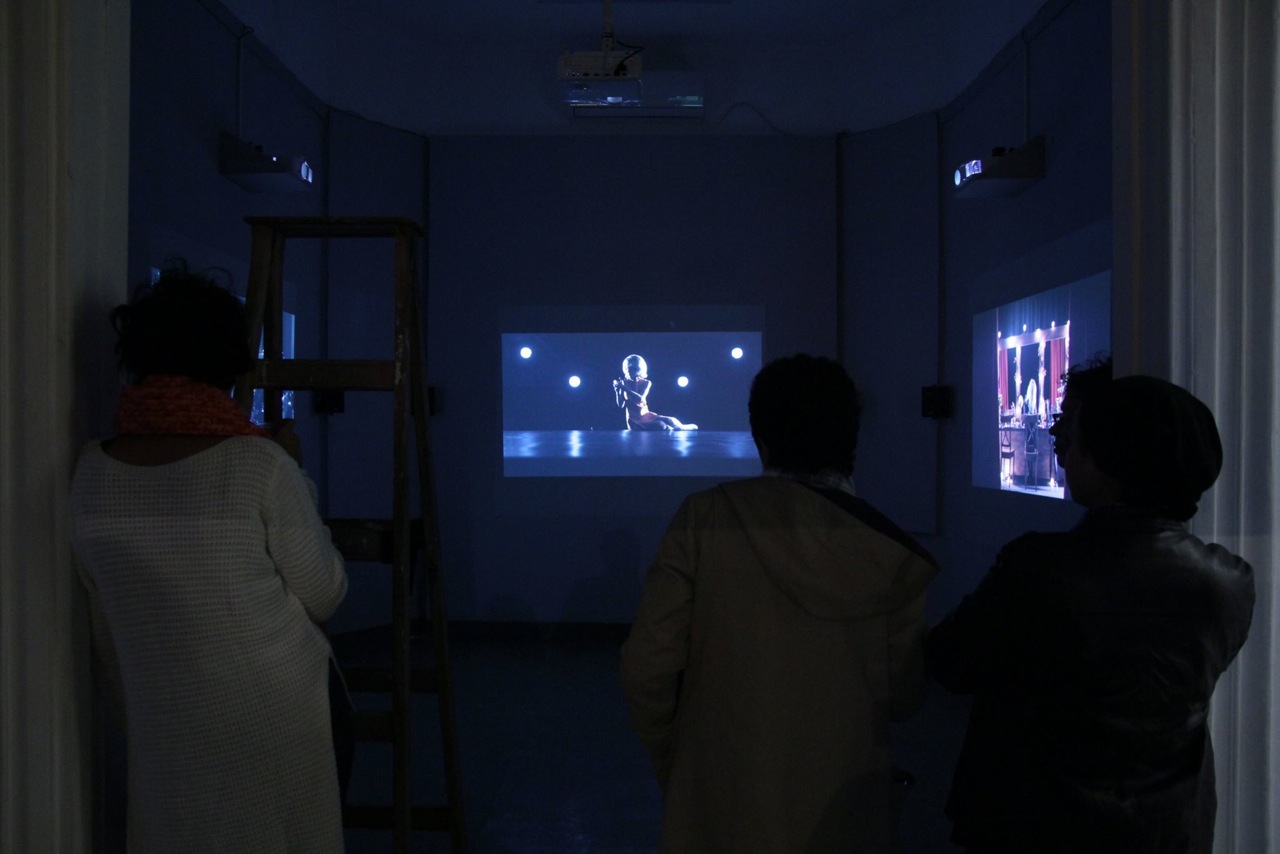
The first thing you notice as you enter the Contemporary Image Collective for the Cairo Video Festival (CVF) exhibition is the dim light. Then you start hearing the screams from Serbian artist Marina Abramovic’s single-channel installation work The Scream (2014).
I was the only one in the space, but the glowing screens all competed for my attention and it was hard to forget the others as I engaged with each one. With its technical flexibility, video has allowed for different forms of spectatorship, so relations between viewer, moving images, architectural space and time have been reconfigured. The play between distraction and attention in a gallery space like CIC or Medrar is not something we find in cinemas — once pretty much the only space in which moving images could be accessed. In a cinema, the spectator is a single unit, with one screen trying to absorb him or her into the darkness of the space. In a gallery, each spectator is multiple mobile units as he or she is done and undone by each screen.
Much like the instability of video as immaterial medium — now a binary code capable of migrating across different media and display modes — the spectator's position in a space like CIC in relation to the screens is also unstable. As I put on my headphones to watch Brazilian artist Camila Marchon’s 27 years 16 o’clock (2012), half my brain was thinking about The Scream and my eye wandered every now and then to see what was on the next screen. I tend to move a lot when I’m at galleries; I don’t stay in front of a work for more than a few minutes. That freedom to move and do other activities (checking your phone, for example) helps create this unique dynamic between distraction and attention that’s come to characterize our engagement with video, in galleries, at home watching TV, or on the street looking at phones or billboards. These shifting modes of engagement with moving images were made possible by video technologies.

But let me be clear: I don’t think that with video we’ve escaped the logic of the apparatus. The technological basis of video still controls our relationship to the (now digital) screen. The ways it does this are different from but no less concerning than the cinematic apparatus, which sets us in a fixed position vis-à-vis the screen.
Perhaps this is what works like Hong Kong artist Yuk Yiu Ip’s Clouds Fall (2014) attempt to remind us of. Showing at CIC, it uses footage from popular video game Call of Duty to construct a world for the spectator that is fully controlled by algorithms. The mutability of video as it becomes binary code is liberating insofar as it allows each viewer/user to choose a path through it, but ultimately the codes contain all the possibilities for how we can engage with it.
Clouds Fall also shows us video’s entertainment function, which doesn’t stay outside the gallery as the video becomes art object. Video is very much part of French situationist Guy Debord’s “society of spectacle.” Although videos in galleries allow for new configurations between spectator, moving image and screen, it’s not necessarily a move that’s liberating or ideology-free. CVF is a remarkable opportunity to think about what projecting images in galleries as opposed to cinemas means — not that it’s a new subject, of course.

Turning left after entering CIC, you see Swiss artist Peter Aerschmann’s three works: SPUTNIK (2014), SNAIL (2014) and /BABEL I (2012). It’s really hard to describe them, but one thing that connects them is computer as tool. BABEL I is an infinite construction site created algorithmically: Digital photographs of construction sites from capitals around the world from Dubai to Johannesburg are manipulated to create one large construction site that unfolds in a continuous tracking shot. Issues of labor and visibility are raised in relation to the computer as the tool of the 21st-century.

As we shift from analog to digital, the shift at the heart of any discussion about video, the computer is the apparatus we have to talk about. With its possibilities and limitations it shapes our relationship to the moving image. Several works at CIC and throughout CVF relate to our relationship to digital images and computer as tool. Good examples are Metropolitan Triangle Garden (Rui Hu) at Medrar, I laugh because you bring your ass to the party (Sandra Araujo, 2014) at CIC and Mohamed Nour’s Catalepsy (2015) at CIC. They compel us to think about the digital turn in relation to ideas about history, memory, stability and instability of material — today’s global culture, more broadly.
A couple of days after visiting CIC, I went to see the second CVF exhibition, at Medrar. Again, the lights were dim, I was the only visitor for most of my time there, and a play between distraction and attention shaped the relationship between space and time.
Right at the entrance is a fantastic installation by Iraqi artist Adel Abidin called Three Love Songs (2010). Its lulling soundtrack is heard in all the rooms, much like Abramovic’s screams. It surrounds you by large projections on three sides. On one you see a jazz singer, a blonde in a yellow dress sitting on the floor, on another a popstar who looks like Britney Spears putting on stage make-up, on the last a luxurious lounge setting into which a singer appears. They all have a blond, classic Hollywood look, but sing in an Iraqi dialect that contrasts strongly with the way they look and perform. The space you’re immersed in is very much psychological. The seeming contradiction between the look of their divas and the dialect arises from the desires we typically project onto blond women who look like 1940s Hollywood divas.

The relation between video and the psychological is explored in a number of works at Medrar. The groundbreaking SELF by Laurene Gartel (1978-2014) is perhaps one of the very first video artist self-portraits. The narcissism US critic Rosalind Krauss identified as part of video’s psychological realm in her essay Video: The Aesthetics Of Narcissim is revisited in several works at this year’s CVF, chief among them SELF.
Tomorrow is what the festival is calling its soft closing. There’s a panel discussion at 7 pm with video artists Sherif El Azma and Gheith al-Amine at Medrar. It should be great, so make sure to attend. The loop exhibitions continue until December 25, so you still have a few days to go see some of the works mentioned here.
تقارير ذات صلة
FestBeat: Talking about institutions and fluidity at Cairo Video Festival
The openness and flexibility of the festival is appealing, just like other spaces free from ministry influence and clear institutional visions.
FestBeat: Ahmed Shawky’s The Crime premieres at Cairo Video Festival
Ahmed Shawky’s Al-Garima and Omar El Zohairy’s Zafir both struggle with a similar set of questions, though in different ways.
FestBeat: Mark Lotfy’s Do As You Said at the Cairo Video Festival
Words become performative utterances that mold the space and, in the way they are spoken, their tone and pitch, contribute to the internal drive of Mark Lotfy’s films.
Your support is the only way to ensure independent, progressive journalism survives.
You have a right to access accurate information, be stimulated by innovative and nuanced reporting, and be moved by compelling storytelling. Subscribe now to become part of the growing community of members who help us maintain our editorial independence.
Join us