
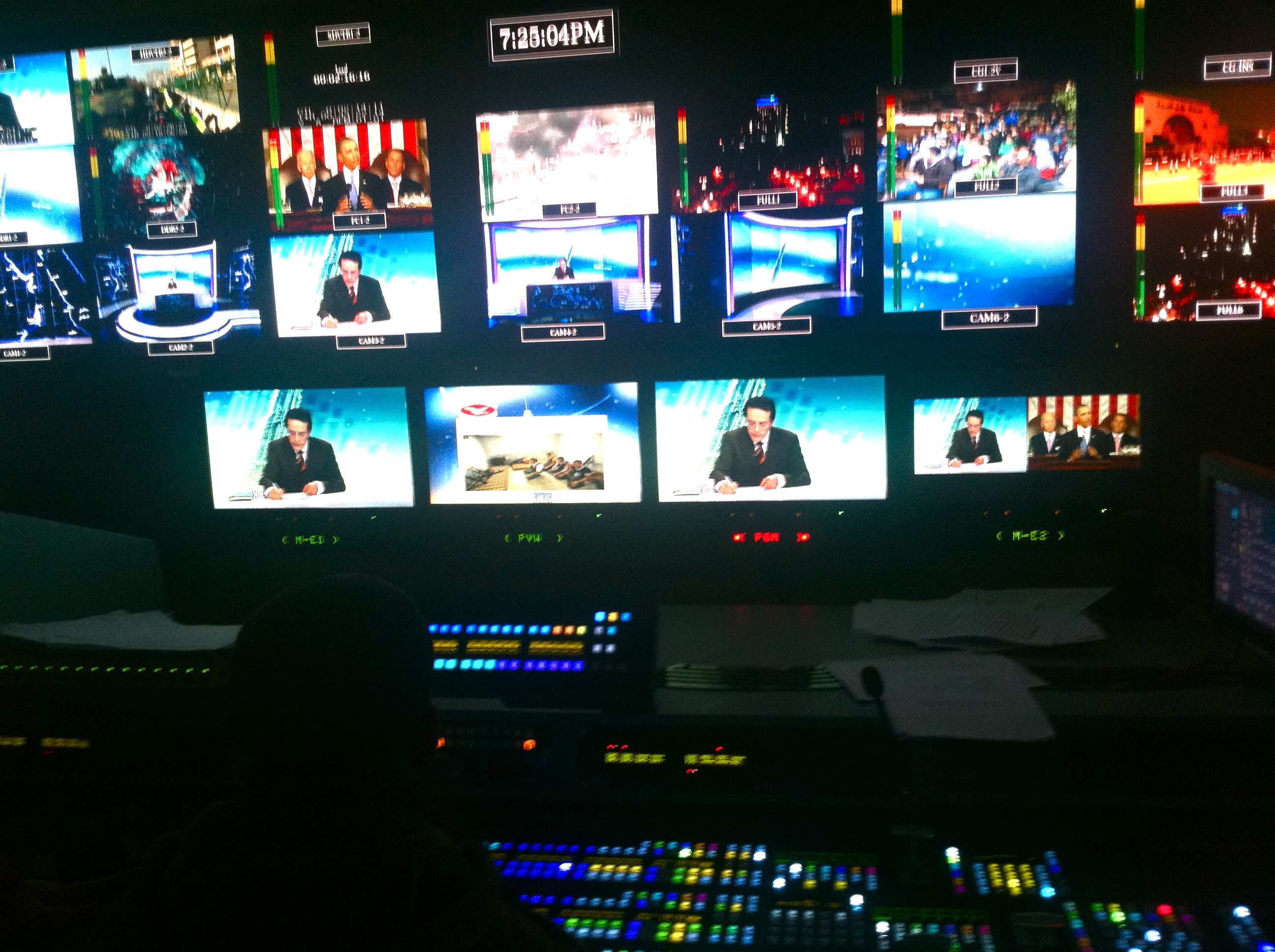
On a Thursday evening, CBC eXtra’s control room seems like something from outer space — it’s in the desert, cold, dark, and full of grainy video feeds and back-lit consoles — apart from the show’s director barking at everyone to shut up so he can make tonight’s show happen.
Most of the light inside the control room comes from an array of screens and technicians’ back-lit buttons. There are no less than 27 screens for the channel’s cameras that are deployed across the country. A few in-studio cameras on the other side of the wall are focusing on the host of a program flinching as a staffer hooks up a microphone behind her back.
“This is the news,” says Mohamed Helmy, the head of the channel’s reports division.
The channel, Egypt’s newest 24-hour news station, is called eXtra, which is fitting.
Its journalists say the channel responds to the changing habits of viewers that want extra raw information, since they already know what the issues are in this country where the highest drama is in current events. But it also represents an additional effort by the mammoth conglomerate Future Media to push its editorial and political line in a new format.
“We are changing direction in terms of audience, and God-willing, eXtra will start broadcasting news [24 hours a day],” says Alaa al-Ghatrify, the director of the new channel.
The channel only started earlier this year and is broadcasting 19 hours a day, joining the ranks of ONtv live and Al Jazeera Mubashir Misr, which pioneered the format of live news feeds targeted at viewers hungry for real-time images regarding events they are already familiar with.
The news industry is however less than profitable, which begs the question why Future, whose ownership is mostly associated with businessman Mohamed Amin, decided to invest a significant sum into a new news channel.
Future Media did not return calls regarding the size of the investment or that of its parent company, but it is undoubtedly a large sum. The producers and reporters that Mada Masr met had extensive resumes before moving to the channel. They are the movers and shakers behind the big names that host programs, including Dina Abdel Rahman, Ibrahim Fayek, Amr al-Shobaki, Salah Eissa, and Diaa Rashwan. This doesn’t even include the technical costs of the dark control room and satellite licensing fees.
“Whoever wants to defend a point of view or offer a new service has to have the motivation to produce and work in news. In the end, people are afraid of [getting into] the news because they hear it’s unprofitable and is very costly,” says Ghatrify, who is also the managing editor of Al-Watan, one of Egypt’s main pro-military dailies and another Future Media company.
Even though state TV charges international news companies as much as US$1,000 a minute for footage, CBC eXtra will give its live feeds free of charge to international news channels, as long as they display the channel’s logo.
Already the company has partnerships with Sky News Arabia, Deutsche Welle, and the BBC. In any case, the small fees for footage are a drop in the bucket. Giving other non-competitors free live feeds is the norm for satellite TV channels, and in the grand scheme of things, charging for footage could work against the goals of the channel.
“They [satellite channels] are mostly used as a power tool rather than for making profits,” says Rasha Abdulla, the former chair of Journalism & Mass Communication at the American University in Cairo. “If it makes profit, great, if it doesn’t so what?”
Ghatrify did not directly answer if the owners of Future interfere with the editorial content of the channel, instead saying that CBC and its affiliates have an editorial policy that is well known.
“Every news agency has its own agenda, especially local news agencies, like Al Jazeera. We want the news to come from Egyptian channels.”
In the reporter’s room, Helmy sits with a group of researchers who are seemingly running on caffeine and nicotine and glued to their computer screens. He’s responsible for assigning CBC’s cameras and reporters all across Egypt and for selecting today’s and tomorrow’s news. In front of him is a sheet with Thursday’s assignments. The day before, CBC eXtra’s cameras were at the stock exchange, the Mubarak trial, Hurghada, and St. Katherine.
“Every conference counts,” says Helmy. The channel was one of the outlets to break the news that Hamdeen Sabbahi would be running for the presidency, simply because it had set up a live feed of the conference.
Moving towards raw, unedited feeds is where the news is going, Helmy and Ghatrify say. Helmy sees it as a move away from the classic talk show model of phone-ins and interviews.
“At CBC eXtra we are being real reporters, not recorders,” he says.
But live television is not by definition unfettered and cannot be editorialized, not to say that it shouldn’t be. Camera angles, interview subjects, and the comments broadcasters use to frame the stories can all put their own narrative on the story for the viewers’ or editor’s benefit.
“Supposedly if you’re looking at something live, people will get the news, but the problem is with all the gate keeping that takes place,” Abdulla says.
Marwa Tantawi, a senior producer, works at least 12 hours a day to produce this content, often at irregular hours to make sure that the feeds keep rolling and to ensure all the kinks in the process are ironed out as CBC gets started. She hopes that eventually she’ll move to an eight-hour day, but the news will keep going 24 hours.

Jahd Khalil
Jahd is a Cairo-based journalist who has contributed to the Los Angeles Times, Al-Monitor, Deustche Welle, and other outlets.
تقارير ذات صلة

The long and costly wait for a new personal status law
Bassant Soliman’s suicide triggered renewed public backlash against personal status laws in Egypt
We will sit together on Srifa hill, Qassem
Two friends try to reclaim a memory other than what the Israeli genocidal machine carved into them.
How Israel recognized Somaliland
Somaliland officials have pursued formal diplomatic recognition for over 30 years.
Your support is the only way to ensure independent, progressive journalism survives.
You have a right to access accurate information, be stimulated by innovative and nuanced reporting, and be moved by compelling storytelling. Subscribe now to become part of the growing community of members who help us maintain our editorial independence.
Join us