
Egypt’s cinematic gems: Land of Fear
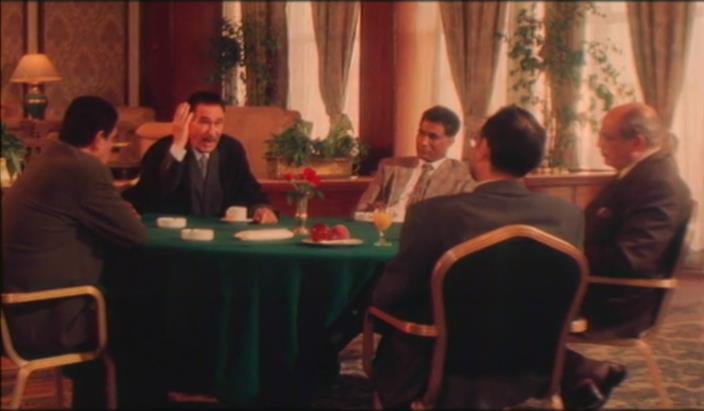
For Ard al-Khof (Land of Fear, 1999), Daoud Abdel Sayed put together one of the best-written screenplays in Egyptian cinema, tying his passion for existential dilemmas to a philosophical storyline about men and prophets, good and sin, religion and sacrifice, and packaged as an epic crime flick full of suspense.
“You will cheat, steal, kill and poison your society,” says General Maamoun to Yehia, who grabs an apple and takes his first bite. “To tell you the truth son, it’s not an easy mission."
Yehia al-Manqabady (Ahmed Zaki) is a fine police officer, chosen by his superior in the late 1960s to infiltrate Egypt's drug dealing underworld in a lifelong security operation called Ard al-Khof (land of fear).
Suddenly, Yehia is expelled from the haven of the security apparatus into the hellish web of the narcotics business. In prison, where he starts his mission as a disgraced officer, inmates call him Yehia Abu Daboura (Yehia the police officer). Following his release, he works at a snooker club, then a nightclub, where he wins the heart of owner and main dancer Rabab (Safwa). She and her club offer Yehia fertile soil to plant the seeds of evil and become a kingpin over the course of more than 15 years.
Meanwhile, we move from Nasser through Sadat to the Mubarak era, and many in the ministry retire or die. The details of the operation become indistinct, as does Yehia, also known as agent Adam.
"Do you have kids…? Don’t answer me… I don’t know anything and I don’t want to know anything," says Moussa (Abdel Rahman Abu Zahra) to Yehia when the latter demands a secret meeting to discover the significance of the information he sends, using the name Adam, to a secret P.O. box for his ministry superiors — his only contact with them.
“When I started the mission everything seemed clear, but afterwards I started seeing everything from behind a sheet of glass and, as time passed, dust accumulated on the glass and I started to see a foggy image,” says Adam to Moussa, explaining the “contradiction between the sense, shape, situation and truth.”
Soon, Adam is caught between dying as a sinful drug dealer or revealing his true identity as Yehia the good officer licensed to sin.
"I am a messenger, just a messenger!" screams Moussa, when Yehia runs to him for salvation.
With Yehia’s classical Arabic voiceover narrating events, watching The Land of Fear is like watching a thriller about drug dealers and assassins, and at the same time reading a philosophy book on God and the creation of the world, in which both activities feel normal and harmonious.
Scriptwriter and director Abdel Sayed developed the dimensions of his archetypal protagonist, the loner who embarks on a journey of self discovery — as in Kit Kat (1991), Ard al-Ahlam (The Land of Dreams, 1993), and Al-Baath Aan Sayed Marzouk (Searching for Sayed Marzouk, 1990) — and made it about the fundamental concerns of human beings: God, good and evil. He broached this in Searching for Sayed Marzouk, but not with the clarity and persistence of Land of Fear. Adam knew his God, but lost track along the long way of temptation and sin, symbolized in Omar the police officer or Satan. (In Searching for Sayed Marzouk the officer's name is also Omar.)
As in Searching for Sayed Marzouk, Abdel Sayed gives his characters meaningful names that point to the religion in the allegory: Yehia and Adam, put together, mean “Adam lives.” General Maamoun, or the trusted who may be God. Moussa (Moses), the post office employee or messenger. Al-Moallem Hodhod, the savant and religious drug dealer played by Hamadi Gheith (hodhod means hoopoe, the bird that spoke to Suleiman). Farida (the unique), Yehia's wife or Eve — though she’s not the one with the apple.
Ahmed Zaki conveys the unraveling identity of his character with brilliance, occupying a much greater chunk of the screenplay than Kamal in Searching for Sayed Marzouk, maybe because the Land of Fear script is more daring, or simply because Abdel Sayed felt that Zaki could do what Nour al-Sherif could not in his 1990 masterpiece.
Women have only a marginal space in Land of Fear: They are all secondary elements in the tale, exactly like Mona in Searching for Sayed Marzouk — an object of temptation with little influence over the course of events, with the sole purpose of bringing a child into the world. In Abdel Sayed’s Rasael al-Bahr (Messages from the Sea, 2010), the women in the protagonist Yehia’s life (a role initially written for Zaki, but played by Asser Yassin) are drawn in a promiscuous or deviant light — his first love turns out to be gay and his second a prostitute. Whether deviant or useless, Abdel Sayed's female roles are always outside the main struggle (except for The Land of Dreams, where the main role is a woman played by Faten Hamama).
The Sufi chants and flute sounds bear the unmistakable touch of the ingenious Rageh Daoud, a frequent movie companion of Abdel Sayed. Ethnic tunes were foreign to soundtracks of the time, and it works beautifully.
Cinematographer Samir Bahzan plays along with these rhythms with his camera, focusing on certain things and ignoring others with his close-ups of apples, balls on snooker tables, and the many other objects in the movie that act as symbols for matters such as fate and life.
There were some major execution problems: Despite Bahzan’s interesting compositions, the lighting is often bad and the sound frequently sub-par. But Abdel Sayed's movies improved technically after Land of Fear, maybe because by 2001 the technology had progressed.
Abdel Sayed's choice to use the formula of the thriller was clever commercially and brought him closer to audiences: His next movie, Mowaten wa Mokhber wa Harami (A Citizen, an Informant and a Thief, 2001), benefited from this proximity. (His latest, Qudrat Ghayr Adiya (Out of the Ordinary), just premiered at the Dubai Film Festival).

Amany Ali Shawky
Amany is a Lifestyle and Society Reporter with Mada. With 10 years in journalism and publishing, she has written for everything from news to culture, environment and fashion, street politics…
تقارير ذات صلة
Egypt’s Cinematic Gems: The Open Door
Ismail Fayed explores Henry Barakat’s adaptation of Latifa al-Zayat’s 'The Open Door'
Egypt’s Cinematic Gems: Love’s Last Story
Raafat al-Mihi’s third feature combines symbolism with an unflinching awareness of reality
Egypt’s cinematic gems: Sleepless Nights
Hany Khalifa's frank film broke the prudish "clean cinema" trend in 2003.
Your support is the only way to ensure independent, progressive journalism survives.
You have a right to access accurate information, be stimulated by innovative and nuanced reporting, and be moved by compelling storytelling. Subscribe now to become part of the growing community of members who help us maintain our editorial independence.
Join us