
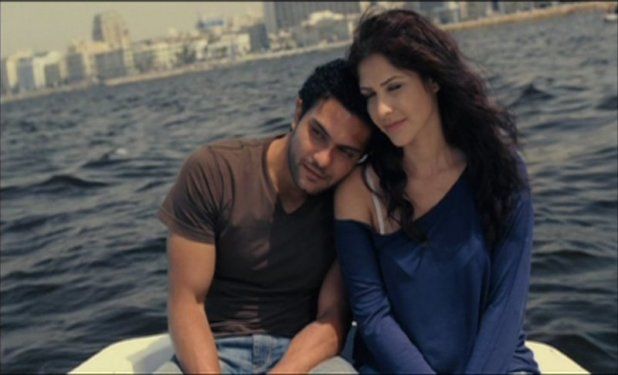
Egypt’s cinematic gem: Messages from the Sea
With a statue of David in the middle of the frame, we see Yehia (Asser Yassin) euphorically skipping down the stairs of his family house in Alexandria.
"I am alone and free," he says, opening a window.
Rasael al-Bahr (Messages from the Sea, 2010), is a dramatic, nostalgic and sometimes nonsensical film about a man who doesn’t stutter when he’s drunk or in love. Continuing the themes and characteristics that have come to be associated with Abdel Daoud Sayed’s films, it will mainly appeal to the director’s die-hard fans – like me.
Following the death of his last surviving relative, young med school graduate Yehia escapes Cairo and finds refuge in Alexandria where happier memories and his beautiful, bisexual Italian neighbor Carla (Samia Asaad) dwell. Jobless and alone, Yehia explores the ancient city and resorts to the sea for food.
He drinks alcohol for the first time, has sexual encounters and gets his heart broken, but his eventual triumph is acceptance, contentment and the wisdom that he can’t change the world. This comes about through a bittersweet struggle with Hagg Hashem (Salah Abdallah), the new owner of Yehia's building, a man who fishes with dynamite and owns most of Alexandria's supermarkets.
In all his films, Abdel Sayed's protagonists resist change. Change is their biggest challenge and the core of their existential dilemmas. They are all different, outsiders, typically suffering some sort of impediment that makes them socially reserved, silent but with a lot to say.
Messages from the Sea picks up threads from Abdel Sayed’s Ard al-Ahlam (The Land of Dreams, 1993), centering on people and their relationship with place. In the earlier film, Narges (Faten Hamama) resists change because she has become inseparable from the neighborhood she once knew and loved. In the second, Yehia fights the battle by returning to the city of his childhood, but finds that Hagg Hashem's new money has changed it a lot.
Long shots of Alexandria’s beautiful architecture take up stretches of film, backed by Yehia’s voiceover and Rageh Daoud's forlorn rhythms. The result is a short, mesmerizing documentary on old stone and emotions within a long feature.
Yehia matures and leave his adolescent fling with Carla behind and ventures on a new love story with Nora (Basma), apparently an upscale prostitute with good taste in music. And at a forgotten bar, he meets Qabeel (Salah Abdallah), a former boxer who’s now a bouncer at a seedy nightclub. Qabeel is his opposite – confident, big and jolly.
Qabeel’s physician informs him of a tumor and the inevitability of brain surgery that may cost him his memory. "I love Beesa,” blurts out the boxer in response, Beesa being an employee at the nightclub where he works.
Daoud's characters always have something buried in them that they strive to get out and when it finally does emerge, it’s at the weirdest moments. This may confuse the audience and feel offbeat, but if you dig into his characters you realize that nothing’s said out of the right context and time. Abdel Sayed’s screenplays are precise about when his intricately drawn characters will crack and give up, or get up and fight. This tends to inspire actors, and accordingly there are stand-out performances from Yassin, with a natural-sounding stutter, and Abdallah, with a generous portrayal of a rundown boxer with a heart of gold.
Also in keeping with Abdel Sayed’s trademarks, Messages from the Sea’s female protagonists are deviant yet loveable and tempting. Farida and Rabab from Ard al-Khof (The Land of Fear, 1999), Hayah in Mowaten we Mokhber we Harami (A Citizen, an Officer and a Thief, 2001) and Fatma in Kit Kat (1991) are all reincarnations of Eve with her apple of sin, sensual, addictive and sinful.
Just as Abdel Sayed sticks with certain locations, he also prefers certain names for his leading characters. Yehia is one of them, meaning life and symbolizing the journey of Adam. And Rageh Daoud's music, a staple of his movies, further ties Messages of the Sea to its older siblings. All this gives the production an endearing familiarity and highlights how each new Abdel Sayed production is a continuation of one big existential project.

Amany Ali Shawky
Amany is a Lifestyle and Society Reporter with Mada. With 10 years in journalism and publishing, she has written for everything from news to culture, environment and fashion, street politics…
تقارير ذات صلة
Egypt’s Cinematic Gems: The Open Door
Ismail Fayed explores Henry Barakat’s adaptation of Latifa al-Zayat’s 'The Open Door'
Egypt’s Cinematic Gems: Love’s Last Story
Raafat al-Mihi’s third feature combines symbolism with an unflinching awareness of reality
Egypt’s cinematic gems: Sleepless Nights
Hany Khalifa's frank film broke the prudish "clean cinema" trend in 2003.
Your support is the only way to ensure independent, progressive journalism survives.
You have a right to access accurate information, be stimulated by innovative and nuanced reporting, and be moved by compelling storytelling. Subscribe now to become part of the growing community of members who help us maintain our editorial independence.
Join us