
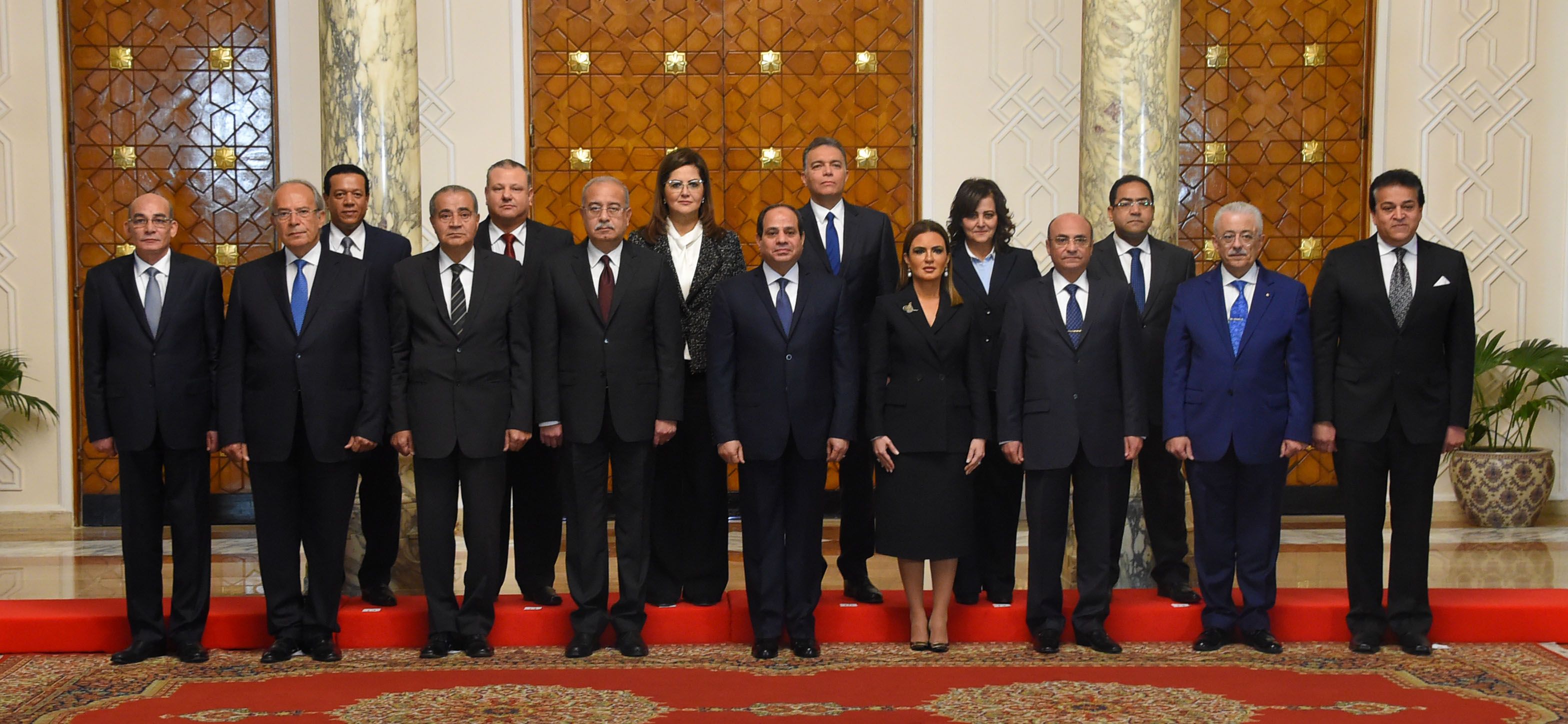
Does a change introduced by the recent Cabinet reshuffle signal the end of transitional justice?
Formerly the Transitional Justice and National Reconciliation Ministry, the Legal and Parliamentary Affairs Ministry has been renamed once again as the Parliamentary Affairs Ministry, raising questions about the scope and limitations of its work.
The Legal and Parliamentary Affairs Ministry was renamed the Parliamentary Affairs Ministry during last Tuesday’s Cabinet reshuffle.
Introduced in 2013, following the military-backed ouster of former Islamist President Mohamed Morsi, the ministry was initially named the Transitional Justice and National Reconciliation Ministry. It was tasked with guaranteeing a safe transition for the country and supporting national unity and reconciliation.
The 2016 appointment of Sherif Ismail as Prime Minister saw the first change in ministry’s portfolio. Rebranded the Legal and Parliamentary Affairs Ministry, it was made responsible for supervising parliamentary affairs, as well as issuing transitional justice and human rights-related laws.
Omar Arafa was appointed parliamentary affairs minister during the February 14 Cabinet shuffle, replacing Magdy al-Agaty.
Now called the Parliamentary Affairs Ministry, the most recent modifications have left question marks looming as to the fate of transitional justice-related legislation in Egypt.
Judge Mohamed Samaha, former legal consultant for the Legal and Parliamentary Affairs Ministry, says that the name change is just a small part of the new limitations placed on the scope of its portfolio.
A source close to the ministry, who spoke on condition of anonymity, shared some insights into the reasoning behind the latest reconfiguration.
There has been conflict with the Justice Ministry over the responsibilities and jurisdiction of the Parliamentary Affairs Ministry since its introduction in 2013, according to the source. The conflict intensified following the ministry’s first renaming, as the prime minister assigned it an increasing number of duties. “The prime minister has now resolved this conflict in favor of the Justice Ministry by changing the title,” the source says, adding that “all the responsibilities of the Legal Affairs Ministry will be transferred to the Ministry of Justice.”
Samaha describes the new ministry as “the link between the government and Parliament.” It is now in charge of preparing laws relating to human rights and transitional justice, leaving the legal affairs departments of each ministry to draft laws in their respective fields.
However a look at past experiences calls into question the newly named ministry’s ability to develop and implement human rights and justice related legislation.
“I was surprised to find that the bill was shelved in much the same way as the majority of bills prepared by the ministry. So I excused myself from working there.”
Judge Ashraf al-Ashmawy, former legal consultant for the Transitional Justice and National Reconciliation Ministry, says that during his time at the ministry its work encompassed four main areas: transitional justice, human rights, the supervision of the Supreme Committee of Legislative Reform and liaising government legislation with Parliament.
“At the time, we translated the concept of transitional justice into a bill for transitional justice, and a commission intended to apply the new law,” Ashmawy recounts. He adds, “Additionally, we interpreted the constitutional articles relating to the development of border and deprived areas including Upper Egypt, Sinai, Marsa Matrouh and Nubia and the articles relating to equality and non-discrimination between citizens.”
Ashmawy participated in the preparation of a comprehensive bill for a law that would guarantee the return of the Nubians to their lands. He asserts that while Nubians agreed to the proposed law, “I was surprised to find that the bill was shelved in much the same way as the majority of bills prepared by the ministry. So I excused myself from working there.”
Mohamed al-Mahdy, a judge at the International Criminal Court and the first to hold the post of transitional justice and national reconciliation minister, says that he was tasked with a significant number of responsibilities when he headed the ministry in 2013. One of these was the supervision of parliamentary affairs.
However, the ministry’s primary task was to establish a mechanism for national reconciliation, which included the reconciliation of political forces and citizens with state institutions, and researching other countries’ experiences of transitional justice.
Mahdy says that he prepared a draft law that laid a foundation for the concept of national reconciliation. “We agreed that it would only be issued by a representative legislative authority elected by the people, and that its provisions would be executed by a commission or body independent of the executive authority, in order to ensure objective standards and equality for citizens.”
“We decided to leave the matter to Parliament, on the condition that it issued the law six months after it convenes,” he adds.
While Parliament is obliged to follow the Constitution, there is no punishment for failing to issue a transitional justice law within the first session.
When Ismail assigned Magdy al-Agaty, former vice president of the State Council, to the post of legal and parliamentary affairs minister in 2016, Agaty asserted that the change in the ministry’s portfolio didn’t mean that the government had abandoned the issue of transitional justice. He claimed that his ministry would present a draft law for transitional justice to Parliament, in keeping with the dictates of the Constitution.
Article 241 of the 2014 Constitution obliges Parliament to issue a law of transitional justice in its first session. The law should guarantee the uncovering of the truth, accountability for the perpetrators of violence, a framework for national reconciliation and compensation for victims.
However, Parliament ended its first session on September 6, 2016 without having issued the law.
Ahmed Ragheb, human rights lawyer and head of the National Community for Human Rights and Law, is not surprised that the law hasn’t been passed, given the state of “unison between the executive and legislative branches of the state.”
Mahdy says that while Parliament is obliged to follow the Constitution, no punishments or consequences are outlines for failing to issue a transitional justice law within the first session.
He adds that Parliament has the legal right to take as much time as it needs to lay a just foundation for reconciliation, whether through reconciliation with the Muslim Brotherhood or by identifying the participants of the January 25 revolution. According to Mahdy, it could be possible for Parliament to conclude that society has reached a state of self-reconciliation, supposedly negating the need for a transitional justice law.
He believes the most recent name change is “an announcement of the end of the conversation about a transitional justice and national reconciliation law.”
Ragheb, however, merely thinks that the seemingly low prioritization of transitional justice, “represents the state’s limited vision of the concept of, and need for, transitional justice.”
The state believes that transitional justice has already been achieved, but this may just be a “justice of the victorious.”
Previously a member of a fact-finding committee appointed by former President Mohamed Morsi tasked with investigating incidents of political violence, he asserts that even though a portfolio was established for transitional justice in 2013, the ministry faced significant logistical and administrative hurdles. One of these was the fact that Mahdy, the minister at the time, spent spells of time without a clearly outlined function.
According to Ragheb the state believes that transitional justice has already been achieved, however he poses that this may just be a “justice of the victorious.” This is reflected in its limited focus, concentrated primarily on condemning Muslim Brotherhood leaders and members through measures such as the establishment of courts dedicated to terrorism cases.
The remodeling of the Parliamentary Affairs Ministry’s portfolio also has implications for the Supreme Legislative Reform Committee. The committee was convened by President Abdel Fattah al-Sisi in 2014 to prepare and draft laws in compliance with the Constitution, and placed under the supervision of the Ministry of Legal and Parliamentary Affairs.
Lawyer Saber Ammar, a member of the committee, thinks that “the change in the name of the ministry will freeze the committee’s work.”
He says that following the Cabinet overhaul, it necessary for Sisi to issue a new decree outlining whether the committee will continue its work, and specifying which ministry it will be affiliated with.
Ammar tells Mada Masr that the committee has faced difficulties performing its role since Parliament first convened, especially as the parliamentary speaker refused to host its meetings in Parliament’s headquarters.
--
Additional reporting by Lina Attalah
Translated by Assmaa Naguib

تقارير ذات صلة
Yet another culture minister: Ministry familiar Helmy al-Namnam
Six months after previous culture minister Abdel Wahed al-Nabawy took office, the Culture Ministry opened its doors Saturday to its third minister this year: writer and historian Helmy al-Namnam. Namnam is…
Will the Cabinet be shown the door?
The possibility of yet another Cabinet reshuffle has been the leading story in Egyptian newspapers and daily talk shows in recent weeks, after President Abdel Fattah al-Sisi’s administration started voicing increasingly…
Speculation abounds after interior minister gets sacked
Though the Cabinet reshuffle announced on Thursday didn’t come as a big surprise, Interior Minister Mohamed Ibrahim’s replacement with Major General Magdy Abdel Ghaffar was an unexpected move for many…
Your support is the only way to ensure independent, progressive journalism survives.
You have a right to access accurate information, be stimulated by innovative and nuanced reporting, and be moved by compelling storytelling. Subscribe now to become part of the growing community of members who help us maintain our editorial independence.
Join us