
Detox | Paranormal: The Myth of the Mangled Plots
WHAT'S UP?
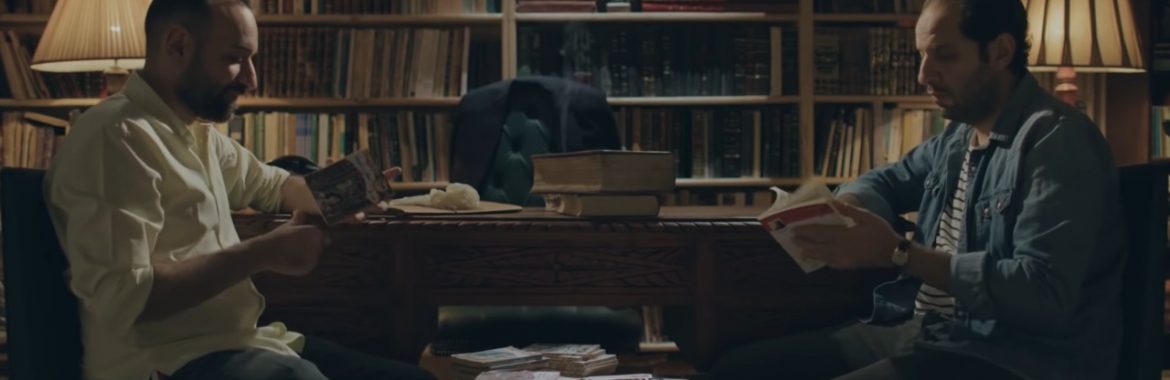
The anticipation that gripped fans and readers of the late Dr. Ahmed Khaled Tawfik’s wildly popular pulp fiction series Ma Waraa Al-Tabeea (Paranormal) ever since we heard it would be turned into a television series finally came to an end on Thursday, with the premiere of the show on Netflix. In the streaming platform’s first Egyptian original production, created by filmmaker Amr Salama, Tawfik’s beloved protagonist — Dr. Refaat Ismail, the sharp, cynical hematologist grappling with questions of the supernatural — is brought to life by actor Ahmed Amin. As an avid fan who has read the entire series time and time again — not only for the “mystery, horror and thrills” that its tagline promised, but also for the company of Refaat himself, my dear old friend — I can safely say that Amin’s efforts were satisfactory, in that he is definitely the highlight of the show.
I was happy to see my friend onscreen, and Amin’s portrayal managed to draw some loud laughs from me, as Refaat often did in the books. However, as the series progressed, the portrayal of the character started to lose its precision, especially after the second episode, where the events of the show begin to drastically part ways with those of the books. This doesn’t present an issue within itself; it is inevitable to make changes when adapting material from one medium to another. The problem is with the new take on the work itself, which affects the portrayal of Refaat — since here he has to interact with reinterpreted (or entirely new) events — and at times even alters the very foundation on which the book series was built. This results in a show that comes off confused, and often confusing, which ultimately compelled me to break the rules set forth by its creator and engage in multiple side talks with my viewing buddy — also a hardcore fan of the original series — to try and make sense of the parts that were unclear. Sorry, Mr. Director, we couldn’t help it.
Let’s take a little step back.
Paranormal, the original book series, is made up of 81 books, the first of which came out in 1993, while the last was released in 2014. Each book has a main event/plot, usually resolved in the same book, while some characters and storylines continue throughout the series. The books do not follow a specific chronology; most of the time the stories are told in flashbacks that Refaat narrates himself, taking place throughout different points in time. It is a device that the author himself has poked fun at sometimes, addressing the reader in the midst of a dangerous situation that Refaat finds himself in to highlight the fact that we know everything would turn out alright since it is Refaat himself who is telling the story in the present. And that’s exactly the thing: Refaat’s survival was never the question, but rather how he survived — that’s what the plot always revolved around. This imbued Refaat with certain Sherlock Holmes-like qualities: he is a logical, observant character with encyclopedic knowledge and a keen eye for detail.
In all of Tawfik’s series — among them Paranormal, Safari and Fantasia — he’d dedicate pages upon pages to background information on the subject of each book. I know students in the Faculty of Medicine who say they were sometimes able to answer questions in their oral examinations based on information they read in Safari. In Paranormal, Refaat’s profession as a hematologist is a pivotal fact that accounts for his knowledge and scientific methodology when approaching problems in the books; in the series it is mentioned only in passing, in one episode out of the entire six. The onscreen solution for presenting such extensive background information is to use an ambassador for the viewer; a character who is unaware of certain things and who therefore asks other characters to provide them with context, so the viewer, too, would understand. The series’ writers chose Refaat to be this ambassador, giving secondary characters the upper hand when it came to scientific expertise. While this could be understandable in light of the creators’ choice to dramatically structure the show so that Refaat’s first brush with the paranormal occurs in the first episode, it still robs Refaat of an important aspect of his character: he is no longer the all-knowing Sherlock Holmes. That said, further harm was done to the character with the process of reconstructing the events.
The easier way to adapt the books to television would have been to rearrange the stories according to the chronology of the events, not the order in which they were published. However, this isn’t what the show’s creators did. Instead, they built this season — the first of several, if Netflix decides to renew — on The Myth of the House, which is the twelfth book in Tawfik’s series. It is also the first book in the series that Salama read, according to the documentary that Netflix produced on the making of the show.
[wonderplugin_video iframe="https://youtu.be/Z5np6U8Wo9c" lightbox=0 lightboxsize=1 lightboxwidth=960 lightboxheight=540 autoopen=0 autoopendelay=0 autoclose=0 lightboxtitle="" lightboxgroup="" lightboxshownavigation=0 showimage="" lightboxoptions="" videowidth=600 videoheight=400 keepaspectratio=1 autoplay=0 loop=0 videocss="position:relative;display:block;background-color:#000;overflow:hidden;max-width:100%;margin:0 auto;" playbutton="https://www.madamasr.com/wp-content/plugins/wonderplugin-video-embed/engine/playvideo-64-64-0.png"]
To adapt the material, the creators deconstructed the book series on two levels: the first is the characters along with their dramatic arcs, and the second is the themes of each book. Afterwards they added the necessary adjustments according to their vision before repurposing the material into a new narrative. It is a good idea, in theory, but the problem lies in the execution, especially on the second level.
When it comes to the characters, massive changes were made. For instance, Maggie, Refaat’s love interest from when he was studying abroad, appears in all of the show’s episodes as the main female lead, although she’s present only in a few of the books’ events, and is usually referred to only through his memories. Here, she is Refaat’s main aide, challenges him at every turn and argues for her right to join him on an adventure in the desert because “So what? What happens to me, happens to you.” Meanwhile, Refaat’s fiancée, Howaida — who is his friend Adel’s sister in the books — is his young, seemingly naïve cousin. His friend Adel, meanwhile, a prominent character in some of the books, does not appear in the series, or any friends of Refaat for that matter. Other recurrent characters in the book are ignored while some marginal characters are magnified, along with attempts to imagine a familial backstory for Refaat, including a strained relationship with his father and brother that’s not worth delving into here.
The new narrative — which revolves around an event that was not central in the books — along with characters whose positions and roles have changed, naturally requires new motives and dynamics: a re-wired dramatic reasoning, if you will. Looking at the final product, it seems to me that creators of the show were not all that concerned with staying loyal to the books. Out of the five books this season was adapted from, the filmmakers only stuck to the narratives of two of them (for the most part) and repurposed elements of the other three into their new narrative, and there really is no problem with that.
The problem, rather, lies in the creators’ negligence of the “how” when it comes to resolving certain conflicts — the reasons behind certain events and the motives behind many of the characters’ actions. So instead of the intricate tapestry that we often find in the books and the care given to building each character and providing them with clear yet nuanced qualities that motivate them to take clever or stupid decisions, the show is a flattened landscape, where one of the protagonist’s sidekicks is always doing the explaining for the viewers, most of the time to no avail. The author’s efforts to lay down the rules of the paranormal world in the books, and Refaat’s attempts to decipher them using the scientific method — despite being the protagonist of a series of books about supernatural happenings — also disappear. The events just keep happening.
[The next passage contains spoilers starting episode three. To avoid the spoiler you’ll find another indication later in the text as to where you should continue reading.]
For example, in the third episode, the creators change the reason as to why Refaat finds himself in the desert as well as the main characters of the story, but the plot still centers on a monster guarding a cave, known as Al-Assas, and the creators still rely on quicksand to get rid of him. In the books, this was preceded by a long struggle and chase around the desert that left Refaat alone after all those accompanying him had died. When the cave guard appears, Refaat tries to kill him using dynamite and a gun but in vain. Refaat tries to avoid the quicksand but his fear and panic as the monster approaches him force him to dive into it. However, armed with knowledge, he remembers the ideal way to deal with the sand: to float horizontally on it, unlike the monster who kicks and kicks in resistance and so eventually sinks. In the show, the cave guard jumps into the quicksand and sinks right away, so it’s not clear why Refaat survives and he doesn’t. There is also an entirely needless attempt to give a background story to the monster. Refaat returns to the cave and meets the cave guard’s mate, who is there protecting — guess what? — their newborn. She leaves Refaat alone after he shows her he does not intend to harm her son, in a sequence straight out of Animal Planet.
Moreover, the visual portrayal of the cave guard is incredibly unimaginative, although it’s clear the CGI ate up a large chunk of the budget. In the book, the monster was described as follows: “You could imagine him as a large gorilla, or a giant wolf, or something like The Hulk — who did not yet exist at the time. You could perceive him as a mass of fire or a ghost-like, transparent being … but no, you’re mistaken. Al-Assas does not resemble any self-respecting monster. He is a creature that surpasses my ability to express. Yes, he’s a tangible being, but he doesn’t resemble any scary thing we know. He is the monster that has not yet been invented, and that’s why I can’t find an image to bring him closer to you. He was scary, he was angry, and he was coming for me … and that was enough.”
So how do you portray this complex creature? The creators' answer was easy: Just take the first description and execute it. In the show, the cave guard is reduced to an actual gorilla, plain and simple.
Another example where the logical sequence of events is ignored and the original stories are stripped of substance is episode five, where the creators decide to make Refaat the protagonist of the exceptionally dark “Myth of the Incubus,” originally about a man fighting his own predetermined destiny, narrating his story to Refaat. Here, the layered tale — brimming with meaning and symbolism — is turned into a series of gimmicky sequences where Refaat fights a ghost in his dreams, and defeats it by pure coincidence. In Tawfik’s original “Myth of the Niada,” the story of the mysterious siren seducing the men of Refaat’s village into disappearance is given a logical explanation that Refaat arrives at after a thrilling journey; here, in episode four, it is given a supernatural dimension to fit into the creators’ vision, but the resolution of the mystery is far from satisfying, with a gaping hole in the middle.
[Spoiler over]
The new plots transform Refaat into another character — one that is troubled, lost, broken and confused: not in a way that humanizes him, because Refaat was never a superhero to begin with. He was always the ultimate anti-hero, but what set him apart was his knowledge, razor-sharp logic and sense of detail. Here, he becomes another typical protagonist like those we see in endless mediocre American shows; one who goes on adventures in a variety of spooky worlds (a theme favored by Netflix as evident from its many horror productions), throws around supposedly witty catch phrases that the writers dub “Refaat’s Laws” (another new addition of theirs) and moves randomly through the narrative with no regards for motives or dramatic causality.
But who cares about character development and dramatic structure when there’s such high production value, huh? The set design, the costumes, the atmospherics — not to mention the big billboards across Cairo’s affluent suburbs, letters signed by Dr. Refaat Ismail sent to influencers across social media … all of this is guaranteed to make the show a hit. A few of the people behind Paranormal have expressed hopes that it will resonate with “universal viewers,” and I truly hope it does; I’m sure people all over the world will enjoy watching those brilliantly shot scenes of desert landscapes and the Egyptian countryside. I don't know what they will feel, however, watching King Kong drown in quicksand, within a very questionable context.
تقارير ذات صلة
Detox | An ode to the delivery worker
On curfew nights, only the roar of delivery motorcycles and the barking of dogs pierced the silence.

Detox | The final puff
I decided to quit, with the hope that I would continue to be kick-ass even without cigarettes.
Detox | A tuk tuk ride through the world of anthropology
We chat with anthropologist Mai Amer, the creator of a new show called Tuk Tuk.
Your support is the only way to ensure independent, progressive journalism survives.
You have a right to access accurate information, be stimulated by innovative and nuanced reporting, and be moved by compelling storytelling. Subscribe now to become part of the growing community of members who help us maintain our editorial independence.
Join us