
Dancing with the wolves
When Hazem al-Beblawi’s nomination for prime minister was announced this week, it may be remembered as another mark of the Nour Party’s rising power in the context of the Egyptian revolution, and of its ability to flirt with the traditional powers of the security state.
The party successfully blocked the ascension of two liberal candidates to the post, instead ushering in Beblawi, who is considered a less ideological figures.
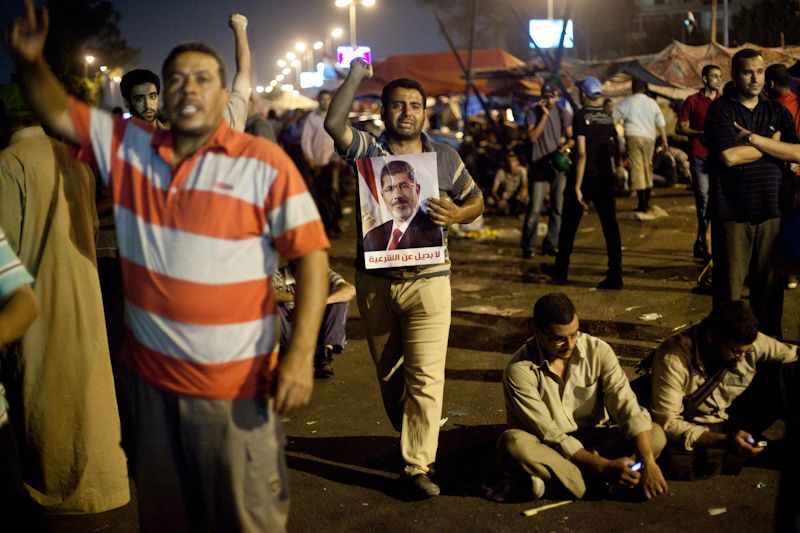
Its new position of power is precarious, however. For the moment, the ultraconservative Islamic party is kingmaker at the nexus of large and powerful forces. It will have to situate itself between a protest movement distrustful of government with an overtly religious character, the forces of the security state that allied with that movement to oust deposed President Mohamed Morsi, and its own base, which largely sympathizes with the Muslim Brotherhood.
For the moment, the Nour Party appears to have done that successfully, putting forward the argument it champions a government that is apolitical, technocratic and consensual. At the same time, these broad and vague terms allow the party to oscillate between the political pressures it is facing, while avoiding compromising on questions of identity in the future.
In comments to Mada Masr, Galal al-Mora, who served as political Islam’s representative at the post-Morsi ouster roadmap negotiations spearheaded by Abdel Fattah al-Sisi, summarized the party’s broad vision as “striving for a country with justice, equality and social justice within an Islamic reference.”
Ashraf al-Sherif, a political scientist at the American University in Cairo sees the presence of Salafis in the political process as more reactive, a position they can afford given their pragmatic inclination that a fully Sharia-based Islamic state is a delayed project. He argues that instead of putting forward a program, they lobby for the amendments of policies presented by other groups, or set certain red lines that force policies to be changed.
“They have to be present in the current political equation to preserve what they have, namely staying in the political sphere,” says Sherif.
Besides blocking the nominations of progressive figures from the premiership such as Mohamed ElBaradei and Ziad Bahaa Eddin, the Nour Party managed to reap another gain —securing legal provisions in the interim constitutional declaration that guarantees the Islamic nature of the state. Amr al-Mekky, a party spokesperson, says that the party could not have accepted an ultraliberal figure in the premiership.
This may prove a political liability for the party as millions took to the streets this month, railing against governance infused with religion and calling for the fall of the Muslim Brotherhood presidency. The protesters reclaimed a seat at the table for liberal activists and politicians that had been squeezed out by the Nour Party alliance with the formerly ruling Muslim Brotherhood.
But the Nour Party’s counterweight to the protest movement and its political affiliates also comes in sync with the security services’ interest in preserving a conservative political agenda as Egypt enters its second attempt at a transition.
Sherif explains how the military needs a legitimate Islamist discourse in the current political roadmap. “The Nour Party becomes the interlocutor of the military and legitimizes the political process. It is a justification for the next measures,” says Sherif. “There are also a lot of interlaced interests between the military, the police and the Salafi Dawah,” he adds, citing how the police state commonly outsources societal regulation to Salafi groups in impoverished areas. Some even say that scrapping Bahaa Eddin’s premiership candidacy is not a reflection of the Nour Party position, but was actually a military preference effectively outsourced to the party.
This alleged interlocution would take place outside of military-sponsored talks. Mekky says that the Nour Party is in bilateral communication with all powers since it pulled out of the roadmap negotiations after more than 50 pro-Morsi protesters were killed at the Republican Guards headquarters in clashes with security forces on July 8.
But party has been compelled to balance a close relationship with the military and the politics of its pious base, many of whom are present and vocal at pro-Morsi sit-ins.
And if the Nour Party had initially decided to cultivate a strong relationship with the military, the bloodshed served as a reminder that it is not wise to get too close publically. Khaled Alameddin, a former Morsi minister, tells Mada Masr that the military was “not neutral.”
In an open letter sent to foreign journalists following the killings, Nour Party Foreign Relations Committee Head Amr Gad attached graphic photographs and videos of the aftermath of the July 8 violence and describing Morsi’s ouster as a coup.
“Don't think that these photos are of causalities from a field of combat,” the letter reads. “They are the victims of a massacre at the hands of the national army. They were peaceful civilian protesters of the military coup that deposed a democratically-elected president.”
Alameddin, whose resignation in March alongside another Salafi presidential adviser laid bare the differences between the Brotherhood and the Nour Party, nevertheless says it opposed the way the Brotherhood was being treated and the closure of Islamist media.
Some members of the Salafi Dawah, the Nour Party parent organization, have resigned in the wake of its cooperation with the military’s plan.
In a video posted online, the head of the Salafi Dawah in Daqahlia resigned in a 30-minute tirade against what he called “attacks on the Muslims.”
Mekky calls the resignations “minor,” however. “ I know some of them but this is not an official thing. Its something emotional, you cannot say that they are part of a new party,” he says.
An expert in Salafi movements at Sciences Po University in Paris, Stephane Lacroix, says that the resignations should not be given an inflated importance.
“While the Nour Party’s core is the Salafi Dawah, it’s something broader than that, with unaffiliated Salafis that don’t necessarily belong to the Salafi Dawah but agree with it on some points voting for it,” he says.
Much of those unaffiliated Salafi voters will have different choices in the coming period, including various ideological competitors with the Nour Party. Some advocate more radical changes to state and society, like Hazem Salah Abu Ismail’s Raya Party and the Salafi Front. Others are more ideologically similar to the Nour Party. The Watan Party was founded earlier this year, when several more politically savvy and ideologically flexible Nour Party members split off to form a new party.
The lead up to the defection of Emad Abdel Ghafour, the party president, in particular prompted a learning process for the Nour Party, in which it was facing important questions about how a religious party should face the requirements of politics. Abdel Ghafour himself was among those calling for Morsi to step down in the face of growing street protests against his rule.
“What’s interesting is that the Nour Party was taking positions taken by other Salafi parties that it previously thought were red lines, but has kept its rhetoric the same,” says Lacroix. He recalls how the Nour Party’s Younis Makhyoun was averse to negotiating with non-Islamist parties, a position Abdel Ghafour disagreed with. With Ghafour’s defection to the Watan Party, the Nour Party is doing none other than negotiating with non-Islamist parties, while developing a rhetoric that represents this political transformation.
For now, it seems that learning process has taught the party to not push too hard at the current moment, thereby making the same mistakes as the Brotherhood. The hard lessons left by the Brotherhood come in particular from their entanglements with the protest movement during the first period of military rule, and the shift on the security establishment afterwards, before both turned on it.
In the end, for the Nour Party, engaging with the current post-Morsi transition is a bet, and only time will tell whether it turns out to be a winning one or not.
“The Nour Party is betting on time. The Brotherhood is gone,” said Sherif. “Other Islamist structures are weak. Islamists won't find other alternatives. In the long run, Islamists will vote for them. Will this bet work, we don't know.”

Jahd Khalil
Jahd is a Cairo-based journalist who has contributed to the Los Angeles Times, Al-Monitor, Deustche Welle, and other outlets.
تقارير ذات صلة
The Bread and Freedom Party: A leftist opposition party in post-coup Egypt
Apart from Safty, nine members of the leftist Bread and Freedom Party are currently detained.

How Egyptian diplomacy navigated the summer of 2013
How Egypt’s foreign policy sailed through the difficult events of the summer of 2013
The hidden world of militant ‘special committees’
“I wanted to live through the military coup. Now, after all I’ve seen, I think I must have been mad.” Thus Youssef —not his real name — began our interview.…
Your support is the only way to ensure independent, progressive journalism survives.
You have a right to access accurate information, be stimulated by innovative and nuanced reporting, and be moved by compelling storytelling. Subscribe now to become part of the growing community of members who help us maintain our editorial independence.
Join us