
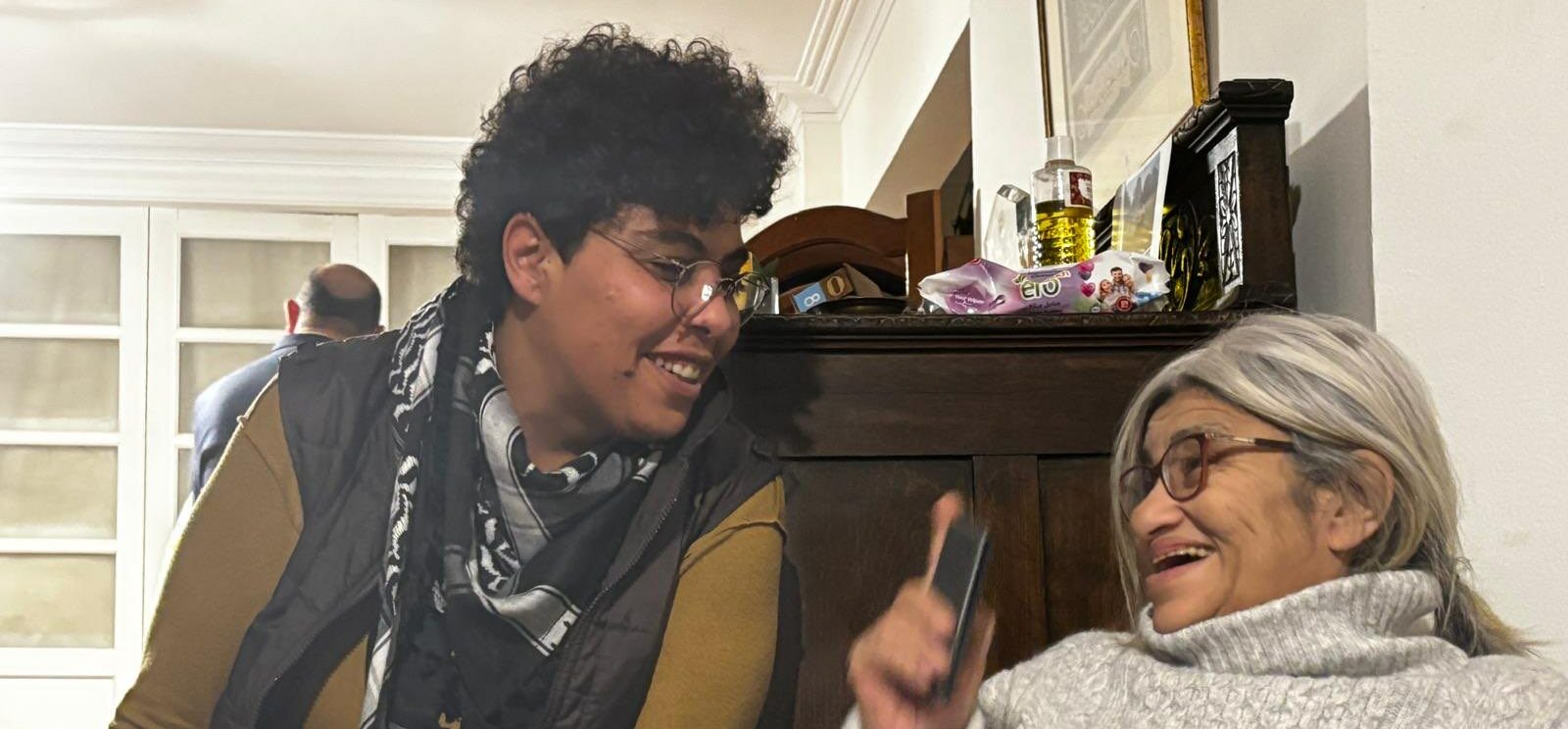
Conversations on an empty stomach: The stories of Laila Soueif, part 2
Laila Soueif, in her seventies, is on a hunger strike. The idea itself is terrifying for all. This is Laila, the mother, putting her body on the line yet again as a final defense for her son, Alaa Abd El-Fattah, who has been imprisoned since Abdel Fattah al-Sisi’s regime came to power. After serving his second sentence — now totaling 11 years in Egyptian prisons — authorities decided it wasn’t enough. They may steal more days from Alaa’s life, but not without Laila raising her voice in resistance. Body for body, soul by soul’s side.
I once tried a hunger strike myself, just for a few days. I vividly recall the clarity of thought that came after the third day without food, as if layers of awareness and memory were peeling away, revealing the raw activity of the mind beneath. It felt as though food coated our consciousness in layers of fat.
There’s something about Laila that constantly pushes the spirit — how to mold it to please it, so it can resist and find its way. On the third day of her strike, as stories and memories surfaced — brought on by the company and the moment, and most of all, the stripping away of mental layers as the body fights to assert its existence — I began to see something full in these details. They offered a new perspective on Laila, reshaping her image from within. Stories shape us. We owe them loyalty by documenting, retelling and securing their place in history.
I wanted our conversations to flow naturally, guided by the moment and her still-vivid memories. Each time I left her home, I would take notes and then write about our conversations as soon as I returned home. I eagerly looked forward to the day I could hand her a copy of these conversations to read and provide feedback. I felt a mix of excitement and fear — excited for her to see these records of her thoughts during this time and fearful of the moment when the stories would stop.
***
Day 19 of the hunger strike
Friday, October 18
Present: Azza Shaaban, Aida Seif, Zein al-Abidin Fouad and Hadeer Mahdawi
Laila is preparing for her trip to England the next day, where another battle with the government awaits. She coordinates her schedule with Sanaa and entrusts Mai with managing Alaa’s visitation food during her two-week absence. Joyfully, she says she’ll have two days off with her grandson Dodo outside of London, where he lives with his mother. For once, she’ll enjoy some peaceful time with him, away from the storm of meetings and engagements. She chooses between pairs of jeans and picks out the few items she’ll pack.
The friends admire a photo of the PEN Pinter Prize Alaa received, shared with renowned Indian author Arundhati Roy. Some comment on Lana’s smile — the daughter of Mona, Alaa’s sister — saying it gave the photo a special glow. I tell Laila that Lana has a way of bringing joy wherever she goes. Laila instantly agrees. “She takes after her mother when she was her age,” she says. Azza recalls how Alaa also had quite a presence as a child. “Alaa was a thoughtful kid, always asking questions. Mona, on the other hand, would light up a room with joy and smiles,” she remarks.
Mohamed al-Baqer and his wife, Neama Hashem, arrive with their newborn daughter Maryam — her first visit to Laila’s home. The group gives her a big welcome. Everyone continues to gaze at baby Maryam as she sleeps in her small crib on top of the dining table.
Day 32 of the hunger strike
Friday, November 1
Present: Sarah Rifky
We were increasingly worried about Laila’s vitals, which dropped significantly after a full month of the hunger strike. On the 30th day, her blood sugar level plummeted to 59 — the lowest since she began her strike. The healthy average is typically around 100. Smiling, she says, “Did you see my blood sugar yesterday? It was 88.” I ask what caused the improvement, to which she replies, “I went to work and gave a lecture to first-year students.” Laila firmly believes that physical activity and mental engagement are the driving forces that keep the body going, no matter its struggles. Her resisting body had begun to change — losing fat and reshaping itself into a leaner form.
She talks about her first-year students, fresh out of high school, noting that Egyptian youth at this stage come with no academic preparation. “The current high school system doesn’t equip them for anything. They also need to ensure that the fields they’ve chosen truly align with their abilities,” she says.
Our conversation shifts to Laila, the high school student, and her relationship with her older sister, Ahdaf. With a wry smile, she says, “I grew up in Zamalek, in a community of family and friends from the Gezira Sports Club and similar circles. But we had windows into other lives and experiences, free from overly rigid parental restrictions. My mother was stricter, but it was my father’s anger that we feared. I was the girl who played with the mischievous students.” She laughs, adding, “but I was also diligent in my studies.” She recalls how, in Zamalek — much like any other neighborhood — there was a band of rebellious teenagers. “I loved riding motorcycles with the boys and had fleeting romances, but I steered clear of drugs. I never hid anything from my parents either. I’d even take my romantic calls on the house phone,” she reminisces.
Laila and Ahdaf shared memories of their childhood and teenage years in Brazil Street and the surrounding Zamalek neighborhood. “Ahdaf was always the polished, captivating mademoiselle — five boys would be infatuated with her at the same time. She was the older sister everyone admired. Meanwhile, I was the punk, trying everything out,” she laughs. After a short pause, she adds, “Our parents never wanted us to be replicas of each other, or of them.”
She recalls her first student protest in high school in the early 1970s, when demonstrations were erupting across campuses over demands for war against the Israeli occupation of Sinai. “I remember watching students march from everywhere, even Zamalek, to Tahrir Square. A student friend and I joined, thrilled. Once we reached the square, we wanted to tell our families we were there, so we decided that each of us would call the other’s family to soften the blow — she called my mother and I called hers. I stayed until my sister Ahdaf and her then-fiance came to take me home. I was young, but I wasn’t punished for it. My parents cared about our academic achievements and skills, which later gave me the confidence to pursue student and political activism in university. By then, no one could come and take me home from whichever square,” she says.
The smell of smoke interrupts our conversation. Sarah suddenly remembers she left Toka’s food on the stove. We dash to the kitchen to find it completely burned. Laughing, I reassure her, “Laila never minds burnt food — she’s an expert at it.” We return, laughing, and tell Laila, “The food is burnt, but it hasn’t turned to carbon yet.”
Laughing, Laila tells Sarah, “That’s what Seif used to say whenever I melted the kids’ bottles on the stove — ‘Laila likes proving she can turn anything into carbon,’ he’d say.” She erupts into laughter, her words tumbling over themselves, as they always do when joy overtakes her.
Day 47 of the hunger strike
Friday, November 15
Present: Ghada Shahbandar, Alaa Soueif and Samar
We were laughing about the absurd ways State Security monitors and pursues activists and political figures as I recalled how my car was stolen from an area that may as well be a site of permanent military barracks. They hadn’t considered the implications this theft might have on criminal security’s reputation in a neighborhood packed with embassies.
Ghada tells us about a State Security officer who spoke to her one day when she had hosted a diplomatic official at her house before the revolution. She had served Syrian food. The officer asked her for details about the dinner, so she began describing the dishes one by one — how they were prepared by Damascene and Aleppan women, the difference between the two culinary styles, and how the security report would include all these critical details. In that moment, the idea emerges that we should compile all our comical stories of security pursuits into a book. Ghada urges me to start working on it some day.
I don’t know how the conversation shifted, but as usual, Laila brings us into her captivating world: teaching and students. She shared a story from when she taught at Fayoum University, beginning with an unintended joke, “After I finished my PhD, our financial situation was a bit tight. One of my professors approached me and said, ‘We can loan you out, Laila, so you can make some money — go to Fayoum.’” I interrupt her here, unable to hold back, “Did he seriously say you’d make money in Fayoum? Your colleagues were heading to the Gulf, buying apartments and cars, and you wanted to go to Fayoum to make money?” We burst into laughter. After a minute of her usual stuttering while laughing, she continues, “Yes, let me explain. At that time, I needed help at home, but our salaries didn’t allow for it. So when I accepted the Fayoum secondment, I would travel two days a week by public transportation. As always, I was excited by the prospect of meeting new students and thought I should just go ahead and do it. I did the math and found that, after deducting transportation costs, my net income was LE20 a month. I thought, ‘Perfect — that’s exactly the salary of the lady who will help me.’ So all the money I earned from Fayoum went to her.” She laughed. “I’ll never forget the students in Fayoum. They were some of the most brilliant math students I’ve ever taught, with an indescribable passion for learning. I would spend long hours with them outside class hours because of their immense thirst for knowledge. Generally, students from outside Cairo are cleverer and more diligent than those in the capital. In Cairo, only 20 percent of students pass on their own merit, without the need to request academic leniency, but in Fayoum, the rate exceeded 60 percent. It’s such a shame — this human wealth is wasted in poverty and lack of resources.”
Day 49 of the hunger strike
Sunday, November 17
The wooden floor creaks under her footsteps at 5 am, marking the beginning of her workday and waking up the entire house with her. I wake up two hours later and try to snap myself out of sleep. I dress to try to keep up with all the morning energy mixed with the smell of smoke. I take the dog Toka for a morning walk. Laila tries to give me some notes about the walking route, but my ears were still clogged with sleep. I pay for not listening when a group of seven or eight dogs attacked us, leading to a morning confrontation that shakes me fully awake. Toka and I win without losses and return to tell the story to Laila, who of course laughs and says, “Didn’t I tell you not to walk down that street?”
She is energetic and excited for her lecture. Her vitals are good, and she is preparing for a long day that starts with a lecture at 10 am and ends with supervision sessions with PhD students until 6 pm.
We exchange our schedules for the day and smoke a cigarette with tea before she leaves for work. As she organizes her papers, her payroll slip appears. I look at it and laugh at the figure a mathematics professor with a PhD, who’s been teaching for 40 years, earns. She laughs too and says, “I just wish they’d understand that we’re not working for the salary. If they could just grasp that this university still stands because there are people who love teaching and care about the future of the country, maybe they’d show some respect and stop what they’re doing to us and to the students.”
In the evening, we both return home, joined by Sarah, and we try to help her prepare Alaa’s visitation food for the next day. Laila usually prefers to handle everything herself — everything is planned with a schedule and a precise method. But I offer to help, reminding her that I paid attention last time and understood the technique, so she lets me assist with some of the details.
As we move around the kitchen, preparing for Alaa’s 43rd birthday visit, Laila packs the food into sealed plastic containers — she has a big cupboard dedicated solely to prison visit boxes and tools. She speaks about Alaa’s most recent letters. They were brief and sad. “He’s in a dark place,” she says, but she is hopeful that the birthday gifts or the visit itself might lift his spirits a little.
In the middle of this, Laila looks at me with disapproval. “I heard you say you were hungry. You all leave the food I tell Um Wael to prepare until it spoils. That’s such a waste!” she admonished.
She scoops small portions of Alaa’s food onto a plate and tells me to eat it, scolding me, “I’m the one on strike here.” I laugh and say, “You expect me to eat prison food and manage to swallow it down?” She laughs. “You reminded me of Ahdaf’s son when he visited us from England a few days ago. We didn’t have food in the house, so I told Ahdaf, ‘Let’s just give him some of Alaa’s food.’ He said, ‘I came all the way from London to eat Alaa’s prison food while his mother’s on a hunger strike?’” she says laughingly. “I stopped feeling hunger a long time ago, kids. The only things I miss are cheese and bread.”
That night, I did eat some of Alaa’s food while Sarah stayed up until 3 am writing him a letter.
Day 51 of the hunger strike
Tuesday, November 19
Present: Alaa Soueif, some young people and family members
We talk about my car, which was stolen from Zamalek on November 5. Alaa Soueif asks me what was in it, and as I answer, I remember everything in the trunk — paper and wooden banners for the cartoon exhibit I organized at the Journalists Syndicate after the arrest of cartoonist and colleague Ashraf Omar, as well as the large cloth banner we held up on the syndicate’s steps after he was tortured. They gasp, and Alaa says, “They’re probably still searching through it, you know.” We laugh.
The conversation moves to the skyrocketing prices, which then leads Laila and Soheir, Alaa’s wife, to talk about the economic crisis following the Israeli occupation, between 1967 and 1977, when many essential goods disappeared, like soap and sugar, and queues filled the streets. It was the direct precursor to the bread riots in January 1977.
Laila turns to her brother and says, “Remember, Alaa? We saw the start of it all the night before. We were taking a relative to Helwan and we saw the queues turning into protests. At that time, the consumer complexes would stay open until midnight. They had no fixed hours — they were the only source of essential goods. People would wait for hours and, that night, the government announced price hikes while people were still in line, so they started to protest. It continued into the morning.”
“I thought the bread riots began in places like factories and universities, where political groups were very active at the time,” I inquire.
“No, of course not. People first took to the streets because of what was happening to them, and then we joined them. The uprising was truly spontaneous. It started in the queues at consumer complexes, which had become centers of anger over worsening conditions. Who would believe we’d wake up one day to find no soap for two weeks? The well-off stored reserves at home, but they were a minority. For years, the general population had to stand in line just to get a bag of sugar or a bar of soap,” Laila says.
At the end of the long day, I tell her that I’ve been writing on our many conversations since the strike began. I’ve kept notes in my head, then in a notebook after I leave, before finally writing them into this file. Her eyes widen in surprise and she says she had a feeling that’s what I’d been doing. She asks to see some of what I’ve compiled so far. “Great! Send it to me so I can print it out and take it on the plane. This will be my reading for the flight,” she says. We agree, and each of us retreats to our rooms.
Day 52 of the hunger strike
Wednesday, November 20
I wake up because Toka decided I must — she keeps scratching at the door of Sanaa’s room, where I’m sleeping. I realize she wants to go out to the street. Laila’s voice comes from her room, “Toka has really taken to you and won’t leave you alone until you take her out. I swear I took her up to the roof to go to the toilet, but she wants a street walk.”
I finish the morning walk, and Laila is moving quickly and energetically throughout the house, preparing travel bags and student papers. She wants to stop by the university before heading to the airport to hand in the students’ results. We go to the balcony to collect the laundry, most of which hasn’t dried yet. She says, “This is Alaa’s laundry, put it in this bag. And this is Alaa’s too, it needs ironing. This is mine, put it in my closet. The rest I’ll take in my travel bag.”
Once the laundry is sorted, we move to the office and she arranges each group of items into separate corners. Among these are the printed pages of our conversations, her passport and other essentials. We finish packing the small suitcase, then prepare the medication bag. Finally, we sit down for a cigarette and a cup of tea after the whirlwind of preparations and before heading out.
We find ourselves talking about Sarah’s letter to Alaa and the ideas it sparked about motherhood and the circumstances in which children are born. I tell her she gave birth to her three children under difficult conditions, when nothing was stable or prepared. She gazes off, silent for a moment, then reflects, “I see now that children need a real period of stability. They need a calm, ordinary home. We tried so hard to separate our lives from theirs, but they had completely different interests. We really tried.”
She cites how their interests and plans were entirely unlike hers or Seif’s. “For example, Alaa was never enthusiastic about the political activities Seif and I were engaged in. While we were focused on torture cases, he was interested in developing technology and making it accessible to people. When he needed to promote his ideas about open-source content and blogs as an alternative form of journalism by the people, he’d go to the metro to distribute his flyers. Sometimes, he even joined protests just to hand out these flyers and start conversations with people, and that’s how he found himself alongside us.”
“The same with Mona. Her sole focus was science, and she put all her effort into that dream until the revolution happened. She then decided to focus on campaigning against military court cases. As for Sanaa, her interests were in another field — arts and video editing. She was only 16 when the revolution began, and she had started working with her friends to publish a newspaper that represented their voice during what was happening.”
We move quickly to gather her things and she shows me a recent photo of Dodo, Alaa’s son, with Lana, Mona’s daughter, in a park in England. She beams, “Did you see this one?” she says, before placing it on the buffet cabinet in the living room, next to the other pictures.
Day 64 of the hunger strike
Monday, December 2
Present: Sanaa
The atmosphere in the house is tense, and concerns over Laila’s health are growing. Sanaa returned with her mother from England and is trying to arrange medical tests to assess Laila’s vital functions. Doctors in both England and Egypt have stated that the routine daily measurements Laila has been taking since the start of her strike — blood pressure, sugar levels, oxygen saturation — are not enough to gauge what’s happening in her resilient body, which has now endured over 60 days without sustenance. The risk of a sudden collapse is becoming very real.
After the usual back-and-forth between Sanaa and Laila over setting up an in-depth medical follow-up plan, they agree to conduct an electrocardiogram and a series of necessary tests requested by doctors. As always, Sanaa tries to get it done quickly, while Laila insists on doing things at her usual slower pace. Sanaa attempts to arrange the tests at a private hospital in Mohandiseen, but Laila strongly objects. She still deeply trusts the public Qasr al-Aini Hospital and considers it her home. “This is my university’s hospital, and it’s still the best place for treatment in Egypt. All the doctors there are my colleagues.”
Sanaa screams in frustration, refusing old solutions and government hospitals. We intervene repeatedly to break up their clashes. Eventually, Laila gets her way and goes to Qasr al-Aini for the tests.
The doctors had warned Sanaa about other subtle indicators of internal decline during prolonged hunger strikes, such as vision impairment, forgetfulness and lack of focus. Laila gave a lecture the day before and said she forgot a few things toward the end, which upset Sanaa. She keeps asking her, “Mama, do you feel your focus has dropped?” Laila insists she doesn’t feel that way and is completely aware. Normally, she says, even before the hunger strike, when a lecture lasts two hours, her focus wanes in the last 15 minutes. She notes that she worked with the students for an hour and 45 minutes.
Sanaa asks Laila’s longtime colleague from the mathematics department, Hani al-Husseiny, about her performance in recent lectures. Joking, he replies, “Laila could teach this curriculum in her sleep.”
To break the tension, Laila asks us to come in and eat. Um Wael cooked a lovely moussaka today, as Sanaa requested, along with chicken, rice, and vegetable soup — but with no celery. Laila says that Um Wael tried to buy celery. Sanaa interrupts, “She barged in on me during an important meeting to say, ‘Go buy celery for the soup,’ The people in the meeting panicked, thinking there was a disaster. I didn’t even know what to say.”
Sanaa finally laughs and the rest of us join in. “Soup without celery feels like it’s missing something,” Laila says. She and Sanaa then head to the kitchen, and we eat Um Wael’s cooking. Laila looks at me, laughing, and asks, “How’s the soup without celery?”
Day 68 of the hunger strike
Friday, December 6
Present: Mostafa Bassiouny, Dina Heshmat, Ahmed Harara and his wife
She recounts what happened in her meeting with British Foreign Secretary David Lammy during her visit to England. Expectations were that the Labour Party had a different plan for handling Alaa’s case and the broader human rights file. The meeting between Alaa’s family and Lammy occurred after Laila had already passed the 50th day of her hunger strike. She had something to say to officials at this moment, “I’m surprised by my body. I didn’t expect it to last this long, but it did. We need to seize this opportunity before it turns into a tragedy for all of us.”
Alaa’s family confronted the current foreign secretary with his statements from when he was a shadow minister before taking office. Lammy attempted to defend his position, asserting that he was a socialist with a committed political agenda. He outlined his government's efforts to assist Egypt's financially challenged population. However, one of Alaa's family members retorted, “You’re dealing with the most socialist family in Egypt, and you cannot outbid their political stance toward the financially challenged or public issues. They’ve been paying the price for these commitments for years.”
The past few days had been tense. Laila’s blood sugar levels dropped again, sinking below 60. The doctors explained that her body was entering a new burning phase — the fat was now concentrated only around the abdomen after the arms and legs had grown thin. Family and friends remained on constant watch over her blood sugar readings, while Laila scolds us all whenever we suggest she reduce her daily efforts. She wants to keep living and working until her body declares its freefall.
Day 69 of the hunger strike
Saturday, December 7
She has a clear plan for the day: finish her university tasks, grade student papers and keep the day free of visitors to focus. She enters her room that morning, browsing the news. She comes across a photo of an imprisoned Muslim Brotherhood member who had been jailed for over ten years. She talks about him, his wife’s struggle and her bravery in defending him. I tell her that, despite the misery these men endure in prison, they are fortunate to have such women by their side. She then recalls the story of a young Muslim Brotherhood member she knew personally. On the day of the Ettehadiya Presidential Palace clashes, she had called him, asking for help to protect female protesters facing horrific assaults. Over the phone, the young man told her he hadn’t gone to Ettehadiya that day and that the group had brought members from outside Cairo to carry out the attacks on protesters. “I will never forget that this young man, whom I trusted for his morals and ideas, was executed in the case of the prosecutor general’s assassination,” she says. “He died unjustly in those last executions, like so many others.”
She also speaks of the significant opportunity the Muslim Brotherhood squandered when they came to power. “We couldn’t believe that the most prepared organization for governance wasted itself on eliminating the opposition as its first task, instead of achieving tangible accomplishments on the ground. Even the religious current in Iran, when it took power, implemented some social and economic achievements for the masses before it became a dictatorship. But for the MB to start by fighting the opposition in the streets — how did they think that would work?”
Mai arrives. They had scheduled a home visit with the lab doctor to take Laila’s samples and run some tests.
We move to the living room and she says, “Okay, I’ll sit with you, drink some anise tea, smoke a cigarette, and then get back to work.” Mai warns her against opening up intricate conversations with me, saying I could talk for hours. She laughs and says, “I’m the same. Most of my conversations with Alaa were like this. Even when he lived in South Africa, we would spend a fortune on phone calls to discuss everything that occupied us.”
Day 70 of the hunger strike
Sunday, December 8
This was her final workday at the university. Her students and colleagues had organized to relieve her of the remaining lectures. Despite her strenuous attempts to insist on teaching her Sunday class, they insisted, now that the strike had reached this stage, that she stop all this effort and limit herself to grading and simple tasks.
As usual, I wake up to the sound of her steps on the wooden floor. I enter her room to find her exceptionally excited. Today, she is going to the university to celebrate one of her most brilliant students in the mathematics department, who has become a distinguished name in his field and is now sought after by universities worldwide. Over our morning coffee, she recounts the story of the boy who came to them 12 years ago, before even completing middle school formally. He had, however, already mastered high school mathematics and began studying Cairo University’s math curricula. She described how Egyptian bureaucracy almost crushed him, had it not been for the enthusiasm of several university professors who supported him. Eventually, he left Egypt and, in just a few years, achieved what major researchers couldn’t. He earned his PhD while still in his twenties. Finally, they were able to convince the department at Cairo University to celebrate him.
With that excitement, she puts on new clothes — most of her wardrobe no longer fits her — and leaves the house. She heads to the taxi drivers’ cafe near home. They know her and she knows them — she prefers them over ride-hailing apps. With fondness, she says, “They’re Seif’s legacy to me. They were all his friends — they took him everywhere. They still remember him and tell stories about him to this day. The university trip is a treat for them — it’s just two streets away.”

تقارير ذات صلة
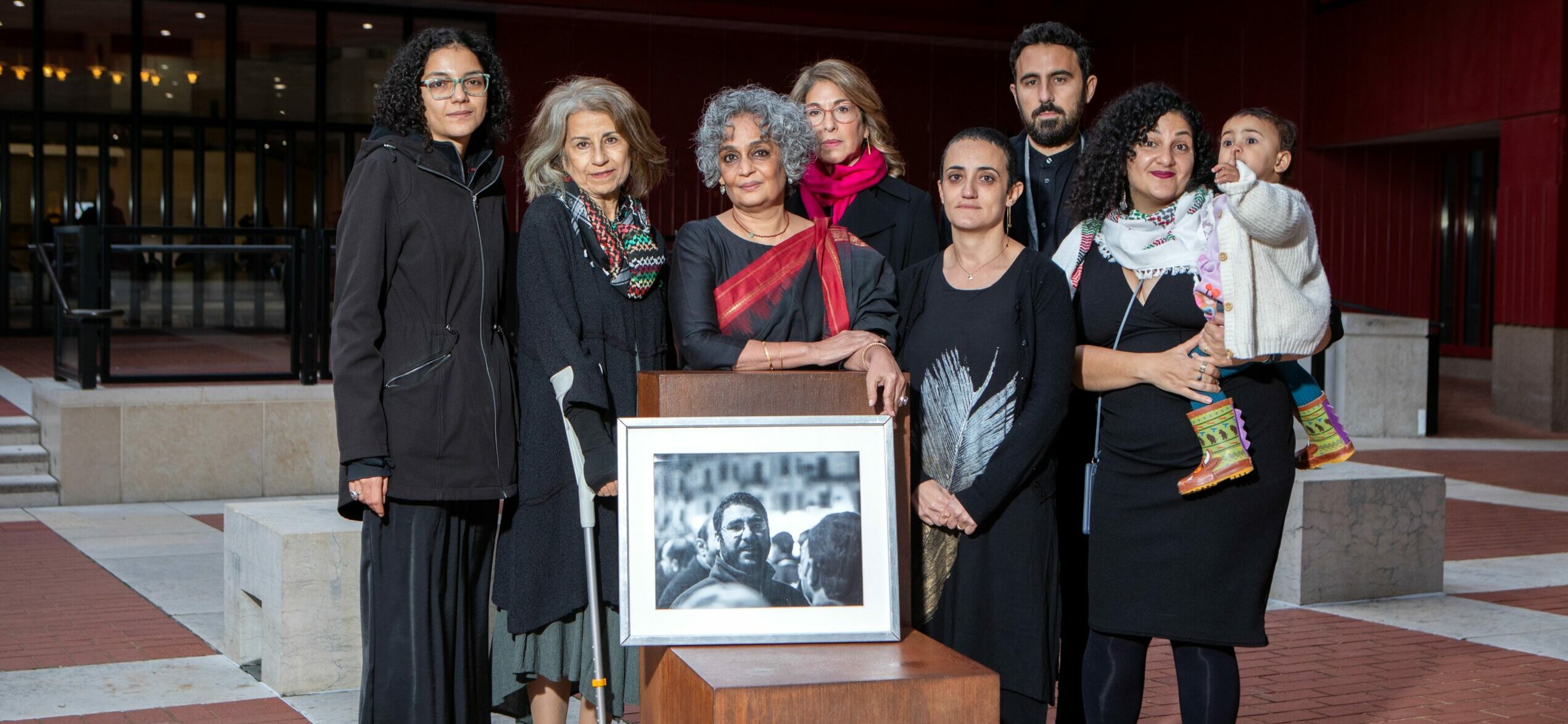
Naomi Klein’s encomium to PEN Pinter Prize 2024 winner Arundhati Roy and Alaa Abd El Fattah, her chosen co-recipient
Writers like Roy and Abd El Fattah, Klein says, act as signals that help us understand the moment.
Without evidence or trial: Remand detention is authorities’ tool of choice to imprison political opponents
Many activists have been subjected to the revolving door of prison
Thinking with Alaa
"When I demand my right to read and write, I am not asking for a luxury."
Your support is the only way to ensure independent, progressive journalism survives.
You have a right to access accurate information, be stimulated by innovative and nuanced reporting, and be moved by compelling storytelling. Subscribe now to become part of the growing community of members who help us maintain our editorial independence.
Join us