
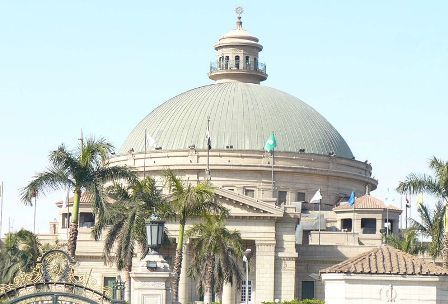
Campus politics
With the country at a political impasse in the aftermath of the ouster of former President Mohamed Morsi last month, a standoff also looms over Egypt’s university campuses as student groups gear up to amend university bylaws previously passed by the Muslim Brotherhood.
Since the January 25 revolution, university bylaws have been at the forefront of campus politics. The polarization in the national political scene between Islamist and secular forces had since made its way into campuses.
Now, students affiliated to the MB are facing a backlash. An investigation committee formed by leaders of the Egypt Student Union (ESU) decided this week to expel five leading members of the union's executive office after they released statements of a "political nature" in its name.
The five students reportedly issued statements condemning what they described as a military coup against Morsi, as well as holding rallies in support of the deposed president in the name of the ESU without consulting the rest of the student body.
A member of the investigation committee, Mohamed Hassan told Mada Masr that the five students were summoned three times over the past month and a half, but declined to attend.
"They lost the right to defend themselves. They also released political statements using the name of the union without consulting the rest of us. According to the student bylaws, this is the suitable punishment.
“We believe that maximum punishment should be applied in such cases," Hassan, who is also the vice president of the Banha student union, said.
Brotherhood students slammed the decision and said they will pursue all legal measures against what they described as an attempt by some factions to control the union.
The expulsion of the five students means that the executive office cannot function until they are replaced.
President of Al-Azhar University’s student union and one of the expelled students, Ahmed Abdel Rahman al-Bakry, told Mada Masr that the expulsion decision was "arbitrary."
"We deem this action illegal. We will appeal this decision," he said.
Researcher at the academic freedoms unit in the Association of Freedom of Thought and Expression (AFTE) Mohamed Nagui said the decision was "extremely politicized."
Other measures could have been taken against the students, according to Nagui. “It is obvious that the decision was taken due to a political deadlock between the Brotherhood students and their non-Islamist counterparts.”
Nagui said the student bylaws stipulate that ESU membership can be suspended if the student "does not comply with the rules of the union.”
"This is a very [vague] phrase and leaves it open to any interpretation. These are the pitfalls of the bylaws that we have been warning against since last year," he said.
Campus polarization
After winning a sweeping majority in 2011 and 2012, Brotherhood students managed to enact contentious student bylaws. The draft was quickly sent to the Ministry of Higher Education to pass with an administrative decision without holding a student referendum.
Criticizing the process as undemocratic, secular student groups were galvanized to building relations and successfully contesting the student union elections early in 2013, pushing Brotherhood students to lose almost half the seats they had secured the year before.
The new Minister of Higher Education Hossam Eissa, a leading university professor and an outspoken critic of the Muslim Brotherhood, promised non-Islamist students that another administrative decision will soon be issued to annul the current student bylaws, making room for new bylaws to be “democratically” formulated.
ESU, comprising presidents and vice presidents of all university student unions nationwide, has been tasked with drafting new bylaws. In a meeting with Eissa earlier in August, they made clear that the bylaws will be amended with input from across the student community.
Hassan is confident that the current bylaws will be suspended via an administrative decision.
“It is illogical to continue with bylaws that were drafted in such an undemocratic way,” he says. “This time, we seek real participation from the student community. We will conduct workshops and meetings across all universities to hear people’s voices, then a referendum will be held.”
The current bylaws were harshly criticized for giving wide powers to the student unions of each faculty to control campus activities, making their authorization a requirement to launch student initiatives.
AFTE has repeatedly slammed the bylaws for opening the door to further control over student activities by giving student unions the right to suspend them.
Critics argued that the bylaws entailed an electoral system organizing student union elections in a way that politicized them, lending the process to partisanship, and alienating broader segments of the student body from taking part in the elections.
According to these bylaws, students only elect members of the committees that form their faculty's student unions, with the rest of the student union structure determined by the elected committee members.
“Students directly elect their representatives in the first stage only, while the rest of the stages involving the positions of the presidents and vice presidents of the unions are negotiated among those who won the first stage. This is completely politicized and marginalizes students,” Hassan explains.
Hassan was part of the delegation that met with Eissa to coordinate the process of amending the bylaws.
During the meeting, the president of the ESU asked members to vote in favor or against amending the bylaws, and a decision was taken to amend them, Hassan explains. The Brotherhood students turned down an invitation to attend the meeting, he says.
“Brotherhood students constitute 19 out of 49 students forming the ESU. They did not attend, which is not our problem,” he adds.
Bakry says the process is illegal
“The ESU’s meeting during which a decision was taken to amend the bylaws is illegal. According to the current bylaws, one third of the ESU members must make the request to amend the bylaws, and two thirds of the ESU’s general assembly must agree to it,” he explains.
The required quota was not met in this meeting, he says.
Fears are mounting that a standoff between the Brotherhood and secular students will take place if a consensus is not reached.
While Bakry affirms that all legal measures will be taken against any violations of the current bylaws, Hassan asserts that the students will not be deterred.
“Nothing will stop us. Brotherhood students are welcome like everybody else to participate in the process. But we cannot continue with bylaws that were imposed on us in such a way,” Hassan explains.
Inter-students politics aside, student activists are also seeking greater representation in university administrative councils. Hassan argues that efforts to amend the bylaws should go hand in hand with amending the Law to Organize Student Affairs.
The law is heavily criticized for not giving students the right to be represented in the university administration.
“We want students to be represented in the high board of every university. Students should have a say in deciding their academic fate. We are aiming to have a student representation of 20 percent on university boards,” Hossam says.
Hassan recounts that Eissa told representatives of ESU that he will be working with university leaderships to amend the law in a way that will favor the wellbeing of the student movement. It remains to be seen whether this will be the case.

تقارير ذات صلة
Campus activities stalled, students decry security intervention
Since the beginning of the academic year last fall, several student groups have voiced concerns about the impossibility of obtaining university permits for different activities. The trend is feared to further…
Students call for general assembly on fate of dissolved Egyptian Student Union
Student union leaders from 16 universities across the country are planning a general assembly meeting to discuss the fate of the Egyptian Student Union (ESU), whose elections were voided in…
Student unions face major challenges ahead of new semester
Mai Shams El-Din on the mountain of problems accumulated since the 2013 overthrow of Morsi, from annulled elections to students' forced disappearances.
Your support is the only way to ensure independent, progressive journalism survives.
You have a right to access accurate information, be stimulated by innovative and nuanced reporting, and be moved by compelling storytelling. Subscribe now to become part of the growing community of members who help us maintain our editorial independence.
Join us