
Cairo Eye: Will the great wheel of history keep turning?
With the return of the Cairo Eye project, PM Mostafa Madbuly carries forward Gamal Mubarak's Egypt 2050 Vision, despite a revolution and local opposition
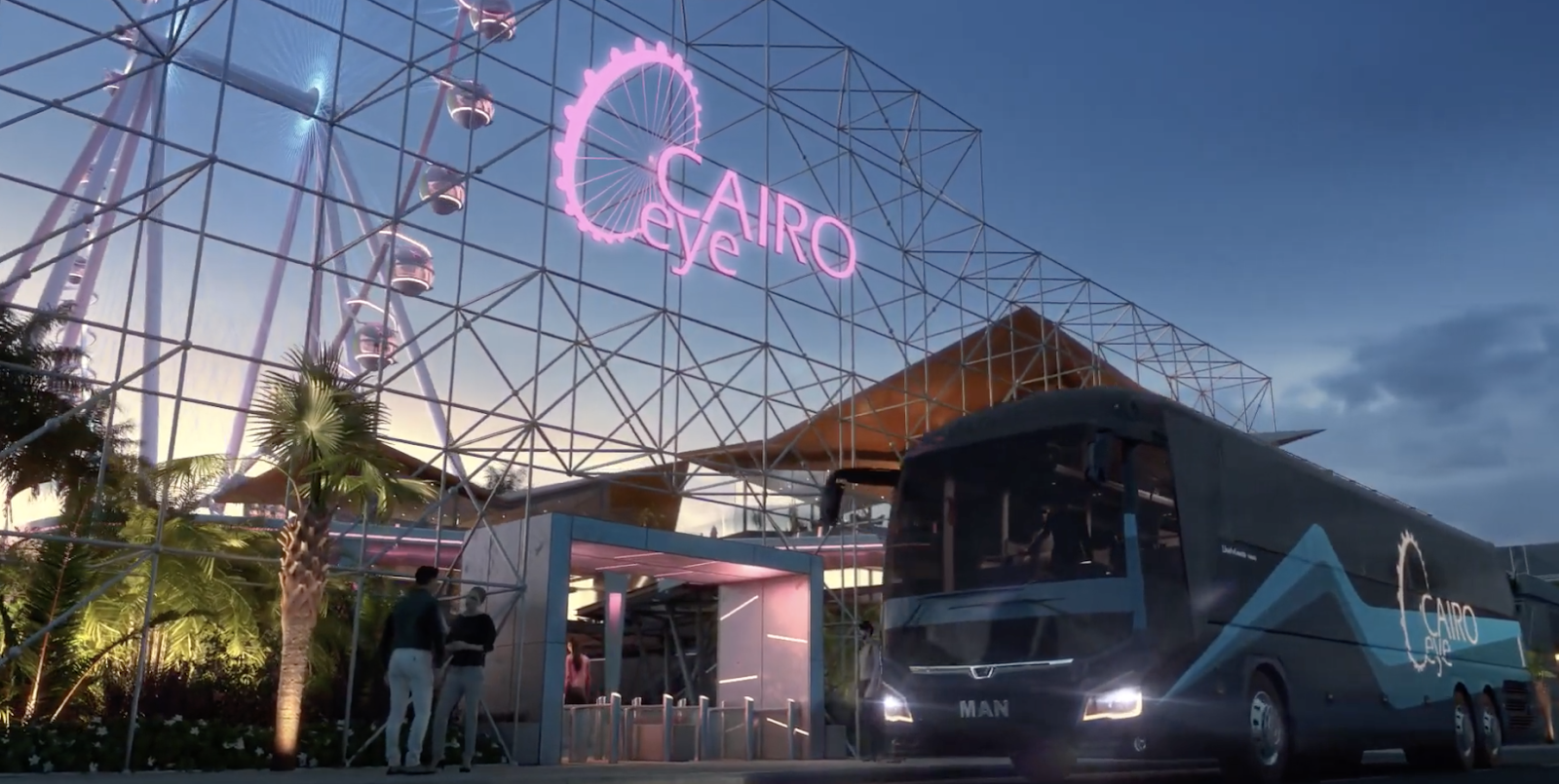
In early January, a video titled Cairo Eye was uploaded on YouTube, offering a disembodied flight over a 3D rendering of the banks of the Nile between Giza and Zamalek. Suspended as if by a string, the viewer is propelled effortlessly along, 6th of October and Qasr al-Nil bridges far below. There is no pollution in this world, so it is easy to note the historic buildings that mark the skyline. There is the Ritz-Carlton, the video prompts us to note in all caps white lettering, and then the Hilton, the Maspero building, the Ministry of Foreign Affairs, Novotel.
There is a dramatic pan, decentering the skyline and bringing into view the titular focus of the video, a new addition to the skyline: a 120-meter Ferris wheel jutting out from the historic Masala Garden in Zamalek. The viewer is swooped down to street level. Sims-like Egyptians chat below a purple neon sign that spells out the words “Cairo Eye.” The viewer glides past the vitrines of storefronts, eateries, entertainment areas set to the backdrop of music from composer Sergey Azbel, whose compositions bear titles like “epic,” “uplifting,” and “inspirational.”
The Cairo Eye, however, is set to become more than a 3D rendering. The New Hawaii for Tourism and Investment company broke ground on the LE50 million project — which will also include a two-story garage and a 3,500-meter long private marina adjacent to Masala Garden — in late January in a ceremony attended by a number of high-ranking government officials, including Major General Amir Sayed Ahmed, a presidential advisor for urban planning, Khaled al-Anany, the minister of tourism, Major General Khaled Abdel Aal, the governor of Cairo, and Abdel Rahman Saeed, the head of the technical secretariat to regulate the disposal of state assets.
In the wake of pushback from residents and government officials about the environmental, urban and heritage impacts of the project, many of these same government figures have shirked responsibility for the project in public comments. However, the project continues to inch forward, with construction slated to begin in February, as it has since a previous iteration of the giant wheel from the mid-2000s under Gamal Mubarak’s Cairo 2050 Vision was waylaid by the ouster of his father in the 2011 Revolution. How has the project survived? Mada Masr spoke to architects and Zalamek residents to understand the history of the project and what dynamics behind opposition to it mean for broader community participation in urban planning.
A round of finger-pointing, leaving no one to hold accountable
“The ministry had nothing to do with this project,” said Tourism and Antiquities Minister Khaled al-Anany, in response to House of Representatives members who criticized him for approving the Cairo Eye project during a parliamentary session on February 4. “The National Organization for Urban Harmony did not research the matter, and, if it is proposed to the ministry, I will not give it clearance to continue,” he said.
National Organization for Urban Harmony President Mohamed Abou Saada told the press that his organization had not received any proposals for the Cairo Eye project, even though the implementation of projects in Zamalek requires a permit from the NOUH per guidelines set out by the Supreme Council for Planning and Urban Development. “The governorate must present us with the proposal and all the relevant studies before we issue a permit. And until now we have not received anything,” he said.
Adding to the list of organizations that have asserted they have no knowledge of the project, the Environment Ministry has also come out to say that it has not been presented with an environmental feasibility report on the Cairo Eye, according to reporting by BBC.
However, Hawaii chairman Ahmed Metwally, the son of the late prominent Port Said businessman Sayed Metwally, told Lamis al-Hadidy in a nationally broadcast interview that he had indeed signed a contract in early December with the Cairo governorate to attain usufruct rights over the Masala Garden for 25 years, in exchange for an annual sum paid to the governorate. Metwally declined to disclose the value of the agreement, adding that it was made without any tenders, but through talks with sovereign entities.
According to Metwally, the company had made environmental and traffic assessments that resulted in the eventual decision of choosing the Zamalek garden as the project’s location.
When some members of the House of Representatives asked the tourism minister why he attended the Cairo Eye groundbreaking ceremony, he said that he was obliged to attend upon the request of the state.

During his speech at the opening ceremony, Cairo Governor Major General Khaled Abdel Aal did not mention the new usufruct agreement over the historic garden. Instead, he talked about how the project aligns with the government’s Egypt Vision 2030 and reflects the collaborative spirit between state institutions and the private sector. The project will promote sustainable tourism development, Abdel Aal contended, highlighting its similarity to other national projects, like the Ahl Misr Walkway and the Maspero Triangle development project, which pushed residents to relocate to social housing far away from the economic hub of downtown Cairo, and the development of Cairo’s historical squares, like Tahrir Square. He also stated that the project meets the necessary environmental and traffic-related requirements.
At the time of publication, the NOUH director Abou Saada and Deputy Housing Minister Abdel Khalek Ibrahim have not responded to Mada Masr’s inquiries about the details surrounding the permits given to greenlight the construction of the Cairo Eye project on the premises of a garden that was classified under the category of “buildings and facilities of distinguished architectural style” in Cairo per a decision from the Housing Ministry last October and as an “archeological site” according to the official website of Cairo governorate. Moreover, the entire island of Zamalek has been classified as an “area with outstanding heritage and architectural value,” according to the Culture Ministry.
The great wheel of history
The idea behind the Cairo Eye project dates back to 2008 or 2009, according to Omar Nagati, the co-founder of CLUSTER, an urban research initiative in Cairo. It first emerged in an architectural competition for developing historic Cairo, which was part of the Cairo 2050 Vision, a strategy that involved various development projects in Maspero, the Nile islands, and the plateau around the Pyramids.
Nagati explains that the strategy of increasing the real estate value of important areas in the city, and thus turning them into investment hubs, has been heavily criticized before. “Even though these plans were put aside during the time of the revolution, many of the urban development projects that are happening now, like the new roads, highways, and Maspero, are an extension of the Cairo 2050 Vision,” he says.
In 2010, the General Organization for Physical Planning announced a winning proposal submitted by two consulting offices, one of which was Egyptian, in a competition to “revitalize the heart of Khedivial Cairo.” This was part of a general strategic plan, Cairo 2050 Vision, that the organization adopted. The winning proposal included a Ferris wheel to be built in the exact location of Cairo Eye, according to the website of Associated Consultants Group, the Egyptian consulting office co-founded by Sahar Attia, an architecture professor at Cairo University. Attia has participated in governmental projects to develop areas, such as Warraq Island and Maspero. She was also appointed by the president as an MP in the current House of Representatives.

The Cairo 2050 Vision was originally part of the National Democratic Party’s 2005 election campaign, which was run by Gamal Mubarak, according to Ahmed Zaazaa, and included work from architects like Albert Speer Jr. — the son of Nazi architect Albert Speer — who was tasked with work in 6th of October City.
According to the GOPP announcement in 2010, the Cairo 2050 Vision included several projects, the most important of which was the removal of self-built housing communities and the relocation of their residents. The areas targeted for this relocation plan included Fustat, Warraq, Boulaq al-Dakrour and Nazlet al-Semman. The strategy also included the construction of new roads, highways, bridges and metro lines, in addition to the relocation of ministries from the city center to another area. Finally, it included the relocation of a part of the city’s southern cemeteries to an area outside the capital as well as the redevelopment of Khedivial Cairo.

One day before the January 25 revolution broke out in 2011, then-president of the GOPP Mostafa Madbuly made a statement in which he said that the Cairo 2050 Vision was an attempt to solve the problems of Greater Cairo, exemplified by the proliferation of unsafe and unplanned areas, high population density in the center of the city, traffic congestion and environmental pollution.
“After the revolution, the 2050 strategy was halted. But in 2014, Mostafa Madbuly said that that is ongoing, and later he said that a substantial portion of Cairo 2050 has been achieved. How did things continue from 2010 onwards, though? Why are the same ideas still present despite the political changes?” Zaazaa said to Mada Masr.
In the period following the January revolution, the phrase “Cairo 2050” disappeared from public discourse. But the GOPP continued to hold onto the same strategy, especially after Moustafa Madbouly took over the Housing Ministry in 2014. In 2017, the ministry relaunched the same strategy under the name of the “Greater Cairo Strategic Plan” a few months before Madbuly was appointed as prime minister. “We have drawn up a strategic plan for the development of Egypt 2050, following a robust document, just so that we are in the clear. Many times I have asked myself, will a day come when I can see a part of this plan get implemented?” Madbouly asked in November of 2019.
Many of the projects first outlined in the Cairo 2050 Vision have come to pass in the intervening years, with the state attempting to push development in Warraq, relocating the residents of Maspero to new social housing in Asmarat, the construction of the new administrative capital, and the construction of ever newer overpasses.
Potential for opposition to a top-down vision of Egypt?
Following the announcement of the Cairo Eye project in January, residents of Zamalek tried to stop it through different channels. There were suggestions to stage a protest, pursue litigation, speak with state officials via personal channels, and involve the media to bring attention to the problem.
“We have hope that they will listen to us and there won’t be any fighting. We want to negotiate, and we have many lawyers and ministers within the community. People are also considering recourse to the courts,” says Nazly Shaheen, one of the co-founders of the Zamalek Association, a volunteer-based community organization to develop the neighborhood, who also had helped revitalize the Aquarium Grotto Garden.
Shaheen launched a petition titled "Stop the Cairo Eye Project in Zamalek" with the intention of presenting it to the president. More than 5,600 people have signed the petition so far, which is meant to be presented to the parliamentarians representing the neighborhood and the rest of the state’s officials.
“We were surprised by this project. There was no community dialogue whatsoever. This is a general problem when it comes to urban planning in Egypt. No one asks the residents what they need or if projects will affect them negatively or positively. There is no such as a participatory process. Decisions come from the top and get implemented,” says Dina Shehata, a Zamalek resident and an expert at the Al-Ahram Center for Political and Strategic Studies.
Salah Hafez, the former head of the Egyptian Environmental Affairs Agency, spoke to Mada Masr about the environmental pollution that the project would cause. In his view, traffic is already an environmental problem, and the extra traffic that the project would engender will produce more pollution, which will have an adverse effect on public health in a country that already has the highest levels of pollution in the world. Hafez, who is also a Zamalek resident, says that the priority should go for the maintenance of the Masala Garden due to its environmental and aesthetic value. Further, there is a shortage of green spaces in Cairo, which, in his opinion, should be an impetus to halt similar projects that take place in green areas, especially in neighborhoods like Zamalek, Manial and Mohandessin.
House Health Committee Head Ashraf Hatem, who is a former health minister, urged the minister of environment to halt the Cairo Eye project as it violates environmental laws. He stressed the need to conduct an environmental assessment for such projects in advance as well as community dialogue sessions with civil society members. Finally, citizens must approve such projects.
MPs Samar Salem and Shaimaaf Halawa submitted inquiries regarding the project to the prime minister, the tourism minister, and the local development minister, since there is no official information about the project until now. Former Tourism Minister Mounir Fakhry Abdel Nour also criticized the choice of location for the project, adding that it violates the law governing business deals with government institutions.
“It is clear that there is an official perspective about Zamalek being a commercial and an investment area. The Ferris wheel is not the issue. It is only a landmark,” says Ahmed Zaazaa, an urban designer and researcher. For Zaazaa, the government’s reluctance to heed the desires of the Zamalek residents, who have considerable leverage and weight, invokes an important question.
“Are those who used to be rich and empowered no longer influential? Or is it that those who have power are no longer those who live in Zamalek, but rather in Uptown Cairo? Is the government scared of any kind of community organizing because if there is a precedent in one neighborhood, other people might be encouraged to do the same?”
Zamalek residents attempted to halt the construction of a metro station in the district last year over concerns that it would damage the island’s infrastructure and “negatively affect the social demographics.” However, these attempts did not succeed in preventing the state from continuing the construction operation of the metro stations.
Zaazaa believes that residents’ current efforts to self-organize are not sufficient. “Zamalek is an important district, but it is not of less importance than other neighborhoods we defend where there are projects not wanted by residents. There is a great value in residents organizing themselves and expressing their stance on a project they reject,” he says. “However, Zamalek residents should do more to self-organize. For example, they can resort to strategic litigation, and they need to let go of classist overtones in order for their rhetoric to gain broader support. The rhetoric of their objections has been marked by classism, such as their claims that ‘amusement parks will bring mobs to our [neighborhood],’ which is very similar to the rhetoric around the metro. Very few people spoke about the metro station’s effect on the structure of buildings on the island, four of which have already been damaged by the metro and were evacuated.”
The issue of community participation is a major question in any urban planning project, argues CLUSTER co-founder Omar Nagati. Stakeholders in a central area, such as downtown Cairo, are not only the residents but workers and employees, as well as citizens who visit the area regularly for services. The state has the right to prioritize the public interest over private and narrow local interests. Yet, the question remains: is there any mechanism in the planning process that ensures community representation via local councils or general public consultation seminars?
Nagati says this question applies to several mega projects across the country where the planning and decision-making mechanisms have remained opaque. Projects are prepared by consultants before they are presented to the committees concerned with making the decision, he says. “How can we ensure real community representation of the concerned stakeholders? Who are they? Are they the residents or the people who frequent the area? Who holds stakes in the Nile Corniche? Is it a certain neighborhood, a certain sector of people, or the residents of the city as a whole? What is the balance between profits of investments and public interests? How can each stakeholder, including government institutions, investment actors, and the civil society, express their position?” Nagati asks.
For Zaazaa, the government’s plan is based on a model ill-suited for the environmental and social realities of Cairo. “The state’s official urban vision for the city is based on Dubai. A global-city-like vision that looks like the Gulf has become an inevitable and necessary matter ... The glass towers in New York and Dubai are not suitable for Cairo’s environment. These towers in the new administrative capital will require thousands of cubic meters of water to operate their air conditioners at a time when we have a water crisis. There is a belief that Dubai is great, so we want to create another Dubai in Cairo,” Zaazaa says, before wondering aloud whether anyone can stop it. “It is as if Cairo as a whole now is just a place under a bridge. Cairo’s levers are disintegrating. We have neglected the city and are exploiting investments on every inch of land to create value.”
تقارير ذات صلة
Economic bridges to nowhere: On the state’s faltering offering program
Experts say the plan is more of a short-term fix to Egypt's economic woes

Daily COVID-19 roundup: May 21
Steps announced Wednesday told of an effort to put substantially more resources into screening cases
Expect higher COVID-19 numbers, but don’t be alarmed, PM Madbuly says
Madbuly also urged that construction operations continue at “maximum capacity” at "all sites."
Your support is the only way to ensure independent, progressive journalism survives.
You have a right to access accurate information, be stimulated by innovative and nuanced reporting, and be moved by compelling storytelling. Subscribe now to become part of the growing community of members who help us maintain our editorial independence.
Join us