
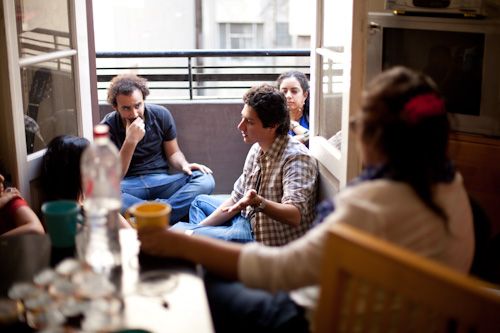
Breakfast with Mada: Abdel-Rahman Hussein on sound-hosting site Dandin
Each week, Mada Masr convenes over breakfast and invites a friend whose work has stirred a curiosity among team members, often because of a tendency to push boundaries.
This week it was Abdel-Rahman Hussein, a journalist who co-founded Dandin, an Arabic-language sound-hosting website which invites people to upload any recordings they like, such as music, comedy, podcasts, politics and poetry.
Mada Masr: Where did the idea come from?
Abdel-Rahman Hussein: It came from being a frustrated musician when I was 21. I wish there was a site around when I was 21 — I’d have deserted everything to be a musician. All these clichés about self-expression are true. You want it to happen and you want to allow people to do the same.
MM: It seems to be modeled after Spotify, where you can create playlists, where it’s all user generated… Do you create profiles for artists? How does the content come together?
ARH: It’s supposed to be by the people for the people. I’m not supposed to be part of it. There's an amalgamation of some of the concepts that drive these types of sites, so what you find on it comes from other users, and what you can do is organize it to your liking, by creating playlists and favoriting tracks, editing it as you see fit. The whole point is for people to exploit the platform, appropriate and misappropriate. When we developed it, the IT company found it difficult to get around the concept — you’re actually letting people upload whatever they want without guidelines? The challenge is to get the point across. There are no guidelines as long as the audio is of sufficient quality that it can be heard properly. Apart from that, it’s a blank canvas.
MM: So you’re not interested in curating the content at all? You feel that it’s more of a platform?
ARH: I am curating to an extent now. When you’re launching, you basically pull strings and talk to whoever you know who might be able to do something. Eventually it’s not supposed to be curated in any way. One of the nice things is that people are popping up and posting stuff and I have no idea who they are. This is quite heartening. Some guy uploaded a gospel album, an Egyptian Christian gospel album. He has seven songs and each has a different style — one is rock, one’s a reggae song…this I wouldn’t have heard anywhere else. Some 17-year-old kid contacted me from Haram, a rapper who asked what the site is all about. Another guy works in a cement company and he’s had all these poems in his drawers for a decade, so he dusted them off and uploaded them on Dandin. And they’re actually quite good. He sent us a very nice message, thanking us for the platform and for making him do poetry again, and he wrote us a poem. He recorded it on his phone on his lunch break.
MM: I’m surprised to hear you say you want Dandin to be open and not necessarily quality driven. I remember you complaining about the music scene in Egypt, how poor it is and how this has been disheartening and that’s why you haven’t written much about it as a journalist. So are you no longer a music snob?
ARH: Well, Dandin is not music-driven. Over the years, I’ve noticed that there’s an incredible energy that comes from people of a certain age, people younger than me, and this energy’s very thrilling to see, intoxicating. That’s why we did it. It’s not just a music website. If you grow up in Egypt, everything you do is met with some sort of resistance. Even on the practical level there’s little you can do. You have this energy, this idea, and trying to pursue it here is exceptionally difficult. There’s always something pushing back against it. What this is really about is allowing that energy to carve a space out for itself. So it’s not about music. In the last three years, there’s a movement. Even if I don’t like all of it personally, there’s something happening.
MM: How do you handle the fact that online platforms such as Facebook have hegemonized the way people consume content in general, music, text, anything? Its being the most successful model leaves little room for people to start specialized platforms, no?
ARH: A big part of developing Dandin is fitting it in this entire concept of how people share stuff on Facebook and Twitter. You have to develop it with that in mind and work with it. I’m not an expert on the Internet to know another way. But Dandin exists as a standalone — you can visit the site and do nothing else in order to use it.
MM: Have you thought about it becoming an archiving system on its own?
ARH: A big part of why I did it is that I have a hard time on SoundCloud. It’s amazing but massive. I got sick of just chancing upon something that someone from here did, that 100,000 people have listened to and I haven’t heard of before. It’s really annoying. I get lost in sites like that.
MM: Why was it important to have it in Arabic first?
ARH: That’s the point as far as I am concerned. I am not doing the website for my friends or for people I know. There’s a lot of good stuff happening irrespective of whether you like it or not. There are things being done that evoke this process of artistic expression, creativity, different strokes for different folks. The whole point is not to have a niche thing. There’s no sense of exclusivity in it. It’s interesting when you go somewhere and look at the audience and find that the audience is never uniform. There are some stereotypical labels in Egypt that aren’t true at all. You can have people who you don’t think know what experimental electronic music is but who actually do it. Four veiled women and a laptop. There you go.
MM: But why’s the interface only in Arabic?
ARH: Because I have no money. I’d have liked to do both. But Arabic was the priority. It had to be in Arabic and it had to be a website. Not an app for example. Not a smart phone app for the same reason — that I want it to be accessible for that 17-year-old from Haram who might not have a smart phone.
MM: What about music from different countries?
ARH: We’re a Middle Eastern platform for the Arab world. We used only used Egyptian colloquial Arabic because the classical is too stuffy for the kind of website that it is.
MM: Have you considered putting old classical music on the site?
ARH: Basically no. This for people who do their own thing.
MM: What if it’s a cover?
ARH: If it’s a cover, it’s fine. There are DJ sets for example.
MM: What’s your copyright policy?
ARH: You own what you put up. It’s yours not ours. We’re only allowed to use it if it’s related to Dandin, so for example if we do an app, we’re allowed to take it. I was considering the option of creative commons, but I decided not to do that now. There’s no censorship and no guidelines of what you can and can’t do. The line’s drawn at racism, harassment and directly intimidating or threatening someone.
MM: What if someone uploads something against the army? Are you liable?
ARH: I don’t think I’d be liable. Would I?
MM: What if people upload songs in love with the army, like a “Teslam al-Ayadi” techno remix?
ARH: It’s ok. But I don’t know how I’d feel about it.
MM: How do you plan to make it sustainable? There are some other websites such as Radio Tram or Wasla Fm but they do it in English. It’s a similar idea, but Radio Tram is more of a radio. They have segments and shows. I spoke to these guys and they expected an organic sustainability that comes through users, kind of like YouTube. But it’s still quite difficult for them to get it out there to the users to make it entirely financially sustainable through them. So they get grants and so on… What do you have in mind for getting it out there beyond the organic grassroots?
ARH: That’s the embarrassing part. We paid everything we have for this and the one thing we haven’t figured out is the business model.
MM: You should come to us at Mada! [Laughter]
ARH: It was a reckless decision by me and my brothers. A labor of love. Of course we want it to be sustainable and to survive. We’ve launched now but there’s very little I can do to add to the website because we have no money. We decided we just wanted it to work and as long as it works, we take it from there. The important thing is that it does what it’s supposed to do. It’s completely free.
MM: There’s controversy around Spotify as it’s free music that artists aren’t getting royalties for. So let’s say this site gets huge and you’re getting millions of visitors, how do the artists benefit? Obviously they’ll get gigs and other revenue streams, but do you have anything in mind in terms of paying artists royalties if they hit a certain number of views, for example?
ARH: We have to think about it. But the Spotify model is that you provide licensed music from record labels. There’s a big debate about how much goes to the artist and how much to the website. This is beyond my scope at this point. I don’t see that happening because we don’t provide licensed music. It’s music uploaded by users themselves and I’m not selling it. The concept is quid pro quo.
MM: Have you thought of developing another iteration — an offline iteration such as providing recording support for people with music projects?
ARH: The sky’s the limit — there’s so much that can be spun off this project. I’d love to end up doing all of it. It will have a life on its own.
MM: How are you finding it on a personal level? You and your brothers are all musically inclined and have a lot of things that have not been shared. Are you uploading your music as well?
ARH: I uploaded a lot of old unfinished stuff. It’s actually inspiring for us, so we’re working on our things.
MM: Why did you choose the name Dandin?
ARH: It’s related to music. It’s interesting, a lot of people didn’t know the word. A lot of people asked what it means. I was surprised.
MM: It means humming!
ARH: A lot of people pronounce it differently. People call it Dindin.
MM: And Dandan. And Dondon.
ARH: It’s proved more problematic than I thought.
MM: Wait, Dandin or Dandan? I thought it was Dandan, as in the past tense. Someone hummed and finished and left.
ARH: There’s different views. Not everyone is in agreement. There’s the musical element. I came up with the name. We had a massive fight over it.
MM: It’s good it’s only you and your brother fighting over the name. [Laughter.] But it’s nice. A human being hums in the bathroom. There’s a personal aspect to it.
MM: So who is Hag Fakhry [who has a profile oh Dandin]?
ARH: Hag Fakhry is emblematic of what this website is about. Someone comes up and does something like Hag Fakhry, and on first hearing it you feel that someone’s being flippant or taking the piss, you give it a second, listen to it again and perhaps on a third listen you realize that there’s a deeply rooted sense of idealism, a sort of gravitas beneath this throwaway one-minute audio track. And that’s exactly what I’m looking for. It’s heartfelt. Hag Fakhry has so far tackled sexual harassment. He’s tackled the pains of the revolution. He’s tackled being dumped by [Mohamed] ElBaradei. These are all things where there’s more to it that meets the eye.
MM: Are people using the site the way you expected?
ARH: I expected it to be used this way. I had no parameter of how it should be used.
MM: How about joking around as opposed to producing art?
ARH: It’s way beyond us to define what’s art and what’s not art, so these are not decisions for me to make. Even if it ended up being tahyees [joking around], when you listen to it it’s essentially more than tahyees. And tahyees can always be an objective in and of itself. The best way to describe the website is through what happens with it.

تقارير ذات صلة
Reem Maged: On the possibility, and impossibility, of a free media
Reem Magued abandoned the media arena for almost two years, and just as her disappearance raised questions, so has her return. Her disappearance coincided with the Egyptian media’s change in…
Breakfast with Mada: Belal Fadl and the state of intellectuals
Columnist and screenwriter Belal Fadl came to one of our Thursday breakfasts at Mada Masr. We spoke about the difficulty of taking a stance amid political polarization and the position…
Breakfast with Mada: Bassem Youssef on cracking the walls
Every Thursday Mada Masr invites someone interesting to the office on the promise of a hearty and fulfilling breakfast prepared by Mada receptionist Osama. It is a ruse that has proved wildly…
Your support is the only way to ensure independent, progressive journalism survives.
You have a right to access accurate information, be stimulated by innovative and nuanced reporting, and be moved by compelling storytelling. Subscribe now to become part of the growing community of members who help us maintain our editorial independence.
Join us