
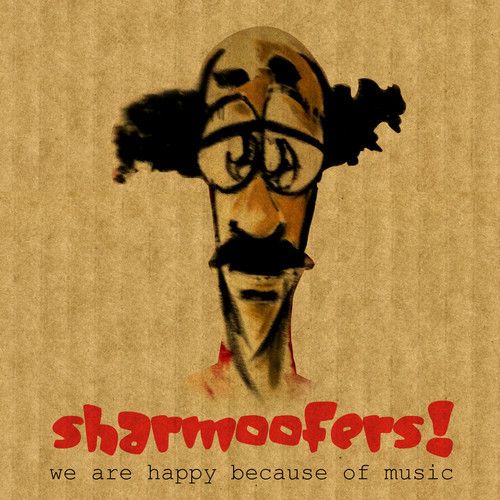
Band of the week: Sharmoofers
I pull up to Bongoz studio in the leafy Cairo suburb of Maadi one evening to meet Arabic reggae-infused rock band Sharmoofers. Two of them, 25-year-old Moe al-Arkan and 32-year-old Ezz Shahwan, join me in the office, while the third, 28-year-old lead singer Ahmed Bahaa, gives his weekly drum lesson. I’m here to find out more about a mysterious character called Mr. Sharmoofer and his secret language.
In just under two years, Sharmoofers have garnered a massive following, with over 588,800 fans on Facebook and over 1 million views on certain YouTube tracks. They’ve acquired these numbers almost exclusively through interacting with people on the Internet. Indeed, when the band was forming, they made a collective decision not to perform until they reached 15,000 Facebook fans.
They played on political satirist Bassem Youssef’s TV show in June 2013, but only debuted live on stage together two weeks ago, at Al-Azhar Park, followed up quickly with second and third performances at the American University in Cairo and Porto Sohkna. In their live shows they perform as Sharmoofers and Friends, joined by Meshwar’s Soli on trumpet and Labib on sax, and additional backing vocalists.
What is it about Sharmoofers that’s garnered them this massive digital following? I could be wrong, but I attribute it to their relatable humor, groovy sound and unrelenting positivity.
All three have played in bands of various genres, from Beatles cover groups to more progressive Arabic pop-rock groups like Salalem, Cairokee and the Percussion Show — and all three Sharmoofers continue to play in the latter. Each comes from the rhythm section — Arkan and Shahwan are both bass and percussion, and Bahaa is lyrics and percussion. This probably explains the “rock steady” vibe of their music.
Asked about the meaning of “Sharmoofers,” the two laugh as they recite the tale.
“It started as an inside joke, based on a cartoon drawing on the wall of my bedroom where we record most of our music. We named him Mr Sharmoofer, and then began to think out his whole character and what he likes to do and listen to,” says Arkan.
The band’s humor and wit is the central focus in “El Boxer,” which is about boxer shorts. Throbbing basslines drive the song’s groove forward. After a couple of verses, layers of percussions break loose as Bahaa uses a sort of Arabic-Rastafarian vocal jazz that resembles scat singing (the band inform me that this is Mr Sharmoofer’s secret language): vocal improvisation with wordless vocabulary and nonsense syllables.
Scat singing often involves a certain comedic timing, as exemplified in Bam Brown, Slim Gaillard and Leo Watson’s 1945 “Avacado Seed Soup Symphony,” where they scat the word “avocado” throughout, or by the late jazz singer Cab Calloway.
As Arkan says, it’s almost as though Bahaa is playing percussion with his voice, attempting to create a beat that fits. “El Cirque” opens up with jittery rhythm guitar, percussion samples and a ponderous bass line, into which Bahaa scats a vocal foray. After the signature opener in all their songs is reached — “al salam alaykoum” (peace be upon you) — it bursts into a ska-infused humorous track of upbeat tempos, jazzy-blues riffs, staccato guitar notes, and a big bang of percussion.
And while this is their signature sound, Sharmoofers draw influence from other genres too, including hip-hop (heard in the heavy bass lines and break-beat style of their hit song, “Sharmoofet”) and Cuban funk (found in “Sinai,” which has a nice little mambofied melody and comedic chorus line that borrows from the “Little Mermaid” film).
In the video for the rhythmically joyous “Khamsa Santy,” the band make their way through a day in Cairo, commenting on the absurdities they come across. They sing anecdotally about needing to shorten their pants 5 cm to avoid ruining them on Cairo’s streets, and eventually erupt into a playful dance session in a back alley against the song’s percussions and saxophones.
Bahaa joins the interview. Explaining his lyrical approach, he says it’s not political music but simply social commentary.
Indeed, rather than describing it as socially conscious, I’d say it’s more a comedic narration of the surreal chaos of living in Egypt. In a way their music is pop: it’s jumpy, catchy and popular. Yet with the creative energy between them — in person, their dynamic feels much older than the few years they’ve been playing together — I’m interested to see how experimental they go in their forthcoming album, “El Ghorfa” (The Room), expected this year.
But mostly, as their “we are happy because of music” motto suggests, Sharmoofers are spreading a much-needed dose of positivity among their listeners. They might not be singing poetry or demanding social justice, but it’s kind of a relief as recently we’ve been abused by nonsensical music fueled by deplorably dogmatic politics like “Kashmagy” or “Tislam al-Ayady.” Most people want to hear something they can relate to, or something that makes them laugh, and Sharmoofers do both — they help add a little light in an otherwise dark pop-rock landscape.

Maha ElNabawi
After graduating from the American University in Washington, DC with a Bachelors degree in Business, Maha began her publishing career in NYC with indie pop culture magazines, the likes of…
تقارير ذات صلة
On the giant that Bassem Youssef did not tickle
Our premature revolution was born from a sterile womb, and from that same womb Al-Bernameg was born unripe

Three films, one spectator and a polemic: Arab documentaries and ‘global’ audiences
Sometimes being simplistic, clichéd and politically problematic is exactly what a film needs to succeed.

A year of comebacks and retreat
With the onset of a new regime, a new government, jail sentences and dropped charges, and preparations for a parliamentary elections, the year 2014 has seen old familiar faces making…
Your support is the only way to ensure independent, progressive journalism survives.
You have a right to access accurate information, be stimulated by innovative and nuanced reporting, and be moved by compelling storytelling. Subscribe now to become part of the growing community of members who help us maintain our editorial independence.
Join us