
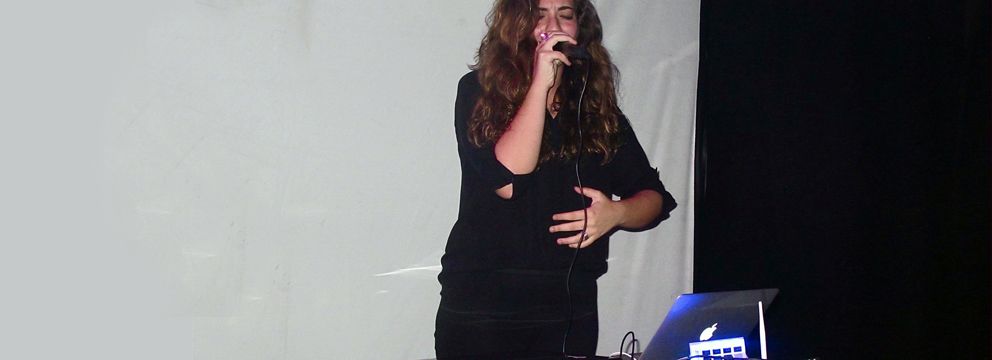
Band of the week: Nadah El Shazly
The long room of Estoril roars with conversation. The booths along the left side of the weathered downtown Cairo restaurant are filled with regular patrons, crumpled suits sit along the bar, and downtown cultural players fill the remaining tables.
Nadah El Shazly walks in as fellow musicians Wetrobots and Cartoon Therapy walk out. She’s a bit frazzled from the June heat.
For a week prior to our interview, I’ve been listening to the 24-year-old’s music — a sound that seems to span many time periods and genres — on repeat. There’s a particular song I’m curious about, “Athar Nowaa,” a collaboration with Lebanese rapper El Rass. It’s unusual, with intricate lyrics but drone-heavy. I want to know how it came together.
Like many musicians of the downtown scene, Shazly dabbled in various performance projects since debuting as an 18-year-old lead vocalist for a punk band who played Misfits covers at venues like Zamalek’s Sawy Culture Wheel. In 2011, she was offered a nightly gig at the Holiday Inn and began pursuing her musical ambitions professionally. She performed in the lobby, accompanied by a jazz cover band.
“It was there then that I learned the basics of improvisation,” she says. “Often times I didn’t know all the words, and I would just feel my way through it.”
It makes sense that Shazly’s beginnings were in jazz as her vocal quality is soulful and raspy, convincingly channeling both Egyptian singers of the 1890s and American R&B singers of the 1940s and 50s.
“When I first started to make music and expand outside of covers, I struggled to find the sound I wanted to create,” she explains, leaning in to fight off Estoril’s noise. “After the jazz band, I spent two years not listening to any music — nothing on my iPod, nothing when driving. I just waited for my head to generate its own sound.”
While working in theater and dance she met Mohamed Shafiq, and the two decided to create a music collaboration that came to be known as “Shorba” (Soup).
“Shorbet Rosas,” written mostly by Shafiq, starts with a sensual, almost anachronistic point of departure: what sounds like a reverbed oud line and melancholic, spatial saxophone, playing more for mood than melody. Switching between Arabic verses and English chorus lines, Shazly uses various vocal techniques, drifting toward R&B-style wails in English and a more improvised mawwal style in Arabic. Although the song begins with minimalism and repetition, eventually we’re led to a classic dom-tak tak, dom tak percussion line as Shazly sings in a bluesy style — “The people are terrified, all the people are lost, all the people are frustrated, and their hope is drunk” — against increasingly tense, industrialized sounds.
“Ghaba,” co-written by Bassem al-Bendary, opens with a deconstructed drone sample and white noise — Shazly can clearly sing with almost anything backing her. For an artist still very early in her career, she has a remarkable command of her voice, fluidly changing the way she sings and intonates. Her vocal range reflects the musical influence of 1890s Egyptian singers such as Munira Mahdaya (some of whose songs are quite startlingly suggestive).
Although Shorba is considered a successful project by the musicians and their audience, Shazly has also continued on to focus on solo work, which can be heard on SoundCloud and live. She explains that in the time following her work with Shafiq, she went deeper into her research of pre-Mohamed Abdel Wahab (1902-1991) singers to better understand Egypt’s vast musical heritage and thus her own work. She enrolled in the Beit el Oud to learn eastern scales and Arabic music theory. She also acquired production skills by joining Epic 101’s music production course in 2013.
She then released “Athar Nowaa” (The Atom’s Trail) with El Rass, a socio-political rapper who performed in the 2013 edition of D-CAF. This time Shazly presented her lyrics more aggressively, playing off El Rass’ hip-hop framework. Strangely this makes her sound a bit like Maryam Saleh, but unlike the latter she doesn’t lose her voice in the cacophony.
The track seems reflective of both Egypt and Lebanon’s ongoing political turmoil.
“It’s about different parts of the brain talking,” Shazly explains. “I was representing the left side and he was representing the right side — he’s the one who wrote the lyrics and we co-composed it.”
“The right and left side of the brain struggle against each other as we exist in the Arab world,” she continues. “Either letting go of things, or being a part of it and choosing to do something about it. Will it stay the same, trying to shout in silence...”
Shazly is currently composing, producing and performing a 30-45 minute live set of original music that resembles her SoundCloud work, but with more electro-pop twists. She uses an effect box on her microphone to loop her vocals and add a chorus and delay effect for a fuller sound. She also mans a laptop and another sampler for extra embellishments and pitch alterations.
Although the music is great, Shazly could benefit from some more conscious interaction with the audience — introducing her songs, perhaps helping guide the audience into her process or thoughts on certain numbers. But she knows this — “I watched a performance of myself recently and it looked like I was giving a speech,” she told me. She says eventually she’d like to also play live with other instrumentalists in a more typical band set up.
Shazly definitely has a sense of humor about music, but also a deep conviction about its possibilities and communal power. What strikes me most is her vocal capabilities. At the rare moments when we hear no effects on her vocal lines, there is an abstraction and purity to the tone of her voice and diction that is reminiscent of better times and evocative of hope.

Maha ElNabawi
After graduating from the American University in Washington, DC with a Bachelors degree in Business, Maha began her publishing career in NYC with indie pop culture magazines, the likes of…
تقارير ذات صلة
Band of the week: Coke Machine
While listening, I can’t shake the feeling that I’m standing on the edges, fingers splayed on the glass, watching something emotional take place. And while my presence isn’t particularly unwelcome,…
Everybody’s a producer in Cairo
It wasn’t always this way: 15 years ago, the alternative music scene was dominated by guitar-based bands playing progressive rock and heavy metal.
Music, crisis and creative spaces in Cairo
We figured, if we’re all going to be cooped up in our houses, we might as well be cooped up in a music studio where we can create, jam rather…
Your support is the only way to ensure independent, progressive journalism survives.
You have a right to access accurate information, be stimulated by innovative and nuanced reporting, and be moved by compelling storytelling. Subscribe now to become part of the growing community of members who help us maintain our editorial independence.
Join us