
Al Jazeera verdict reasoning accuses defendants of ‘impersonating journalists’
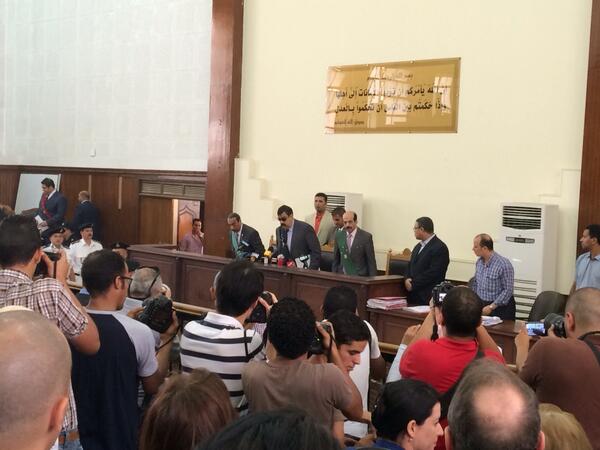
Al Jazeera journalists sentenced in late August are not journalists, according to the reasoning of the Cairo Criminal Court, which was released on Monday.
The verdict’s reasoning — as published in the privately owned Al-Shorouk newspaper — accusing the defendants of “impersonating journalists” because they were neither registered with the Journalists Syndicate nor the Press Center, may have implications for both Egyptian and foreign journalists based in the country.
Three Al Jazeera journalists, alongside students Sohaib Saad, Khaled Abdel Raouf and Shady Abdel Azim, were sentenced to three years imprisonment on August 29, while two others were acquitted of all charges.
While the defendants were cleared of charges of belonging to a terrorist organization, they were accused of disseminating false information with the intention of tarnishing Egypt’s image and reputation, as well as illegally broadcasting, on the basis that the Qatari-based Al Jazeera channel is banned in Egypt.
These are the main points of the verdict reasoning:
Al-Jazeera journalists not journalists
The court stipulated that the three journalists were not actually journalists because they are not members of the Journalists Syndicate and do not have a press card issued by the Press Center to foreign journalists working in international media.
In Egypt, a minority of journalists are in fact registered with the syndicate (and none who work for online newspapers, as these are not considered by the syndicate as journalistic outlets).
The director of the Arab Network for Human Rights Information (ANHRI) Gamal Eid explained to Mada Masr that the state has long used the issue of syndicate registration to silence critical journalists.
“Since the Mubarak era, we have been confronted with the rationale that you are not a journalist unless you have syndicate membership. The state knows that this is wrong. The state knows that journalists are journalists when they actually practice the profession without having to have cards. This is illegal,” he said.
No proper authorization
The reasoning also held the defendants responsible for their legal status, describing Mohamed Fahmy as the “administrative official” of the channel, although he was only the bureau chief, without any administrative roles.
Press freedom activist and former advisor for the New York-based Committee to Protect Journalists (CPJ) Shaimaa Aboul Khier explained to Mada Masr that Al Jazeera was working to get permissions for its employees in Egypt. The state, however, usually authorizes only those who follow the state’s official line, she says.
A report released by a technical committee, which was delegated by the court to examine the reports and video evidence presented by prosecution, denied that there was any manipulation in the journalists’ news reporting. This finding contradicted the reasoning, in which the court claimed that the news material in question was manipulated.
“In court, the head of prosecution asked committee officials about their personal opinions of the videos, regardless of their report and they confirmed that they were manipulated, and that’s what the details released may have been based on,” she clarified.
In addition, any legal responsibility of unlawful broadcast should not be the responsibility of the journalists, she asserts, but the sole responsibility of the channel’s administration.
For Khier, there is a clear trend of authorities becoming increasingly intolerant of anything that strays far from state rhetoric, as seen in the closure of several media and press platforms.
Al Jazeera part of an international conspiracy
The reasoning of the verdict also concluded that the Al Jazeera channel is part of an international conspiracy against Egypt. It claimed that two of the defendants, former bureau chief Fahmy and producer Baher Mohamed, set up an unauthorized media center in a hotel room in the Marriott Hotel in Zamalek.
The court also claimed that the Muslim Brotherhood supported this endeavor by employing a group of young men to work from an apartment in Moqattam to help the journalists.
Lack of objectivity
The reasoning goes on to slam Al Jazeera for its lack of objectivity, singling out Al Jazeera Mubasher Misr in particular, although none of the defendants were working for the channel.
It described Al Jazeera Mubasher Misr, an Egypt-focused Al Jazeera channel separate from Al Jazeera English, as a platform calling for the fall of Egypt, citing evidence including testimonies from Fahmy.
The three journalists were accused of producing reports that serve the interests of the Muslim Brotherhood. In one instance of this, the court explained that Peter Greste reported that the Tamarod movement was a conspiracy against the Muslim Brotherhood.
Tamarod spearheaded the calls for mass protests on June 30, 2013, and collected millions of signatures for petitions demanding Morsi’s ouster and early presidential elections.
The court also added that Greste’s report quoted members of the Brotherhood’s counter-movement, Tagarod.
The court accused Al Jazeera of deliberately filming Tahrir Square during the June 30 protests from a certain angle, in order to misrepresent the square as being empty.
Eid asserted that the ruling’s criticism of the editorial content of the reports is the “cost of the political standoff between Egypt and Qatar, and has nothing to do with whether the journalists actually committed any crime. The reasoning talked about the angling of the cameras while filming Tahrir, but state TV did the same thing. Again, this is a professional mistake, not a crime.”
He explaining that objection to the way news organizations frame news reports should not result in criminal charges for journalists. “But this only happens in a state of law,” he asserted, “and Egypt is far from being a state of law.”
***
Mostafa Nagy, the lawyer representing Mohamed and Greste, told Mada Masr that while the defense team is still in the process of reviewing the reasoning, the team’s appeal will depend mostly on the report of the technical committee.
“The committee’s report concluded that there was no fabrication in the content of the news reports that were in question," Nagy says. "We will depend on this report, as well as other evidence, to prove that my clients are innocent."

Mai Shams El-Din
Mai graduated from the American University in Cairo with a degree in journalism. She worked mostly for local English-language news outlets but has also been writing in Arabic, particularly when…

Toqa Ezzidin
Toqa is a journalism student and news reporter with an interest in political and cultural affairs.
تقارير ذات صلة

The long and costly wait for a new personal status law
Bassant Soliman’s suicide triggered renewed public backlash against personal status laws in Egypt
We will sit together on Srifa hill, Qassem
Two friends try to reclaim a memory other than what the Israeli genocidal machine carved into them.

How Israel recognized Somaliland
Somaliland officials have pursued formal diplomatic recognition for over 30 years.
Your support is the only way to ensure independent, progressive journalism survives.
You have a right to access accurate information, be stimulated by innovative and nuanced reporting, and be moved by compelling storytelling. Subscribe now to become part of the growing community of members who help us maintain our editorial independence.
Join us